YouTube
Among its peers, YouTube stands out for adopting the most systematic and corporate approach to compliance with legal obligations in Türkiye. Operating under the Google umbrella, the platform largely meets the requirements of Law No. 5651 in terms of reporting discipline, advertising transparency, and user information mechanisms. However, a technical deficiency remains: the absence of the explicit phrase “YouTube” in the trade name of its local legal entity, which falls short of the “distinctive phrase” criterion mandated by legislation.
The platform’s representative structuring in Türkiye has evolved in lockstep with the legislative timeline. Following the enactment of Law No. 7253, representation was established via “Google Bilgi Teknolojileri Limited Şirketi” on 12 January 2021. Established by the US-based Google LLC, the company initially held a capital of TRY 150.000, with Kenneth Hohee Yi authorised to act on its behalf.76 By 4 October 2022, the capital structure was strengthened, raising the figure to TRY 2.250.000.77
The arrival of 2023 brought aggravated legal conditions for social media platforms, prompting significant structural amendments. On 5 May 2023, the company’s title was updated to “Google İstanbul Bilgi Teknolojileri Limited Şirketi” and its capital was injected with substantial funds to reach TRY 122.250.000, surpassing the new legal minimum.78 This move demonstrated a clear will to comply with the financial and administrative demands of Law No. 5651.
By 2025, the management structure had matured into a broader professional framework. An internal directive defining authorised signature groups was registered on 24 June 2025.79 Immediately thereafter, US and Indian executives (including Rodney Gaines, Shaun Christopher Hazen, and Siddharth Mundra) were appointed to Group A and Group B signatory roles.80 This confirms that YouTube operates its Türkiye office as an integrated component of Google’s global hierarchy.
| Legal Obligations | Status | Notes |
|---|---|---|
| Representative Obligation | Meets | Official representative appointed in Türkiye. |
| Local Company Establishment |
Meets | Istanbul-based capital company established. |
| Trade Name Condition | Partially Meets |
Phrase “Google” exists in company title but direct “YouTube” phrase is absent (Google İstanbul Bilgi Teknolojileri Ltd. Şti.). |
| Explicit Affiliation & Authorization |
Meets | Company is fully authorized and held responsible regarding YouTube services offered by Google LLC. |
| Turnover & Reporting Obligation |
Unknown | No public information regarding report submission to BTK. |
| Application Form for Users | Meets | Special web form exists for Articles 9 and 9/A of Law No. 5651. |
| User Application Processes | Meets | Application categorisation and evaluation criteria are detailed in transparency reports. |
| Transparency Reports | Meets | Reports include breakdowns for removal due to legal and policy reasons, content type, and article basis. |
| Personal Data Localisation | Does Not Meet |
Not specified in transparency reports whether user data is hosted on servers in Türkiye. |
| Hashtag and Content Liability |
Partially Meets |
Policies are explained generally, but implementation information is absent. |
| Creating a Crisis Plan | Unknown | No public information regarding a crisis plan. |
| Providing Information to Judicial Authorities |
Unknown | No statistics regarding data sharing with judicial authorities. |
| Ad Library | Meets | Google Ads Transparency Center (Ad Library) link and scope shared in reports. |
| Bandwidth Throttling Sanctions |
Not Applied |
Not applied to date under Law No. 5651. |
| Administrative Fines | Unknown | Information regarding current fines not included in reports. |
| Other Obligations | Partially Meets |
Information provided regarding algorithmic transparency (4R Principle) and policies for children. |
Transparency Reports Assessment
YouTube has maintained a consistent reporting schedule since 2021. However, a significant analytical flaw persists: the lack of “cross-tabulation”. While incoming applications are separated by legal basis (Article 9 vs Article 9/A), the outcomes (removed, rejected) are presented only in aggregate. Consequently, it is impossible to determine the specific success rate of applications filed under “personal rights” versus those filed under “privacy”.
| Period | Turkish Report |
Art. 9 Statistics |
Art. 9/A Statistics |
Categorical Data |
Notes |
|---|---|---|---|---|---|
| 2021-1 | Yes | Yes (262 Requests) |
Yes (92 Requests) |
Partially Exists |
Result data (removal/ rejection) not disaggregated by article. |
| 2021-2 | Yes | Yes (348 Requests) |
Yes (172 Requests) |
Partially Exists |
Result data (removal/ rejection) not disaggregated by article. |
| 2022-1 | Yes | Yes (298 Requests) |
Yes (109 Requests) |
Partially Exists |
Result data (removal/ rejection) not disaggregated by article. |
| 2022-2 | Yes | Yes (219 Requests) |
Yes (175 Requests) |
Partially Exists |
Result data (removal/ rejection) not disaggregated by article. |
| 2023-1 | Yes | Yes (223 Requests) |
Yes (60 Requests) |
Partially Exists |
Result data (removal/ rejection) not disaggregated by article. |
| 2023-2 | Yes | Yes (166 Requests) |
Yes (87 Requests) |
Partially Exists |
Result data (removal/ rejection) not disaggregated by article. |
| 2024-1 | Yes | Yes (240 Requests) |
Yes (107 Requests) |
Partially Exists |
Result data (removal/ rejection) not disaggregated by article. |
| 2024-2 | Yes | Yes (347 Requests) |
Yes (112 Requests) |
Partially Exists |
Result data (removal/ rejection) not disaggregated by article. |
| 2025-181 | Yes | Yes (688 Items) |
Yes (223 Items) |
Partially Exists |
Result data (removal/ rejection) not disaggregated by article. |
Content removal rates for legal grounds generally hover in the 40-50% band, particularly regarding administrative requests, indicating high compliance with court and administrative orders. However, for individual user applications, the picture differs. A significant portion (30-60%) result in “No action taken”, suggesting that many user complaints fail to meet the platform’s internal legal thresholds or procedural requirements.
A positive note is YouTube’s detailed coverage of algorithmic content management and advertising transparency, reflecting an effort to demonstrate accountability beyond mere removal statistics.
The Disaggregation Problem
Despite its systematic structure, YouTube’s reporting suffers from a critical opacity regarding data breakdown. For instance, in the 2025-1 report, 75.52% of applications were filed under Article 9 and 24.48% under Article 9/A. Yet, the report states that 197 items (21.6%) were removed on legal grounds without specifying which article justified the removal. This prevents any analysis of whether the platform is more sensitive to privacy violations than to personal rights claims.
The Legal Disconnect: Article 9
Most concerning is the obvious inconsistency regarding the repealed Article 9 of Law No. 5651. The Constitutional Court’s annulment of this article entered into force on 10 October 2024.82 Despite this, YouTube’s report for the first half of 2025 explicitly declares that 688 items (75.52% of the total) were evaluated under this repealed provision.
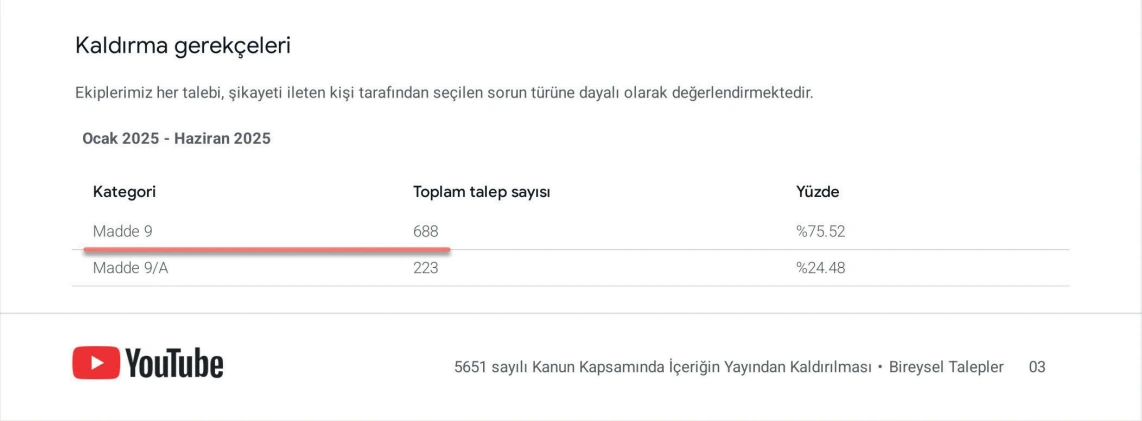
The continued application of a normatively repealed provision as an active ground for content removal points to a serious disconnection between legal regulations, administrative practices, and platform implementation. This failure to align with the current legal reality, combined with the refusal to transparently disaggregate removal decisions, demonstrates that YouTube’s reporting practice, while corporate, falls short of true accountability.
-
Turkish Trade Registry Gazette, No. 10243, 12.01.2021, p. 1495. ↩
-
Turkish Trade Registry Gazette, No. 10674, 04.10.2022, p. 1008. ↩
-
Turkish Trade Registry Gazette, No. 10825, 05.05.2023, p. 31. ↩
-
Turkish Trade Registry Gazette, No. 11358, 25.06.2025, p. 110. ↩
-
Turkish Trade Registry Gazette, No. 11359, 26.06.2025, p. 466. ↩
-
In the 2025-1 report, the Article 9 and 9/A breakdown appears to be provided based on the number of items rather than the number of requests. ↩
-
Constitutional Court Norm Review Decision: CC, Merits 2020/76, Decision 2023/172, 11.10.2023, Official Gazette 10.01.2024-32425. ↩