LinkedIn
LinkedIn’s approach to fulfilling its representation obligation in Türkiye diverges sharply from its peers. While platforms like Meta, X, TikTok, and YouTube have transitioned to direct “branch” or “affiliated subsidiary” status, changing their titles and raising capital to TRY 100 million as mandated by Law No. 7418, LinkedIn has pursued an “indirect” strategy, seemingly designed to circumvent these structural and financial burdens.
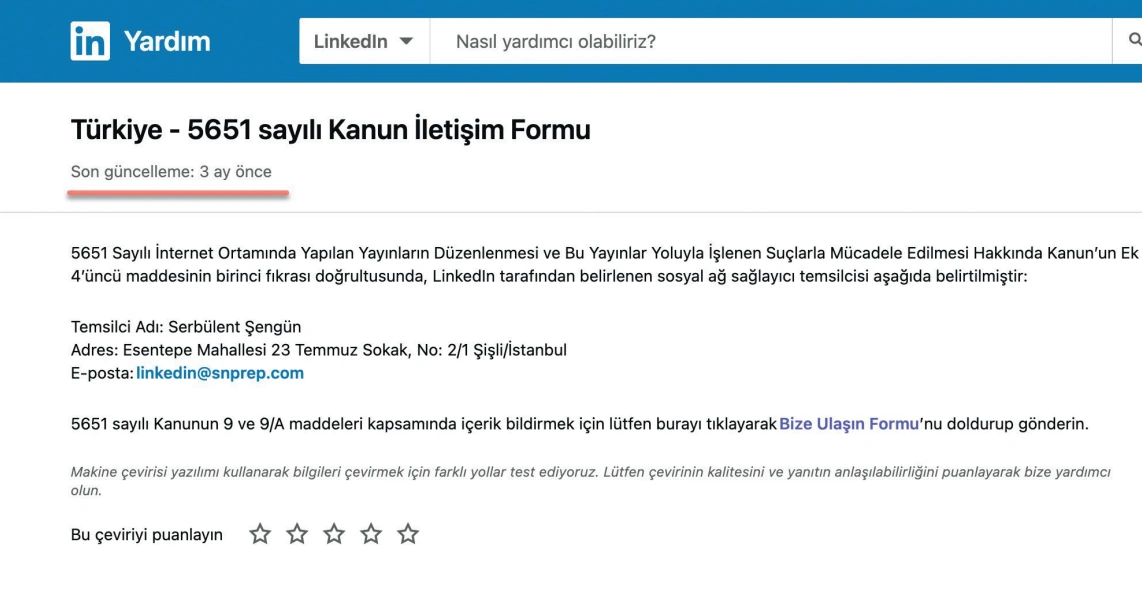
Officially, the platform’s operational contact in Türkiye is still listed as “SNPREP Danışmanlık Hizmetleri Anonim Şirketi” on the BTK web page.98 Established on 17 November 2020 by BTS Danışmanlık Hizmetleri A.Ş. (a law and consultancy firm), this company was capitalised at a modest TRY 50.000, with Serbülent Şengün authorised as a board member.99 His authority was extended for a further three years on 29 November 2023.100
However, following the tightening of regulations, this arrangement fell short. The local entity failed to meet two critical conditions mandated by Law No. 7418 for legal entity representatives: the inclusion of the platform’s distinctive name (“LinkedIn”) in the trade title, and the TRY 100 million capital requirement.
The Pivot to a ‘Real Person’
Faced with this structural deficiency, LinkedIn appears to have pivoted in 2025. Rather than capitalising a local subsidiary, it opted for the alternative route chosen by VKontakte and Dailymotion: the appointment of a “Real Person Representative”.
The timeline of this shift is murky. While SNPREP was effectively cited as the representative until 2025, LinkedIn’s official help pages were quietly updated during that year. They began declaring Serbülent Şengün (the individual) and the e-mail address linkedin@snprep.com as the representative, bypassing the legal entity structure entirely.101
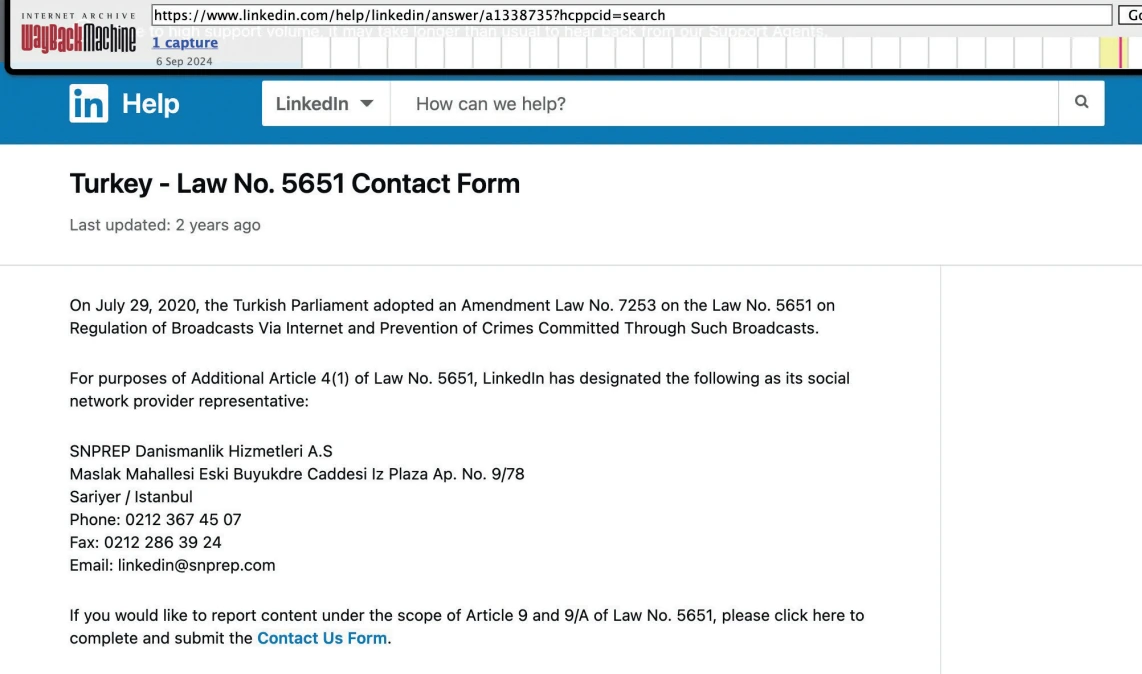
Archival data from the Wayback Machine confirms that SNPREP was still listed as the representative as late as September 2024, nearly two years after the 2022 legal amendments requiring stricter compliance. This long period of “representation by proxy” via a local consultancy firm allowed LinkedIn to maintain a presence in the Turkish market while avoiding the substantial financial and administrative commitments undertaken by its competitors.
This situation demonstrates that LinkedIn has long avoided establishing a direct, well-capitalised, and fully authorised corporate structure in Türkiye. Instead, it adopted a model of “representation by proxy”, channelling legal and administrative liability through a local consultancy firm and its manager. This structure, documented in the minutes of the TGNA Digital Media Commission,102 reveals that while the platform maintains a market presence, it has steadfastly refrained from undertaking the financial and administrative commitments embraced by its peers. It was only in 2025, following a delayed and circuitous route, that LinkedIn finally decided to discharge its legal obligations via a “real person”.
Furthermore, as detailed below, LinkedIn’s transparency reporting discipline is virtually non-existent.
| Legal Obligations | Status | Notes |
|---|---|---|
| Representative Obligation | Meets | Official representative appointed in Türkiye. |
| Local Company Establishment | Not Applicable | Indirect representation via consultancy firm (2022–2025), followed by “real person” model in 2025. |
| Trade Name Condition | Not Applicable | Trade name conditions not met during 2022–2025; currently inapplicable under “real person” model. |
| Explicit Affiliation & Authorization |
Not Applicable | Public registry documents for the representative company lacked explicit affiliation details (2022–2025). |
| Turnover & Reporting Obligation | Unknown | No public information regarding report submission to BTK. |
| Application Form for Users | Meets | A Turkish application page created by LinkedIn exists. |
| User Application Processes | Unknown | Detailed process information regarding legal handling is missing. |
| Transparency Reports | Does Not Meet | No systematic reporting is conducted. |
| Personal Data Localization | Does Not Meet | Not specified in transparency reports whether user data is hosted on servers in Türkiye. |
| Hashtag and Content Liability | Unknown | Unclear whether the notification system meets legal conditions. |
| Creating a Crisis Plan | Unknown | No public information regarding a crisis plan. |
| Providing Information to Judicial Authorities |
Unknown | No statistics regarding data sharing with judicial authorities. |
| Ad Library | Does Not Meet | Ad library is not visible. |
| Bandwidth Throttling Sanctions | Not Applied | Not applied to date under Law No. 5651. |
| Administrative Fines | Unknown | No information regarding whether applied. |
| Other Obligations | Unknown | No publicly available information. |
Transparency Reports Assessment
LinkedIn’s transparency reporting discipline is virtually non-existent. Of the nine reporting periods since 2021, only a single report (July–December 2022) has been published to the public.103
This factual void stands in stark contradiction to official declarations. In a TGNA Digital Media Commission meeting on 3 March 2022, LinkedIn’s legal representatives explicitly stated on the record that reports were submitted to the authority and published regularly on their website every six months.104 The reality is quite different: eight of the nine required reports are missing.
In the exceptional single report published, LinkedIn stated that it received no requests from Türkiye under Article 9 or Article 9/A of Law No. 5651. This paints a damning picture as it suggests that LinkedIn constructs its legal compliance merely as a performative exercise, a matter of ticking administrative boxes or simply appearing to have done so. Consequently, the platform has failed to fulfil its transparency commitments to the public, directly contradicting the assurances it gave to the TGNA.
| Period | Turkish Report |
Art. 9 Statistics |
Art. 9/A Statistics |
Categorical Data |
Notes |
|---|---|---|---|---|---|
| 2021-1 | No | - | - | - | Not published. |
| 2021-2 | No | - | - | - | Not published. |
| 2022-1 | No | - | - | - | Not published. |
| 2022-2 | Yes | No (0 Requests) |
No (0 Requests) |
No | Stated that no request received under Art. 9 and 9/A. |
| 2023-1 | No | - | - | - | Not published. |
| 2023-2 | No | - | - | - | Not published. |
| 2024-1 | No | - | - | - | Not published. |
| 2024-2 | No | - | - | - | Not published. |
| 2025-1 | No | - | - | - | Not published.105 |
The ‘Zero Requests’ Anomaly
In the solitary report that was published, LinkedIn claimed to have received zero requests from Türkiye under Article 9 or Article 9/A. This claim defies credibility when compared to global data.
For context, under the EU Digital Services Act (DSA), LinkedIn reported receiving 886 official content removal orders from EU countries in the first half of 2025 alone (including 642 from France and 137 from Germany).106 In the previous period (February 2025), these numbers were at the level of 464 for France and 169 for Germany. While hundreds of official requests are processed even in EU countries where freedom of expression standards are relatively high, the claim that “zero” requests were received in a country like Türkiye, where access blocking decisions are intense, is not credible.
Furthermore, the category titled “Infringement or Defamation” listed under “Grievance Reasons Selected by User” (Table 3a) through the DSA reports shows substantial engagement, registering more than 3.000 times every six months (3.204 in February 2025; 3.224 in August 2025). Given that thousands of users utilise this category across Europe, the claim that not a single request originated from Türkiye is simply not credible. Ultimately, the failure to publish eight of the nine mandatory reports renders any qualitative evaluation impossible; the entire process remains a black box.
Global Data Reveals the Truth
When LinkedIn’s Global Government Requests Report is examined, the discrepancy becomes undeniable.107 The data documents that LinkedIn received content removal requests from the Turkish government regularly during the very periods it failed to report locally. Moreover, it complied with these requests at rates reaching 100%.
| Period | Number of Requests | Actioned | Action Rate (%) |
|---|---|---|---|
| 2024-2 | 22 | 22 | 100% |
| 2024-1 | 25 | 21 | 84% |
| 2023-2 | 9 | 8 | 89% |
| 2023-1 | 5 | 5 | 100% |
| 2022-2 | 10 | 9 | 90% |
| 2022-1 | 8 | 8 | 100% |
| 2021-2 | 10 | 10 | 100% |
| 2021-1 | 24 | 23 | 96% |
LinkedIn’s approach to legal obligations in Türkiye can be characterised as indifferent and opaque. The platform systematically violates its reporting obligations, while global data exposes it as one of the most compliant providers regarding government censorship requests (96–100% compliance). This arouses suspicion that LinkedIn processes official Turkish requests without classifying them under Law No. 5651, effectively hiding its activities from public scrutiny.
-
See https://internet.btk.gov.tr/sosyal-ag-temsilci-rehberi/ ↩
-
For establishment information, see Turkish Trade Registry Gazette, No. 10204, 17.11.2020, p. 969. ↩
-
For board membership and authority extension, see Turkish Trade Registry Gazette, No. 10968, 29.11.2023, p. 479. ↩
-
For LinkedIn Türkiye Representative declaration, see https://www.linkedin.com/help/linkedin/answer/a1338735 (Access Date: December 2025). ↩
-
TGNA Digital Media Commission, Journal of Minutes, 7th Meeting, 03.03.2022, p. 14. (Serbülent Şengün participated in the meeting with the title of Chairman of the Board of SNPREP and LinkedIn Türkiye Representative). ↩
-
Reports belonging to other periods were not encountered on the platform’s transparency pages or relevant platform pages. ↩
-
TGNA Digital Media Commission, Journal of Minutes, 7th Meeting, 03.03.2022, p. 20. (In the meeting, LinkedIn officials declared that reports were published regularly). See https://www.tbmm.gov.tr/Tutanaklar/TutanakGoster/2924 ↩
-
Only an English report was published for the 2025-I period. The Turkish version of the report, containing limited information, could not be accessed. No response was given to the message we sent to LinkedIn regarding this matter and other unpublished reports. For the English report, see https://content.linkedin.com/content/dam/help/tns/en/LinkedIn_Short_Biannual_Report_June_2025_ENG.pdf ↩
-
Data compiled from Transparency Reports dated “February 2025” and “August 2025” published by LinkedIn under DSA (Table 9 – Orders from Member States’ competent authorities). See https://www.linkedin.com/help/linkedin/answer/a1678508 ↩
-
See https://about.linkedin.com/transparency/government-requests-report ↩