Introduction
The EngelliWeb Report of the Freedom of Expression Association provides an assessment, as of the end of 2025, of the steadily intensifying Internet censorship and access blocking practices in Türkiye, conducted with reference to Law No. 5651 on Regulation of Publications on the Internet and Combating Crimes Committed by Means of Such Publications which entered into force approximately 20 years ago and to subsequent regulations that have emerged since.
As is well known, statistical data on websites blocked from Türkiye were never officially disclosed either by the Telecommunications Communication Presidency (“TİB”), until its dissolution, or by its successor, the Information and Communication Technologies Authority (“BTK”); nor were statistical data on blocked websites, news articles (URL-based), and social media content ever officially disclosed by the Association of Access Providers (“ESB”). The EngelliWeb reports, accordingly, contain the only available statistical data in this field and have become the reference point in this area.
The non-disclosure of official statistical data on access blocking has hardened into a deliberate governmental policy, and parliamentary questions on this matter received only negative responses in earlier years.14 In responses provided in previous years by the Ministry of Transport and Infrastructure, the grounds advanced for non-disclosure of the number of blocked websites and statistical figures were that disclosure “could cause problems in the prevention of, and the fight against, crime, in particular by leading to the deciphering of content relating to child pornography. Moreover, since such figures are not officially or collectively disclosed by other countries, an unfair perception against our country has been created at the international level on the basis of these figures, producing information pollution”.15 In 2024 as well, while the Ministry of Transport and Infrastructure declined to disclose total figures, various responses to written parliamentary questions referred only to the proportional breakdown of access blocking decisions issued under Article 8 of Law No. 5651.16 This perfunctory mode of response has persisted for many years, yet the access blocking and content removal sanctions imposed under Law No. 5651 are not confined to Article 8. The questions periodically submitted by members of parliament are likewise not focused on Article 8 alone. As this report sets out in detail, sanctions are applied to websites and content under Articles 8, 8/A, 9/A, and until its annulment, Article 9 of Law No. 5651. The responses provided by the Ministry of Transport and Infrastructure, however, consistently refer only in generic terms to the proportional breakdown of websites blocked by the President of BTK under the catalogue offences set out in Article 8.
The matter of this proportional breakdown has itself drawn criticism from the Constitutional Court. In its precedent-setting Yaman Akdeniz (2) judgment, adopted unanimously in Plenary in February 2023,17 the Constitutional Court found that the rejection of the applicant’s request for information regarding the statistics on Internet access blocking decisions amounted to a violation of freedom of expression in connection with the right of access to information. As will be detailed in this report, notwithstanding the Constitutional Court’s judgment, BTK has not provided the applicant with the access blocking statistics that form the subject matter of our EngelliWeb reports.
The 2025 EngelliWeb Report, prepared within the Freedom of Expression Association, has been compiled in order to share with the public detailed statistical information both for 2025 and on a cumulative basis as of the end of 2025 concerning websites and domain names blocked from Türkiye, news articles (URL addresses) subjected to access blocking and/or content removal, and social media accounts and posts. Similar reports will continue to be shared with the public annually by the Freedom of Expression Association in the years to come.
As of the End of 2025, 1.505.484 Websites Have Been Blocked from Türkiye
The EngelliWeb reports published by the Freedom of Expression Association in previous years documented that the total number of domain names blocked from Türkiye stood at 347.445 as of the end of 2018, rising to 408.494 by the end of 2019, 467.011 by the end of 2020, 574.798 by the end of 2021, 712.558 by the end of 2022, 953.415 by the end of 2023, and 1.264.506 by the end of 2024. As will be detailed below, during 2025 an additional 232.441 domain names were blocked from Türkiye, as far as could be identified within the scope of the EngelliWeb project. With these 232.441 newly blocked domain names and websites added to the previous total, the cumulative number of websites and domain names blocked from Türkiye as of the end of 2025 reached 1.505.484, blocked pursuant to 1.284.464 distinct decisions issued by 875 different institutions and judgeships, on the basis of the various provisions and powers detailed in this report.
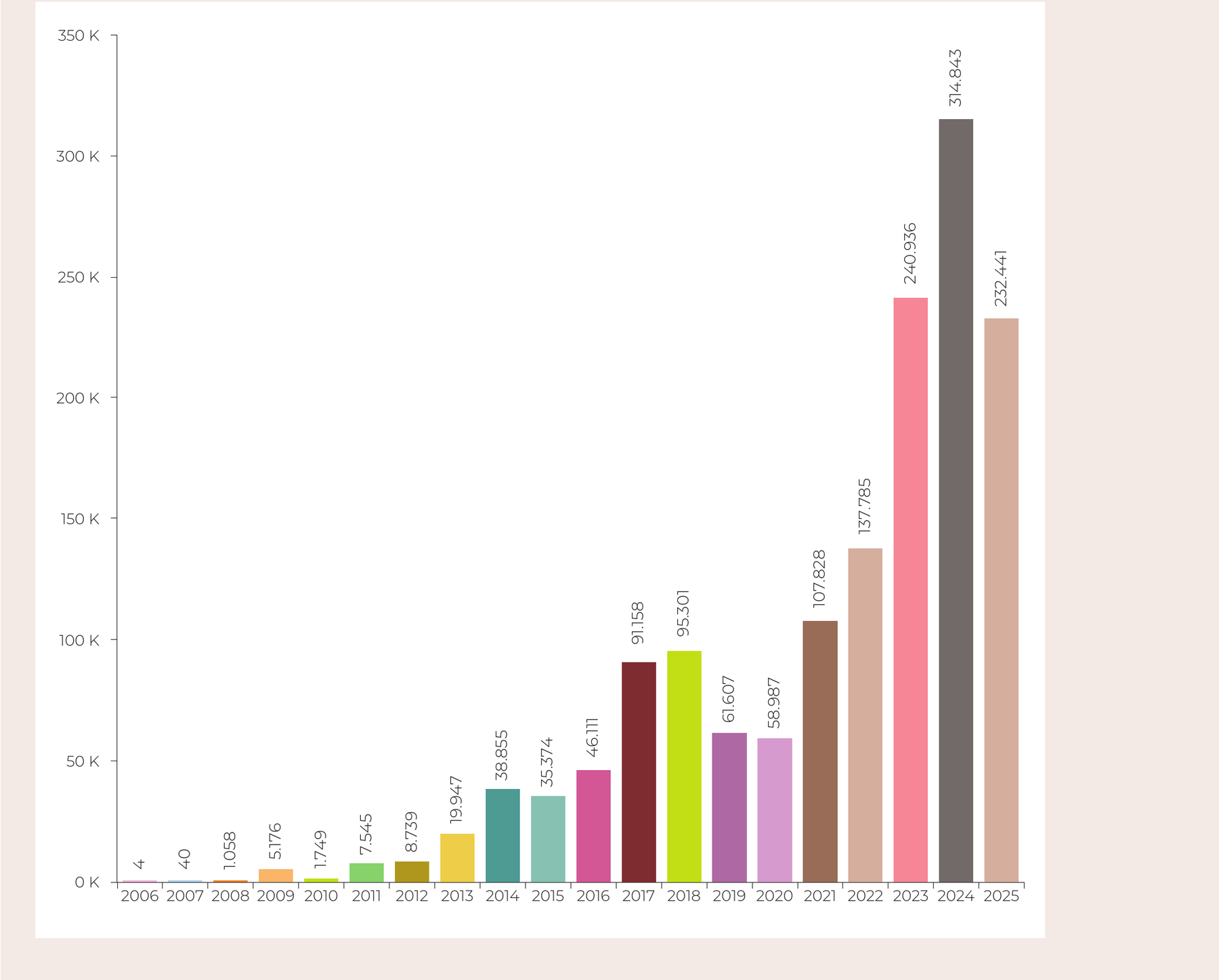
Viewed on an annual basis, and as shown in Figure 1, the number of websites blocked from access in 2025 (232.441) fell short of the previous year’s record level (2024: 314.843). This apparent decline cannot, however, be read as signalling a structural easing of access blocking practices or a narrowing of their scope. The primary explanation lies in the contraction of two specific categories: the number of domain names blocked by the Turkish Football Federation fell from 50.120 in 2024 to 16.821 in 2025, while BTK’s absolute blocking volume in the gambling and betting category fell from approximately 221.000 to 122.856. The contraction in these two categories arithmetically accounts for the bulk of the year-on-year difference observed in the annual total. By contrast, the proportional share of the President of BTK, the true centre of gravity of access blocking, within the overall blocking volume rose from 82% to 84,6% over the same period. In other words, while absolute figures receded, the dynamic of centralisation continued to gain strength. At the same time, the surge in the National Lottery Administration’s blocking volume from 2.875 to 15.669 indicates that a portion of the blocking burden has shifted from BTK to sectoral regulatory bodies, set against the coordinated institutional backdrop of the “Action Plan to Combat Illegal Betting, Games of Chance and Gambling in the Virtual Environment (2025–2026)”, proclaimed by Presidential Circular in November 2025. The 2025 figures, accordingly, may convey a misleading impression of relief when read solely in terms of absolute values. Once subjected to a proportional and structural analysis, however, they demonstrate unambiguously that the intensifying dynamic of administrative censorship is continuing apace.
Indeed, when compared with previous years (2023: 240.936; 2022: 137.785; 2021: 107.828; 2020: 58.987; 2019: 61.607; 2018: 95.301), the figure of 232.441 still represents the third-highest level on historical record. Amounting to approximately three times the annual average for the roughly 20-year period since the enactment of Law No. 5651 and the commencement of access blocking practices (2007–2025: an annual average of 79.236 websites), this figure shows that domain-level access blocking practices continued at full pace throughout 2025.
-
See the Written Question put by CHP Niğde MP Ömer Fethi Gürer to Vice President Fuat Oktay, no 7/8292, 04.02.2019 https://www2.tbmm.gov.tr/d27/7/7-8292s.pdf, and the written response thereto of 22.04.2019 https://www2.tbmm.gov.tr/d27/7/7-8292sgc.pdf ↩
-
Yaman Akdeniz (2), App No 2016/6815, 15.02.2023. ↩