Sanctions under Article 8/A of Law No. 5651¶
A new Article 8/A entitled “Content removal and/or access blocking in cases where delay would be prejudicial” was added to Law No. 5651 on 27.03.2015.103 By Article 8/A, judges were granted, in the first place, the authority to issue content removal and/or access blocking decisions in relation to publications on the Internet on one or more of the grounds of the protection of the right to life and the safety of persons and property, the protection of national security and public order, the prevention of the commission of crime, or the protection of public health.
Furthermore, under Article 8/A, the Prime Ministry (from 27.03.2015 until 02.07.2018) and, thereafter, the Presidency were granted authority, in cases where delay would be prejudicial, to request the President of BTK to order the removal and/or access blocking of Internet content for the purposes of the protection of the right to life and the safety of persons and property, the protection of national security and public order, the prevention of the commission of crime, or the protection of public health.
Similarly, the executive organs operating under the heading of “relevant ministries” were also granted authority to request the President of BTK to act. However, that authority was confined to the protection of national security and public order, the prevention of the commission of crime, and the protection of public health.
The President of BTK, upon assessing such requests, may decide on content removal and/or access blocking in respect of publications on the Internet. The decision shall be notified by the President immediately to access providers and to the relevant content and hosting providers. The requirements of the content removal and/or access blocking decision shall be implemented immediately and in any event within four hours of notification.
While requests for access blocking under Article 8/A are implemented by the President of BTK, the President must submit the administrative measure he has taken to the approval of criminal judgeships of peace within 24 hours, and the judgeships must assess and rule on such requests within 48 hours. Access blocking decisions issued under this Article are issued by means of URL-based blocking, that is, by blocking access only to the broadcast, section or part in which the violation occurred. However, where it is technically not possible to block access to the content in question, or where the violation cannot be prevented by URL-based blocking, an access blocking decision may also be issued in respect of the entire Internet site.
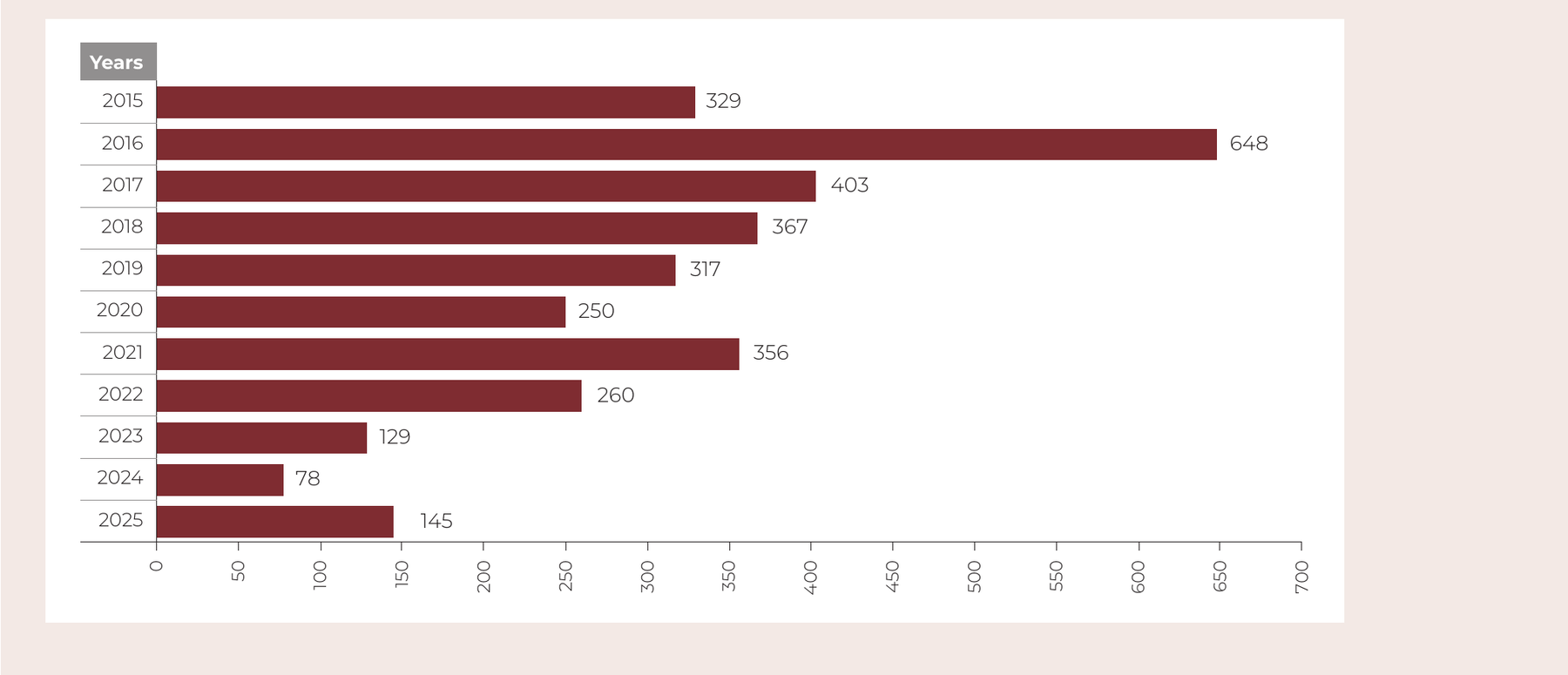
In practice, Article 8/A has, particularly since the general elections of 07.06.2015, begun to function as a political instrument of silencing. Looking at the annual distribution, 64 decisions were issued in 2015, 103 in 2016, 79 in 2017, 90 in 2018, 62 in 2019, 179 in 2020, 368 in 2021, 471 in 2022, 120 in 2023, 71 in 2024 and 179 in 2025; as of year-end 2025, a total of 1.786 Article 8/A decisions have been identified. These access blocking and/or content removal decisions were issued by 158 different criminal judgeships of peace across Türkiye.
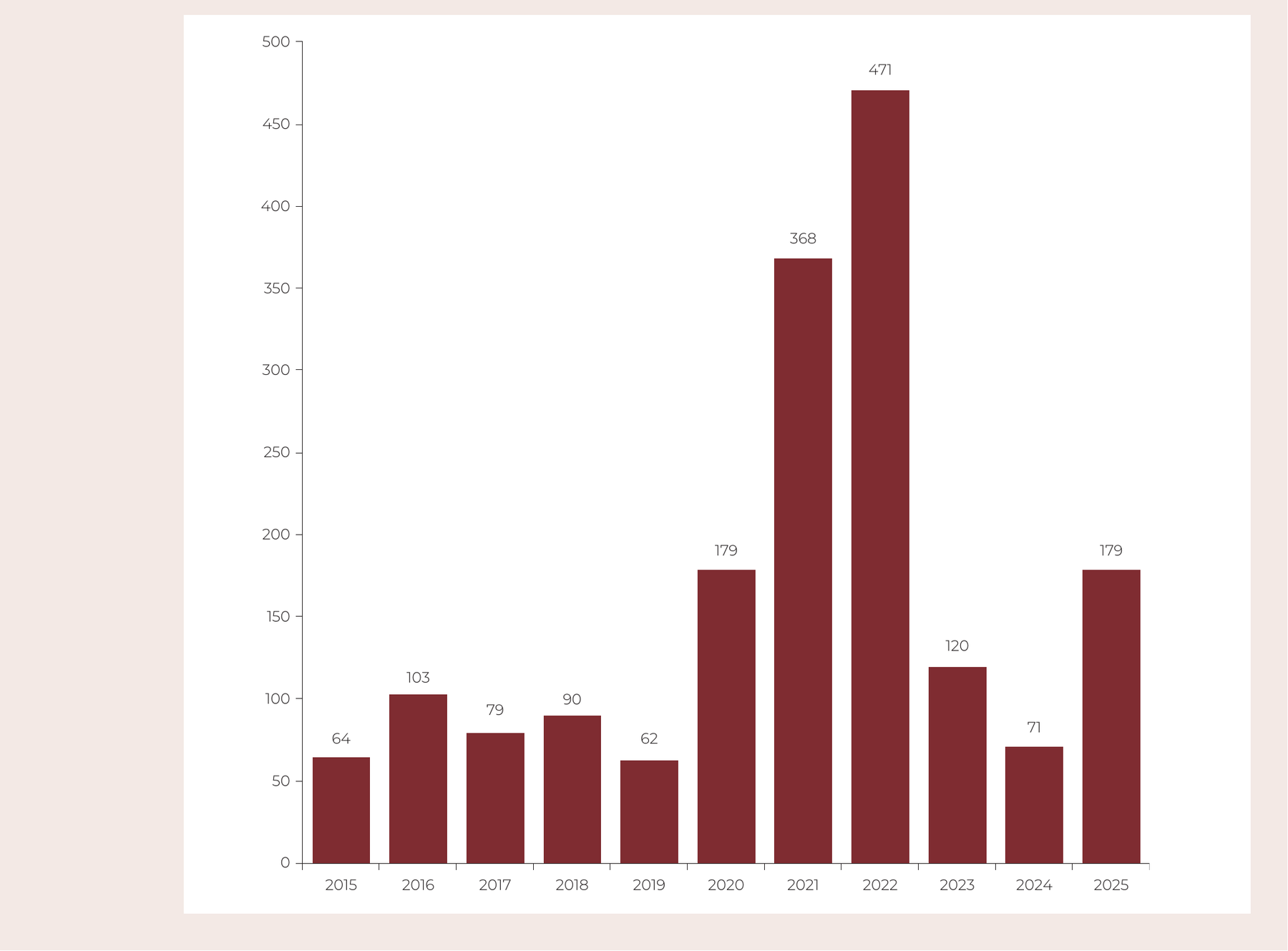
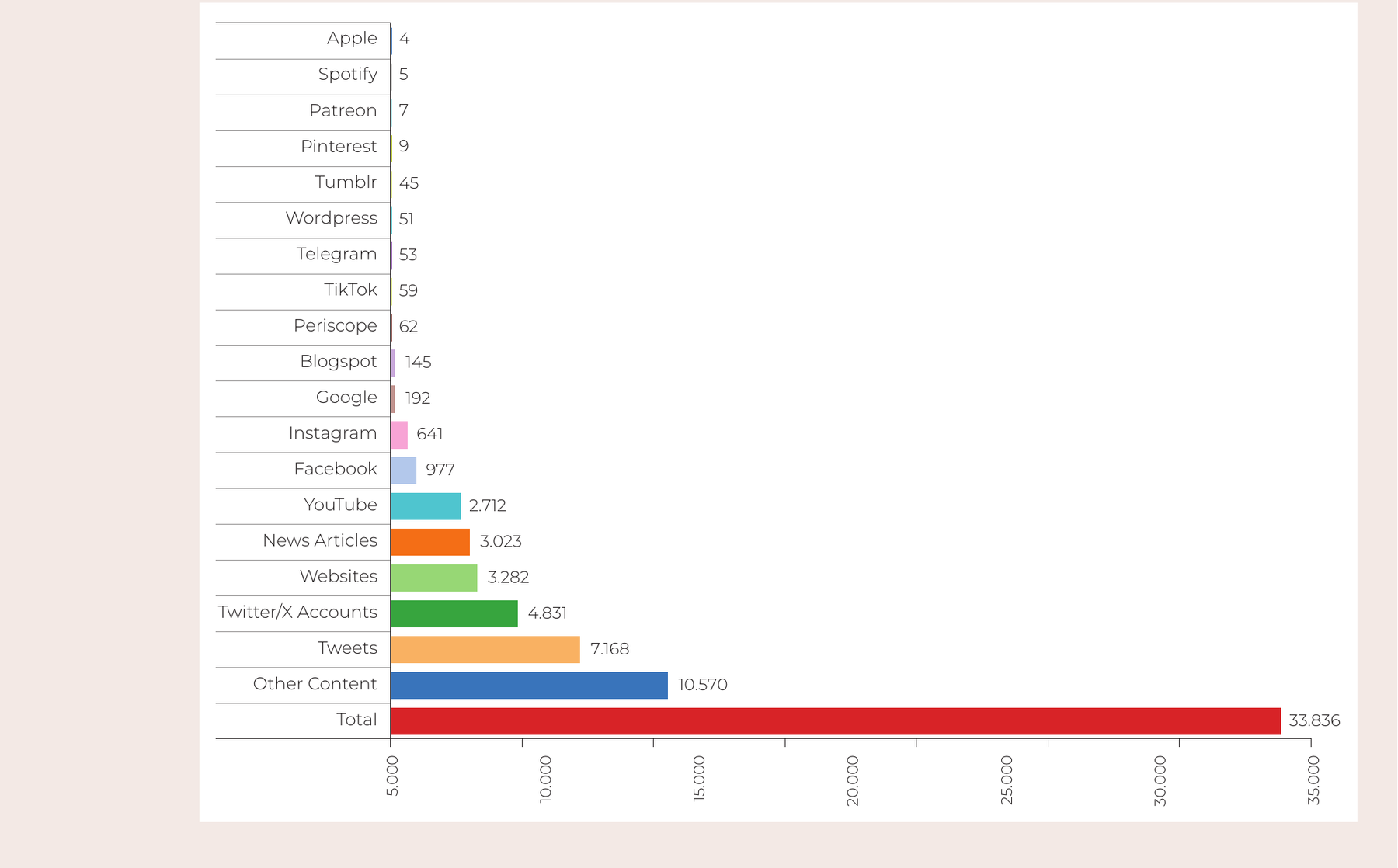
The year in which the largest number of decisions was issued since the entry into force of Article 8/A is 2022, with 471 decisions. As will be detailed below, sanctions were applied through these decisions to more than 33.836 Internet addresses.104
Assessment of Article 8/A Decisions by Criminal Judgeship of Peace¶
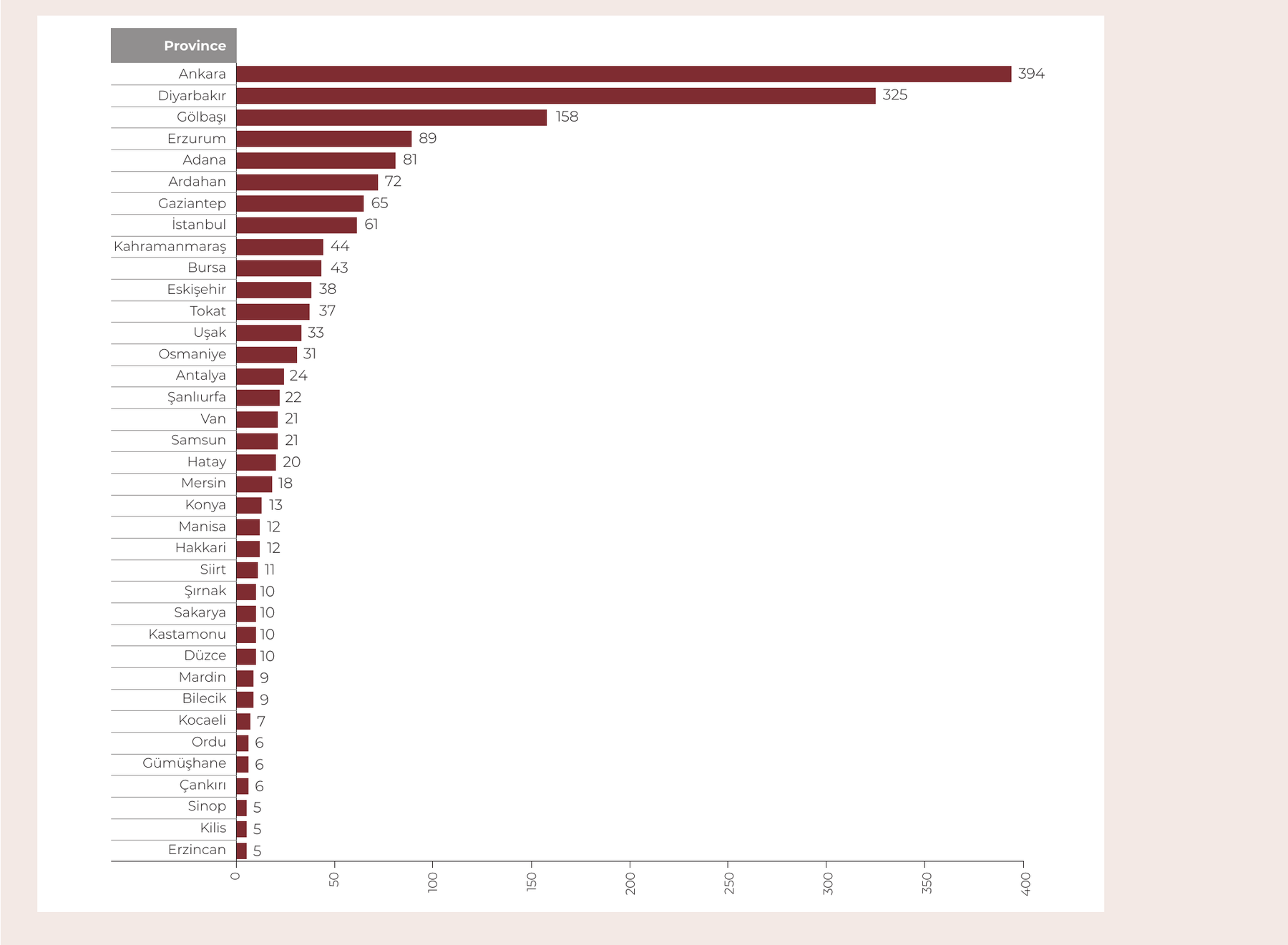
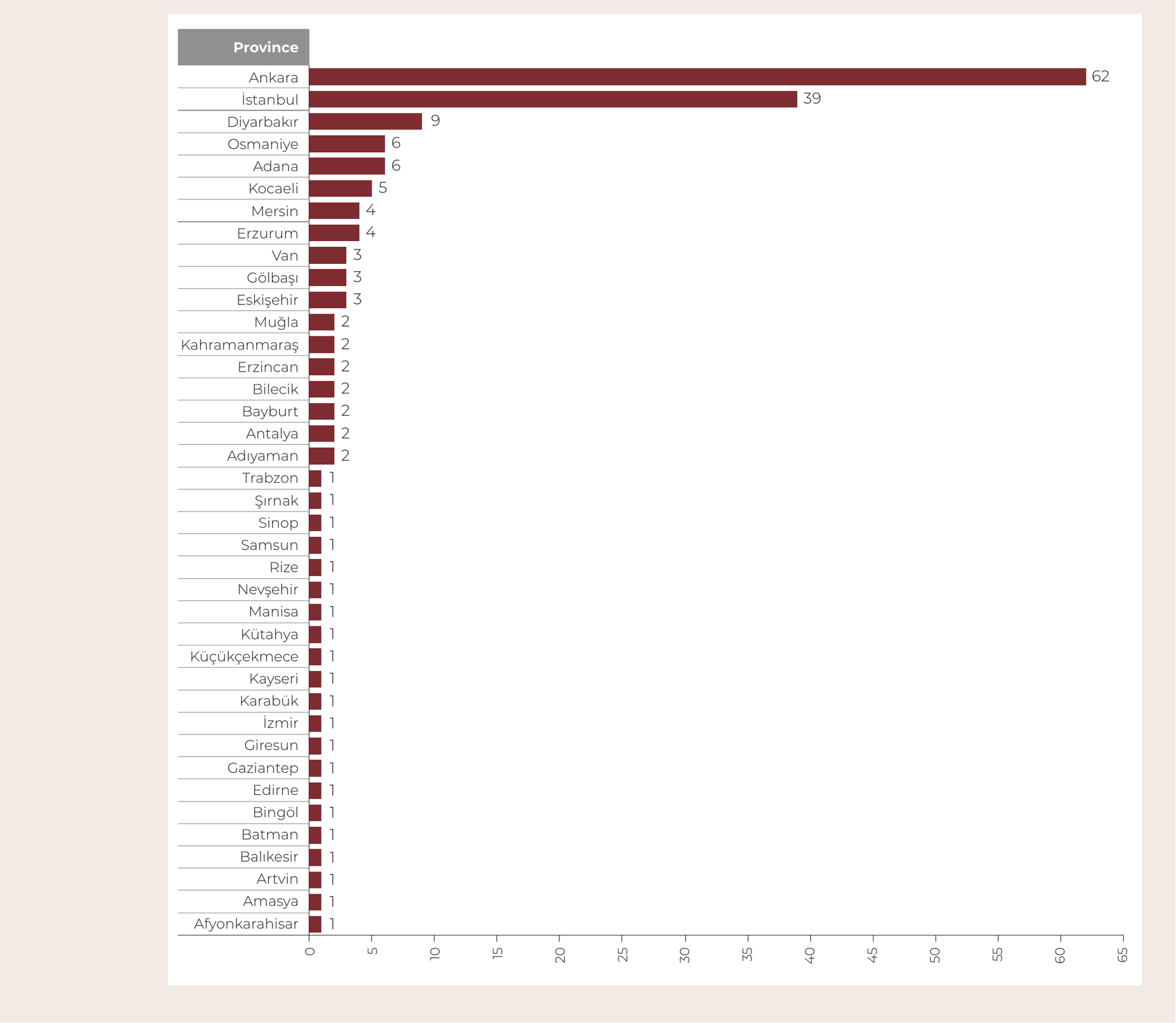
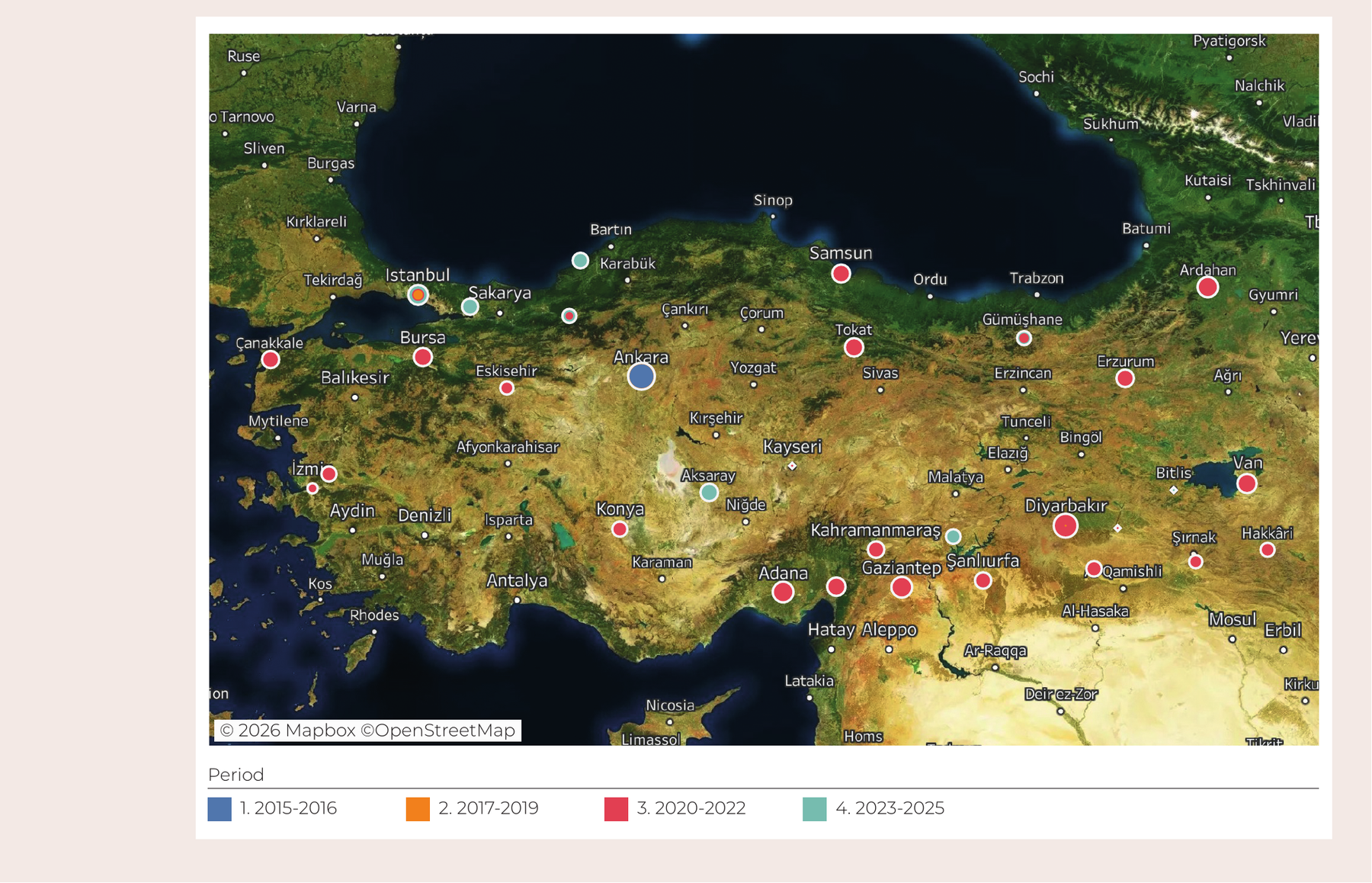
On an assessment by criminal judgeship of peace, the great majority of the 1.786 decisions issued by year-end 2025 were issued by criminal judgeships of peace in Ankara (a total of 394 Article 8/A decisions). The criminal judgeships of peace in Diyarbakır rank second with 328 Article 8/A decisions, and the Gölbaşı (Ankara) Criminal Judgeship of Peace ranks third with 158 decisions.105 In this context, of the 1.786 Article 8/A decisions issued in the 2015–2025 period, 552 (31%) were issued by the Gölbaşı and other Ankara criminal judgeships of peace upon requests made by the Prime Ministry and subsequently the Presidency and the relevant ministries. In 2025, the largest numbers of Article 8/A decisions were issued by criminal judgeships of peace in Ankara (62 decisions) and Istanbul (39 decisions).
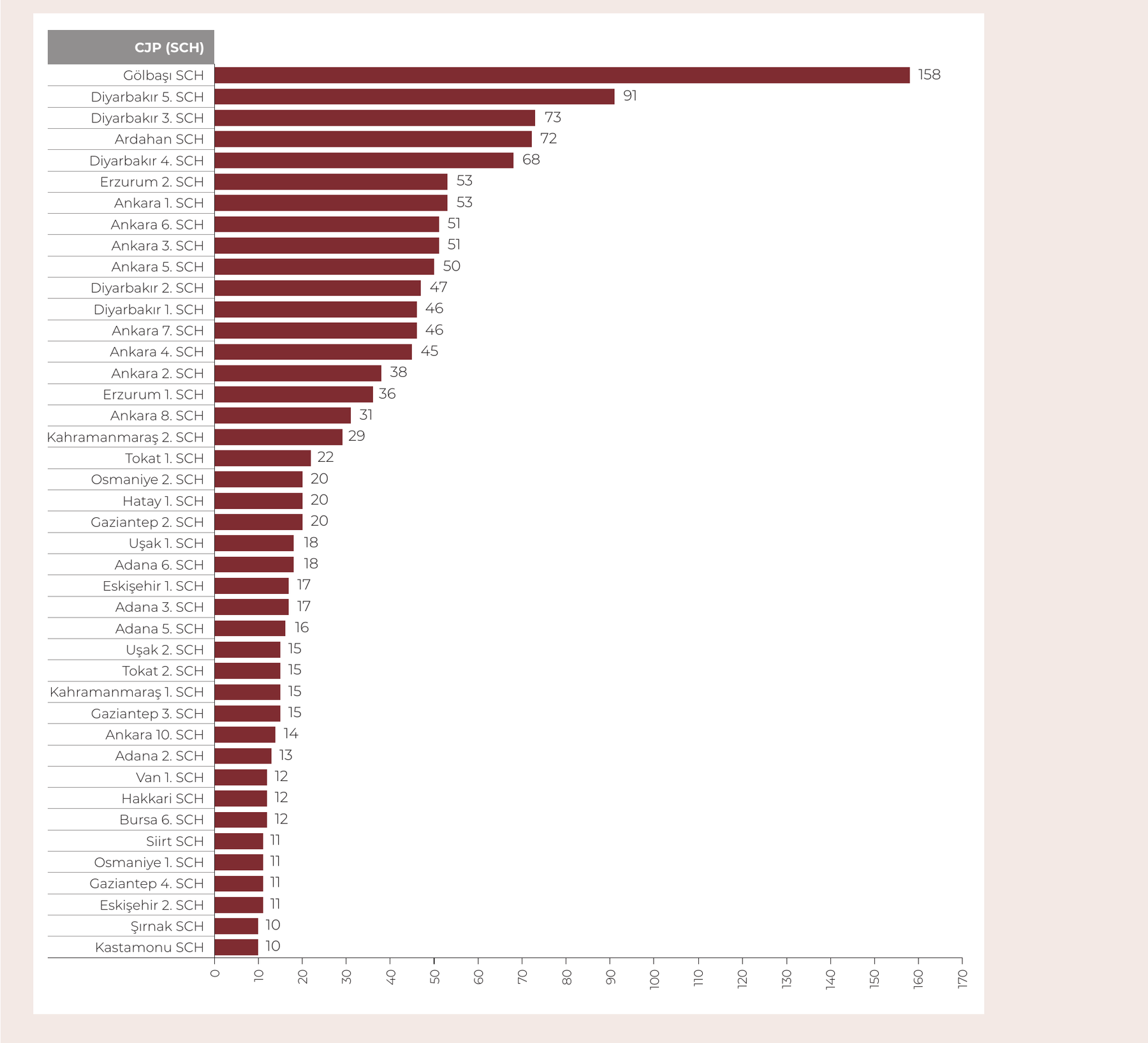
On the level of individual judgeships, as of year-end 2025 the largest number of Article 8/A decisions, 158, was issued by the Gölbaşı Criminal Judgeship of Peace. Second is the Diyarbakır 5th Criminal Judgeship of Peace with 91 Article 8/A decisions; third, the Diyarbakır 3rd Criminal Judgeship of Peace with 73 Article 8/A decisions. Fourth is the Ardahan Criminal Judgeship of Peace with 72 Article 8/A decisions; fifth, the Diyarbakır 4th Criminal Judgeship of Peace with 68 Article 8/A decisions.
As will be set out in detail below, Article 8/A of Law No. 5651 has, since its entry into force, come to be used in an increasingly extensive manner as an arbitrary and unsupervised instrument of censorship that narrows the space for freedom of expression. Considering the geographic distribution of the criminal judgeships of peace and the concentration of decisions, the fact that decisions are concentrated in particular periods and provinces has turned into a practice of judicial automation, whereby requests emanating from the executive organ are systematically implemented through judicial authorities. In this context, the fact that 31% of the 1.786 decisions issued in 2015–2025 originate from judgeships in Gölbaşı and Ankara is not the indication of accidental geographic distribution, but of the concentration of central requests channelled by the Presidency and the relevant ministries through the President of BTK in specific judicial nodes. This concentration shows that the phenomenon of “judicial automation” manifests itself most clearly precisely before these judgeships, that is, at the points to which the central administrative request flows most directly.
Furthermore, Article 8/A, by allowing the blocking of access to, or removal of, content to be justified on broad and open-textured concepts such as “public health”, “public order” or “national security”, has opened the way for disproportionate interference with freedom of expression. The increasing number of criminal judgeships of peace beginning to exercise this authority likewise shows that the practice has ceased to be centralised and has been disseminated, and that the judicial system has been made part of the censorship mechanism. The most striking confirmation of this structural tendency emerges from a comparison with the case law of the Constitutional Court. As will be detailed below, the Constitutional Court’s case law since the BirGün judgment, which has repeatedly emphasised that Article 8/A may be applied only to content that constitutes a prima facie violation and presents a clear threat to public order, has not been applied by the criminal judgeships of peace in any of the 1.388 decisions issued from 2020 onwards as of year-end 2025. A court’s disregard of binding constitutional case law hundreds of times in succession indicates not individual judicial error, but a systemic pattern of conformity, in other words, a practice in which judicial autonomy has given way to judicial conformity.
A significant part of the 179 decisions issued in 2025 must also be assessed within this structural continuity. A significant portion of the said decisions consists of decisions issued by criminal judgeships of peace targeting various social media accounts, primarily X (formerly Twitter), in the protest process triggered by the detention of Istanbul Metropolitan Municipality Mayor Ekrem İmamoğlu on 19 March 2025. This development demonstrates in the most striking manner that Article 8/A has been transformed into a systematic instrument of silencing in periods of extraordinary political tension.
A proper understanding of this geographic concentration, however, requires assessment not only of the statistical weight of particular judgeships, but also of the administrative source feeding the requests directed at those judgeships. Indeed, from 2020 onwards, with the increase in the Gendarmerie’s activity in the cyber field, the geographic distribution of Article 8/A decisions has undergone a fundamental transformation. The mechanism of that transformation is examined in detail in the next section.
The Gendarmerie’s Role in Article 8/A Decisions in 2020–2024 and the Legal Contradictions¶
With the activation, in August 2019, of the Department for Combating Cybercrime within the Gendarmerie General Command, both a geographic and a substantive expansion has occurred in the sanctions issued under Article 8/A of Law No. 5651.107 Whereas before 2020 the number of Article 8/A decisions issued by criminal judgeships of peace outside Ankara stood at only 10, with the increase in the Gendarmerie’s cyber activities this number rose to 142 in 2020. The pattern of geographic concentration set out in the previous sub-section, in particular the high ranking of the criminal judgeships of peace in Diyarbakır and the Ardahan Criminal Judgeship of Peace, is directly connected to this development. In the provinces where the Provincial Gendarmerie Commands carry out operations, the concentration of decisions at the local criminal judgeships of peace can be seen to have increased markedly; the placement of the Ardahan Criminal Judgeship of Peace in fourth position with 72 decisions, considered together with the fact that this small border province is located in a geography of intensified gendarmerie operations, ceases to be an accidental statistical deviation.
During this period, the Provincial Gendarmerie Commands carried out mass operations against websites and social media accounts alleged to involve, primarily, illegal betting under Law No. 7258, obscenity,108 the sale of narcotic and stimulant substances, and “terrorist organisation propaganda”;109 they applied to criminal judgeships of peace for the blocking of access to thousands of identified items of content.
A total of 339 gendarmerie-focused decisions examined in detail by İFÖD within the scope of the EngelliWeb project between 2020 and 2024 (2020: 70, 2021: 51, 2022: 123, 2023: 70, 2024: 25) have laid bare a structural and systematic legal contradiction. Although the Gendarmerie units have consistently made their requests under Article 8/A (national security and public order), and broad references to that provision feature in the judgeships’ reasoning, the operative part of the great majority of decisions was constructed on Article 9 of Law No. 5651 (violation of personality rights). For example, in none of the 70 decisions examined in 2020, and in none of the 123 decisions examined in 2022, was the operative part constructed by reference to Article 8/A. The judgeships approved the Gendarmerie’s “security”-based requests by bringing them within the scope of personality rights. This indicates that the criminal judgeships of peace have created an “automatic approval” mechanism in which they mix together provisions of the law in order to avoid rejecting requests emanating from the security bureaucracy. This mechanism rests not on judicial review, but on bureaucratic conformity.
The practical consequences of this legal contradiction are weighty. The arbitrary permeability between Article 8/A and Article 9 makes the question of the regime to which decisions are subject for purposes of objection and review uncertain, and complicates the effective recourse of content providers to legal remedies. Moreover, the approval of the Gendarmerie’s requests on the ground of personality rights effectively shields applications made on grounds of public security from judicial review. In other words, the request emanates from the security bureaucracy while the operative part is grounded in a private-law norm.
During this five-year period, the target of gendarmerie-focused supervision has expanded from betting and obscene websites to political speech on social media platforms such as X (formerly Twitter) and TikTok. In particular, by 2024, TikTok has come to occupy a central position on the Gendarmerie’s supervisory radar, owing to its young user base and to viral content production. Although the reasoning of the decisions is based on claims such as “national security” and “the prevention of the commission of crime”, detailed analyses of the concrete violations of the content have been avoided. Article 8/A has been operated as a routine administrative tool, used to have the Gendarmerie’s large-scale scanning activities in the cyber field approved through the judiciary. The fact that the criminal judgeships of peace, faced with these requests, do not refer to any case law of the Constitutional Court, and in particular to the “prima facie violation” criterion, documents that the dominant reflex is one not of judicial autonomy but of judicial conformity.
Content Analysis of Article 8/A Decisions: 2015–2025¶
Through the 1.786 Article 8/A decisions issued by 158 different criminal judgeships of peace identified between 29.05.2015 and year-end 2025, as is shown in detail in Figure 21, access has been blocked to 33.836 addresses: more than 3.280 news sites and domain names, more than 3.000 news links, more than 4.800 Twitter accounts, approximately 7.200 tweets, more than 970 Facebook content items and more than 2.700 YouTube videos.110 The fact that Instagram, Blogspot, Telegram, Patreon, TikTok, Periscope and Pinterest content has, in the recent period, also begun to be subject to Article 8/A decisions indicates that the scope of sanctions has been expanding systematically towards new platforms.
The sanction decisions issued under Article 8/A are predominantly issued on political motivations. This censorship practice targets, in general, Kurdish and left-wing news sites, the social media accounts of dissidents and activists who carry to the public news items blacked out in the national media, and the posts of citizen journalists with large followings.
From the past to the present, Article 8/A has been operated as a systematic instrument of censorship in particular against the independent media organisations that broadcast in regional languages on Kurdish political issues. Within this scope, before 2023, news sites such as Sendika.org111 and SiyasiHaber.org, along with Dicle Haber Ajansı (DİHA), Azadiya Welat, Özgür Gündem, Yeni Özgür Politika, Rudaw, RojNews, ANF, Kaypakkaya Haber, Yüksekova Güncel, Güneydoğu'nun Sesi İdil Haber, Kentin Özgün Sesi Bitlis Güncel, Besta Nuçe, JINHA, Demokrasi.com and JinNews have regularly been blocked from access. The analysis of domain-based data makes the scale of this “regular blocking” concrete. The said news sites have attempted to continue broadcasting by adding sequential numbers to the end of their domain names after each blocking. Each new domain name, however, was shortly blocked again by a fresh criminal judgeship of peace decision. In the 2015–2025 period, Kızıl Bayrak alone was blocked through 89 different domain names, Sendika.org through 62, Özgür Gelecek through 62, and Mezopotamya Ajansı through 52. The 265 domain-name blockings belonging to these four news sites show that Article 8/A has been de facto transformed into a permanent and indefinite instrument of censorship.
The scale of censorship has not been confined to local or national press; it has targeted global sources of information as well. Upon the request of the Prime Ministry, on the allegation of “praising terrorism and threatening public order”, wholesale access blocking was imposed on the Wikipedia platform on 29.04.2017.112 This disproportionate decision was only lifted two and a half years later by the Constitutional Court’s judgment, when the platform was again made accessible. By 2020, news sites with large followings such as OdaTV113 and Independent Türkçe,114 as well as the JinNews news agency, were blocked serially through Article 8/A decisions; notwithstanding applications brought before the Constitutional Court, the access blocking of these sites continued until the end of 2023.
On a separate front, Article 8/A has also frequently been deployed to black out content concerning Türkiye’s cross-border military operations or foreign-policy crises. For example, in April 2016, when Türkiye–Russia relations were politically tense, the Russian news agency Sputnik was blocked through the direct invocation of Article 8/A. Similarly, the non-profit Wikileaks platform, which publishes leaked documents based on anonymous sources, along with Dağ Medya (one of Türkiye’s first practitioners of data journalism), Jiyan.org,115 Halkın Sesi TV and a great many personal blog addresses (Blogspot, WordPress) have been the express targets of this provision. Over the course of this process, URL-based access blocking has been imposed on countless news items of leading national press organs such as Cumhuriyet, Sözcü, BirGün, Evrensel, Diken, Sendika.org, T24, BBC, Artı Gerçek, Gazete Duvar, soL Haber and OdaTV; social media accounts such as Dokuz8haber’s Twitter account have also been blocked from access.
These data show that access blocking and content removal decisions issued under Article 8/A of Law No. 5651 have ceased to be exceptional measures. On the contrary, news sources and actors situated on a particular political and social line are being systematically targeted. The sanctions imposed on an increasingly diverse range of platforms reveal that the technical scope of content control has expanded and that critical expression and news activity of a political character have been significantly suppressed. The ineffectiveness of judicial review, and the belated implementation of Constitutional Court judgments, render these rights violations permanent. The rejection of nearly all objections lodged before lower courts renders the censorship de facto irreversible. The imposition by judicial authorities of sanctions on abstract and expansive grounds, without regard to context or the public interest of the content, both seriously threatens and inflicts irreparable damage on the pluralist media environment that is the foundation of a democratic society.
Content Analysis of 2025 Article 8/A Decisions¶
The application of Article 8/A of Law No. 5651 in 2025 presents an unprecedented picture for the field of Internet freedoms in Türkiye, both in terms of the quality and the quantity of censorship. The scale of this picture becomes evident on examination of the statistical comparison between 2024 and 2025.
In 2024, by 71 decisions issued by 35 different criminal judgeships of peace, access was blocked to a total of 828 addresses, the great majority of them tweets. Within this scope, sanctions were applied to 77 news sites and domain names, 127 individual news items, 20 X (formerly Twitter) accounts, 285 tweets, 12 Facebook content items, 72 Instagram addresses and 27 YouTube videos.
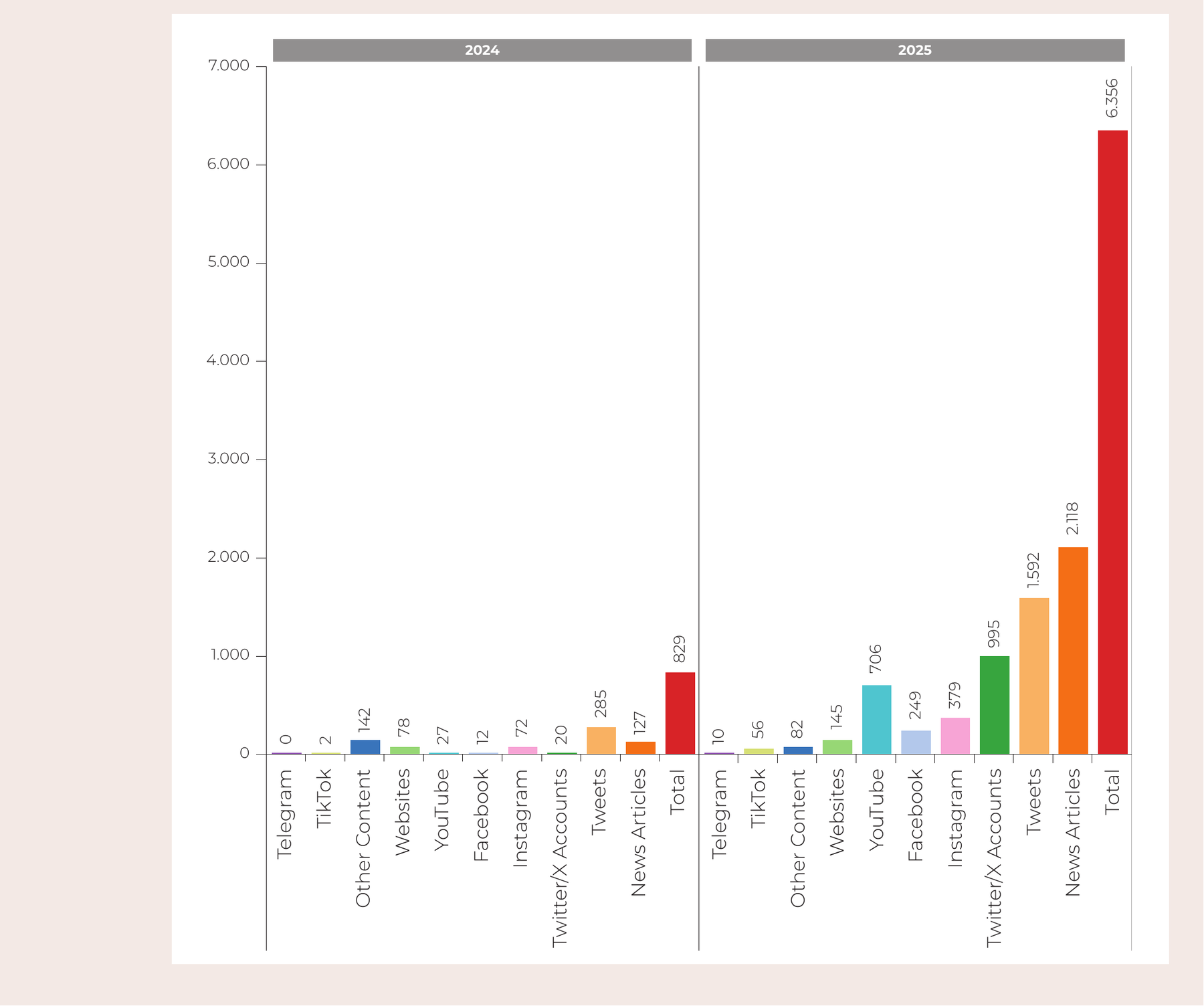
In 2025, however, the scale of the censorship mechanism reached a qualitatively different dimension. The number of criminal judgeships of peace signing decisions rose to 78, and the number of decisions to 179; the number of blocked addresses exceeded 6.300. In 2025, access was blocked to 145 news sites and domain names, 2.118 individual news items, 995 X (formerly Twitter) accounts, 1.592 tweets, 249 Facebook content items, 379 Instagram addresses and 706 YouTube videos. The jump in wholesale blocking decisions against X accounts from 20 to 995, and in individual news blockings from 127 to 2.118, clearly demonstrates that Article 8/A has ceased to be an exceptional measure reserved for extraordinary situations and has been transformed into a routine administrative procedure.
The Political and Legal Background of the Rise in Article 8/A Applications¶
This jump in numerical data is not mere statistical growth; it is the direct reflection of two fundamental legal and political developments.
The first is the legal vacuum created by the Constitutional Court’s annulment of Article 9 (violation of personality rights). Politicians, senior bureaucrats and pro-government capital groups, who in the past used Article 9 to obtain sanctions against news items concerning allegations against them such as bribery, corruption, nepotism and stock manipulation, have, in 2025, transferred this practice of “reputation management” directly into the “national security and public order” framework of Article 8/A. The use of the state’s heaviest national security instrument to protect personal and commercial reputation has wholly detached the provision from its constitutional limits.
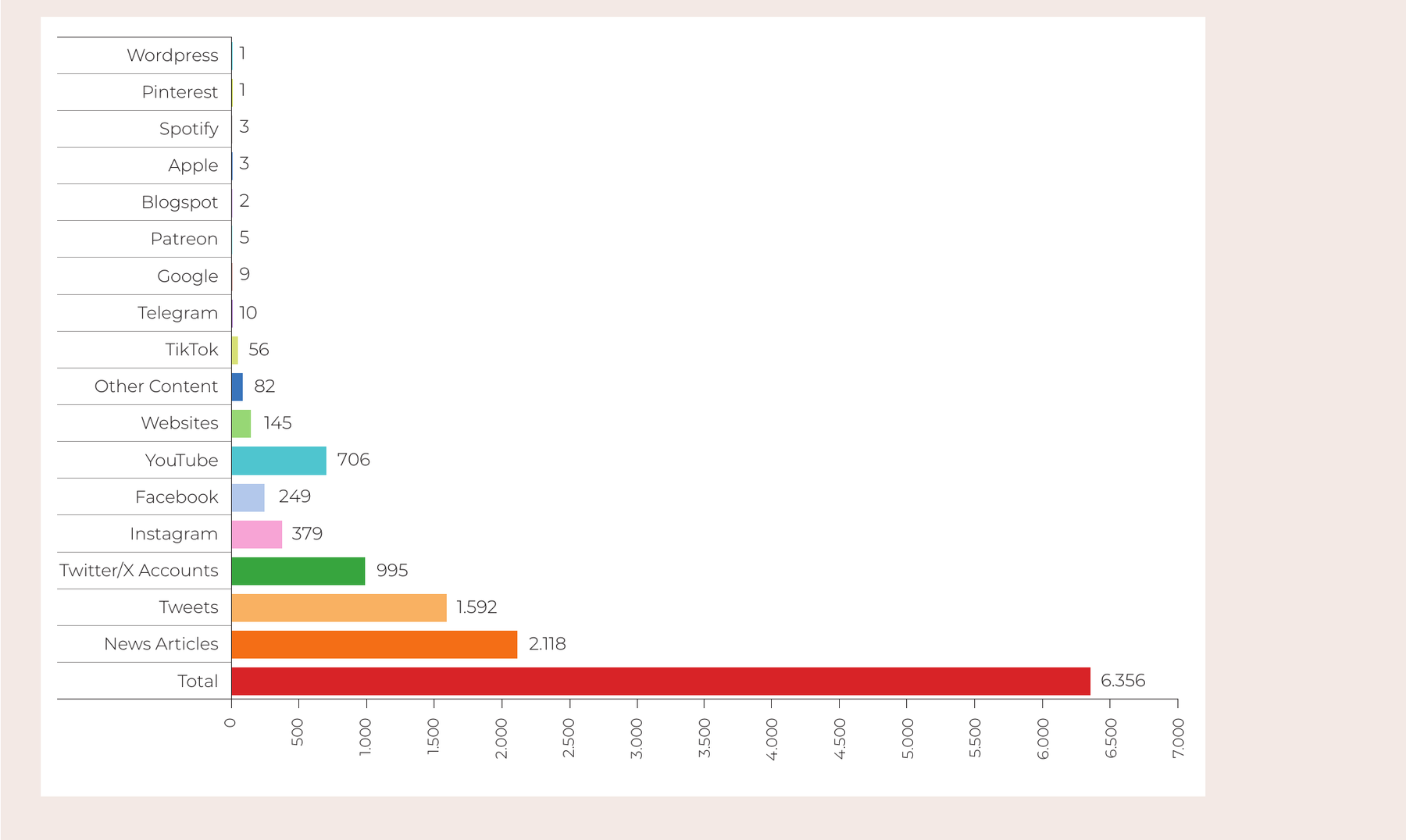
The second and most decisive development is the political process that began on 19 March 2025 with the detention of İBB Mayor Ekrem İmamoğlu and more than 100 other individuals. In the face of the social events that erupted in the wake of these operations, the street protests, the university demonstrations and the boycott calls, Article 8/A was systematically instrumentalised to “silence social opposition”. A large portion of the 995 X (formerly Twitter) account blockings and of the sanctions imposed on many news items and content items in 2025 targeted, in this process, student initiatives, civil society organisations, opposition political campaign accounts and protest maps that were sharing information.
The data show that Article 8/A has dealt its heaviest blow to independent journalism and to freedom of social communication. The application of sanctions to 2.118 individual news items and the domain-based blocking of 145 different websites reveal that a new systematic mechanism of pressure on the press has been brought into play. Unlike the application of Article 9, Article 8/A operates in a manner wholly removed from transparency: sanction notifications are transmitted to news sites through BTK, but the relevant criminal judgeship of peace decisions are not included in the enclosures. The requirement that news sites obtain the decisions from the judgeships themselves delays objection processes. The judgeships, for their part, serve these decisions on the parties belatedly, or, in breach of the principle of fair trial, do not serve them at all. Similarly, the 8/A decisions transmitted to X by BTK during and after the 19 March 2025 process are not communicated to account holders. While the platform complies swiftly with these sanctions and renders user accounts and content invisible from Türkiye, it refrains from forwarding to users the decisions on which the censorship rests.
That the practice of wholesale access blocking of an entire X account in response to an allegation of individual violation (995 accounts) has seen a serious rise compared with previous years also confirms that the principle of proportionality of the Constitutional Court is being systematically disregarded by the criminal judgeships of peace. The blocking of 706 items of content on YouTube, 379 on Instagram and 56 on TikTok shows that censorship has not remained merely text-based, but that it now targets the visual and auditory flow of information as a whole. The fact that in 2025 even links belonging to platforms that sustain the digital economy, independent content creators and artistic production, such as Google services (Docs, Drive), Apple infrastructures, Spotify and Patreon, are also blocked from access reveals that the scope of Article 8/A has been expanded without limit, towards every kind of independent voice and every commercial vehicle that the Internet sustains.
Independent Media and Journalism Caught in the Vise of “National Security”¶
The decisions issued in 2025 were not confined to the blocking of specific news items; the domain names of news websites, the social media accounts of correspondents in their entirety, and YouTube channels were blocked from access in a wholesale fashion on the grounds of “national security and public order”.
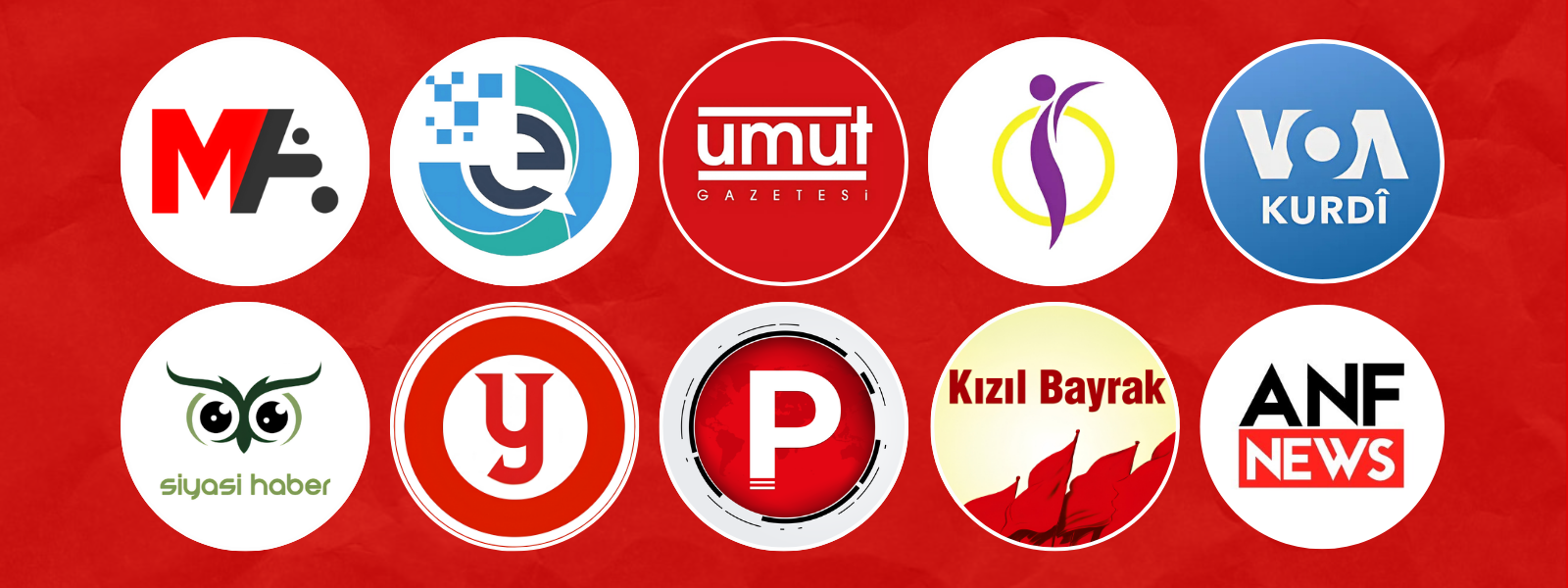
The first wave of systematic sanctions against independent news agencies and outlets occurred in early January. By decision no 2025/91 of 02.01.2025, the Ankara 10th Criminal Judgeship of Peace blocked the domain name of Siyasi Haber; simultaneously, the X (formerly Twitter), Instagram, Facebook, TikTok and YouTube accounts of Mezopotamya Ajansı, JinNews, Yeni Yaşam and Siyasi Haber were rendered invisible from Türkiye. On the same day, the new domain name of Yeni Yaşam was separately blocked by decision no 2025/7 of 02.01.2025 of the Diyarbakır 4th Criminal Judgeship of Peace. This wholesale censorship operation was extended on 8 January through decision no 2025/558 of the Ankara 10th Criminal Judgeship of Peace, which imposed collective access blocking on the domain names of outlets including Alınteri, ETHA, Devrimci Demokrasi, Gazete Patika, Kızıl Bayrak, Özgür Gelecek, Umut Gazetesi and Yeni Demokrasi. In the months that followed, the alternative addresses of Mezopotamya Ajansı were once again targeted by decisions no 2025/570 of 19.02.2025 of the Adıyaman 2nd Criminal Judgeship of Peace and no 2025/985 of 25.03.2025 of the Adıyaman 1st Criminal Judgeship of Peace. The same Adıyaman decision blocked the “dengeamerika.com” domain name of Voice of America’s Kurdish service, while the domain name of the Fırat News Agency (ANF) was blocked by decision no 2025/10014 of 19.09.2025 of the Ankara 5th Criminal Judgeship of Peace.
Investigative journalism activities and news distribution channels were targeted directly and permanently for silencing through Article 8/A. The X account of Artı Gerçek and that of the journalist Metin Cihan were subjected to wholesale access blocking by decision no 2025/1794 of 05.02.2025 of the Ankara 4th Criminal Judgeship of Peace, and the accounts were rendered invisible from Türkiye by X. The YouTube, X and Instagram accounts of the journalist Abdurrahman Gök were blocked by decision no 2025/2434 of 13.02.2025 of the Ankara 6th Criminal Judgeship of Peace. The “Bombacı Mülayim” account, which shared posts about rights violations suffered by police officers, was blocked by decision no 2025/2122 of 11.02.2025 of the Ankara 3rd Criminal Judgeship of Peace. At the end of February, the accounts of numerous journalists including Umut Taştan and Elif Çetiner were blocked.116 In mid-March, the posts of Nupel.tv and various Kurdish journalists were censored by decision no 2025/3812 of 18.03.2025 of the Ankara 8th Criminal Judgeship of Peace.
News aggregator accounts with millions of followers were also brought within the scope of Article 8/A. The “DarkWeb Haber” account was blocked on 20 March; the “BPT”, “Boşuna Tıklama” and “ZAMajans” accounts were blocked by decision no 2025/1013 of 29.03.2025 of the Ankara 11th Criminal Judgeship of Peace. The accounts of the journalist Erk Acarer were blocked repeatedly in March117 and June.118 In the case of Furkan Karabay, every new account opened in succession by the detained journalist was rendered invisible immediately, in May and December.119
News reports concerning corruption, irregularities and urban neglect were also systematically suppressed through Article 8/A. The reports by the journalists Murat Ağırel and Bülent Mumay on Met-Gün İnşaat tenders were blocked by decision no 2025/3723 of 14.04.2025 of the Istanbul 3rd Criminal Judgeship of Peace; Diken’s reports on the “Ö.B./Seda Sayan” operation were blocked by decision no 2025/1685 of 07.05.2025 of the Istanbul 12th Criminal Judgeship of Peace; and the report by BirGün and İsmail Arı on the “citizen sentenced to imprisonment” was blocked by decision no 2025/2465 of 12.06.2025 of the Karabük Criminal Judgeship of Peace. The accounts of journalists Rojda Altıntaş,120 Altan Sancar,121 Ali Macit122 and Günay Aslan123 were also added to this chain of sanctions over the summer months.
Interference with press freedom extended to YouTube content creators and columnists. The YouTube channel of Fatih Altaylı was blocked on account of a video containing political analysis by decision no 2025/9025 of 07.08.2025 of the Istanbul 6th Criminal Judgeship of Peace. The YouTube channels of Jahrein and Mind Vorteks were censored at the end of May; the channel of Can Dündar was censored in early September. Medyaradar was blocked by decision no 2025/8825 of 16.09.2025 of the Istanbul 2nd Criminal Judgeship of Peace; the X account of Sendika.Org was blocked in October.124
By the end of the year, Barış Terkoğlu’s column entitled “Did someone say a state governed by the rule of law?”, which criticised bureaucratic appointments,125 Devrim Gürkan’s post concerning RTÜK lobby information,126 Serdar Akinan’s posts about TÜGVA broadcasts, and Alican Uludağ’s post regarding the building collapse in Gebze127 were blocked on grounds of national security. The wave of censorship continued with decision no 2025/12221 of 10.12.2025 of the Istanbul 2nd Criminal Judgeship of Peace, which collectively blocked reports published in Bianet, Diken, Evrensel and Yetkinreport on the “White Toros” analyses prepared in response to statements by Özgür Özel. The year closed with the censorship, by decision no 2025/13668 of 18.12.2025 of the Istanbul 4th Criminal Judgeship of Peace, of Bahadır Özgür’s reports on stock market manipulation. This picture demonstrates unambiguously that Article 8/A has been transformed into a routine administrative approval mechanism encompassing not merely isolated news items but the entirety of Türkiye’s independent news ecosystem.
İBB Operations, Social Backlash, and the Blocking of Political Communication¶
2025 was the year in which Article 8/A of Law No. 5651 was used as a systematic instrument of censorship not for terrorism or emergency security incidents, but to silence street protests, student organisations, acts of civil disobedience, and the political-campaign-grade communications of the main opposition. Particularly from March 2025, when the political and judicial operations targeting İBB Mayor Ekrem İmamoğlu began, the right of democratic society to receive information and to protest was effectively dismantled through censorship practices implemented by the judiciary and the administration.
The process of detaining İmamoğlu and more than 100 others on 19 March 2025 was conducted simultaneously with a comprehensive restriction of digital communications. Immediately after the detention orders, from 7.00 a.m. on 19 March, bandwidth throttling was imposed across Istanbul on the X, YouTube, Instagram, Facebook, TikTok, Twitch, Telegram, Signal and WhatsApp platforms. This administrative intervention, which lasted approximately 42 hours, is on record as a disproportionate and wholesale measure aimed at preventing the organisation of social backlash and the flow of information.
With the end of bandwidth throttling, censorship shifted to a more targeted and permanent dimension through decisions issued by criminal judgeships of peace under Article 8/A. On 21 and 22 March, the X accounts of more than 40 youth organisations that had shared content concerning student demonstrations, along with numerous profiles sharing information about the street protests, were blocked from access by decision no 2025/4198 of the Ankara 10th Criminal Judgeship of Peace, decision no 2025/2829 of the Mersin 1st Criminal Judgeship of Peace and decision no 2025/1106 of the Ankara 11th Criminal Judgeship of Peace. This wholesale approach extended even to the accounts of women’s organisations and posts concerning the dispute between the police chief and a superintendent in Kocaeli over the use of tear gas during the protests were silenced on grounds of “public order” by decision no 2025/1815 of 24.03.2025 of the Kocaeli 3rd Criminal Judgeship of Peace.
Civil disobedience and boycott initiatives were also among the principal targets of Article 8/A. The websites “boykotyap.com”, “yandaslarboykot.com”, “boykot.web.tr” and “guncelboykot.com”, which were created by the CHP following İmamoğlu’s arrest and listed brands close to the government, were blocked by decision no 2025/4129 of 27.03.2025 of the Ankara 4th Criminal Judgeship of Peace. In the same period, the “Freedom Map”, which displayed the locations of the protests, and the “itaatet.me” website created by student initiatives, were censored by decision no 2025/1012 of 29.03.2025 of the Ankara 11th Criminal Judgeship of Peace. The effort to continue broadcasting from the alternative addresses “boykotyap.net”, “boykotla.app” and “boykot.me” was blocked by decision no 2025/4204 of 02.04.2025 of the Istanbul 2nd Criminal Judgeship of Peace; the “Freedom Map” was blocked for the second time by the same judgeship’s decision no 2025/4202. The CHP’s third alternative address, “boykotyap.org”, was likewise blocked from access on 12 May, by decision no 2025/3481 of the Küçükçekmece 3rd Criminal Judgeship of Peace. By the end of the year, sanctions of this kind reached the point of prohibiting the “Boycott Detective” mobile application by decision no 2025/10836 of 05.12.2025 of the Istanbul 12th Criminal Judgeship of Peace.
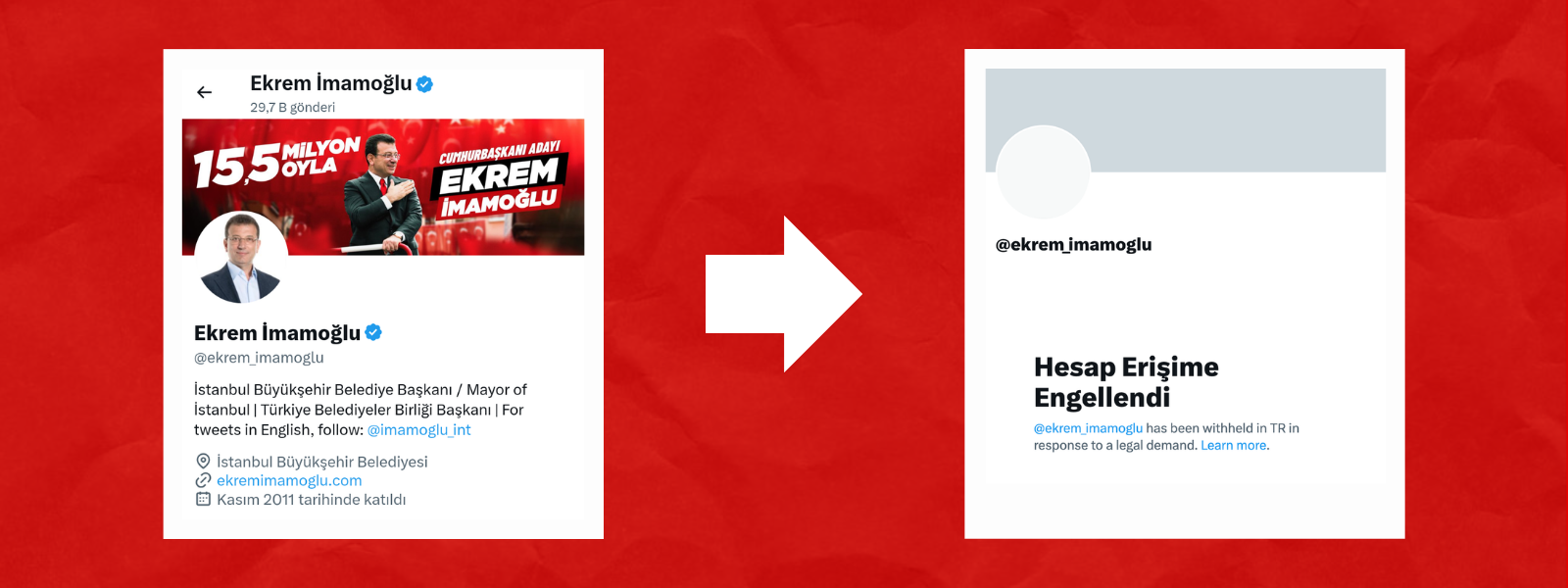
Public figures supporting the process and political communication channels were likewise subjected directly to Article 8/A sanctions. The X accounts of well-known actors Berna Laçin, Rojda Demirer and Alican Yücesoy, along with those of several journalists, were blocked on account of sharing boycott lists by decision no 2025/4204 of 02.04.2025 of the Istanbul 2nd Criminal Judgeship of Peace. İmamoğlu’s personal X account, with 9.7 million followers, was blocked by decision no 2025/4361 of 24.04.2025 of the Istanbul 8th Criminal Judgeship of Peace. In May, İmamoğlu’s international account “imamoglu_int” was likewise blocked. Reports concerning the academic Assoc. Prof. Yasin Çetin, who had prepared the report leading to the annulment of İmamoğlu’s diploma, were also blocked under Article 8/A. In November 2025, the “CBAdayOfisi” account opened in connection with İmamoğlu’s possible presidential candidacy, along with the “CBAdayOfisi1” and “CBAdayOfisi11” accounts opened after successive blockings, were blocked from access one after the other by decision no 2025/11774 of 13.11.2025 of the Istanbul 10th Criminal Judgeship of Peace.
Judicial reality and political criticism were also targeted directly: the “istanbuliddianamesi.com” website and X account, which shared details of the indictment in the İBB investigation, were blocked by decision no 2025/12716 of 15.11.2025 of the Istanbul 6th Criminal Judgeship of Peace. This chronology documents the transformation of Article 8/A into an unlawful routine that places every form of social and political communication into the category of “national security threat” for the purpose of shielding a political process.
Shielding Bureaucrats, Members of the Ruling Bloc, and Capital Groups under the “8/A” Armour¶
Throughout 2025, Article 8/A of Law No. 5651 was severed from its constitutional limits and transformed into a comprehensive “reputation management” mechanism for political figures, senior public administrators and capital groups close to the government. The legal vacuum created by the Constitutional Court’s annulment of Article 9 was filled by routing allegations of bribery, tender irregularities, stock market manipulation and unmerited appointments through the framework of “national security and public order”.
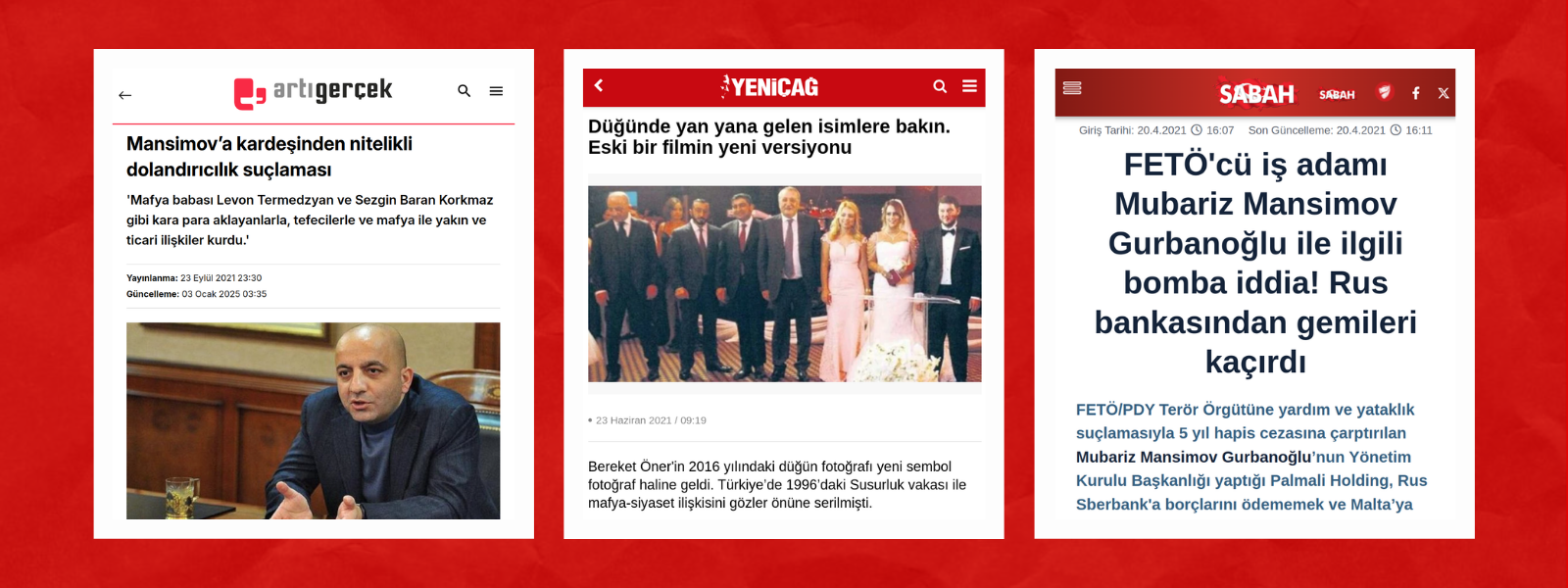
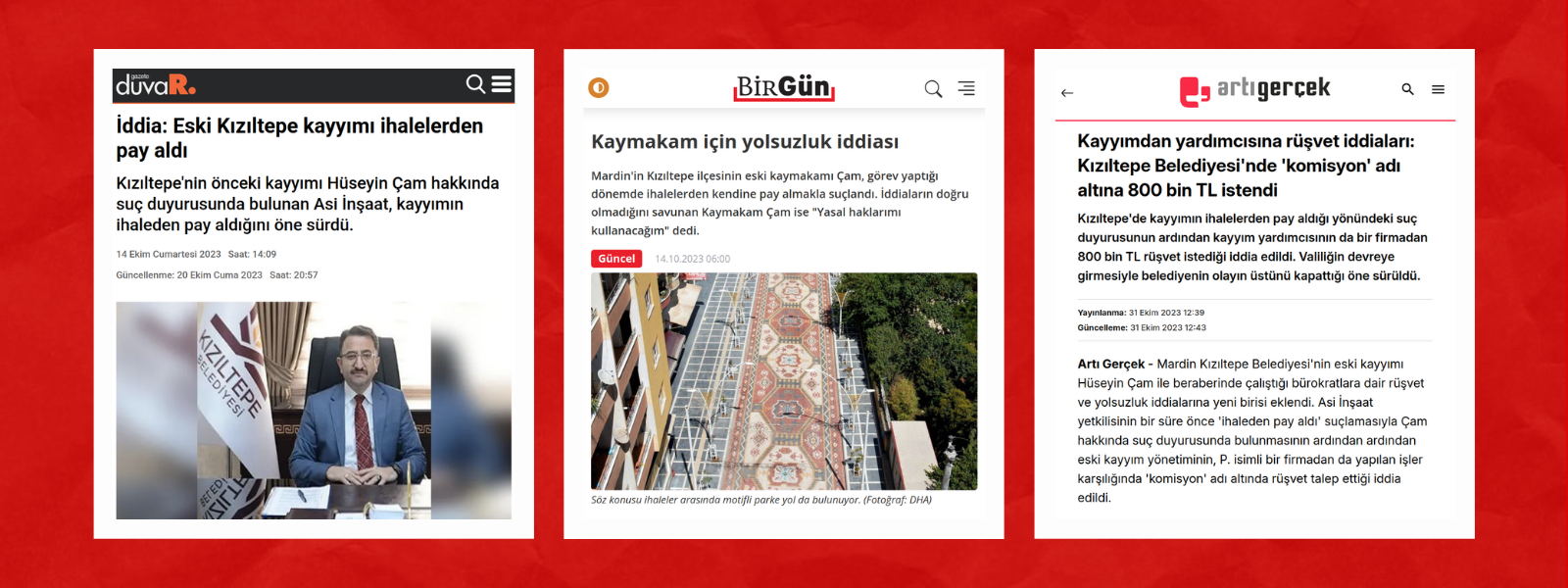
Reports concerning allegations of bribery and the taking of shares in tenders against the former Mardin Kızıltepe Sub-Governor and trustee Hüseyin Çam were blocked by decision no 2025/896 of 11.02.2025 of the Nevşehir Criminal Judgeship of Peace. Reports concerning the fraud allegations against the businessman Mübariz Mansimov Gurbanoğlu and his relationship with Sezgin Baran Korkmaz were blocked by decision no 2025/1934 of 12.02.2025 of the Istanbul 9th Criminal Judgeship of Peace.
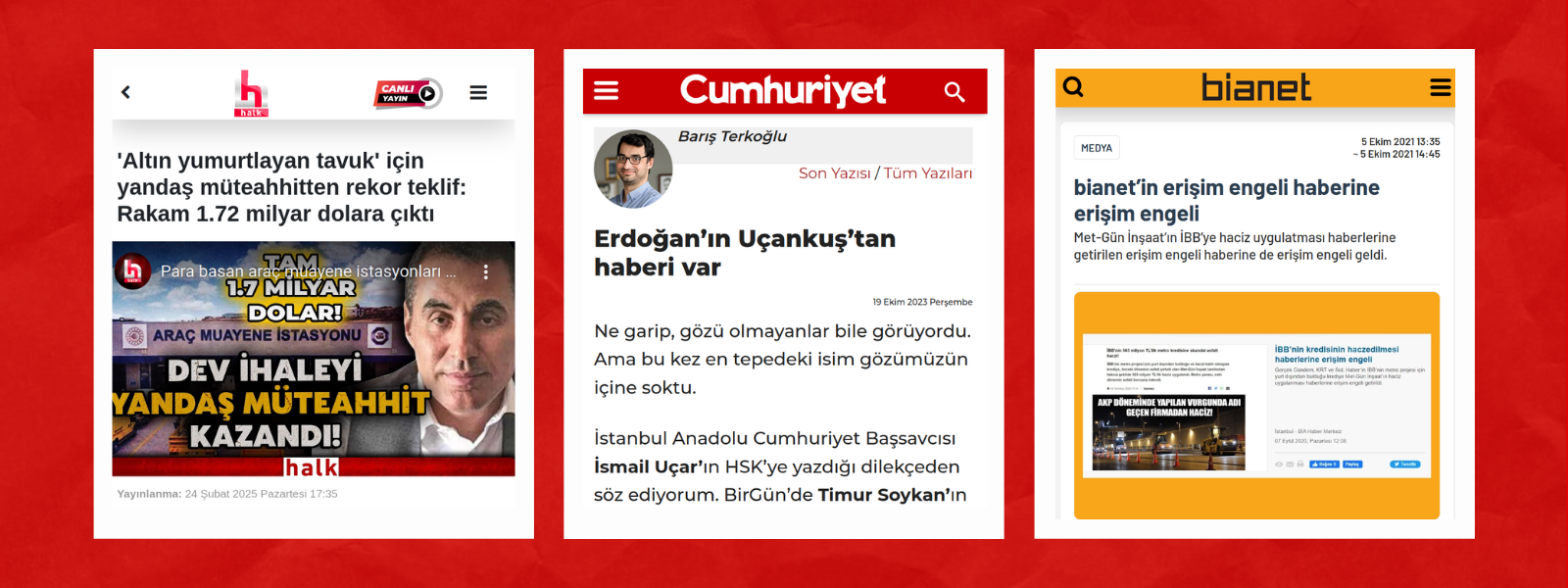
This wave of censorship deepened with decision no 2025/3723 of 14.04.2025 of the Istanbul 3rd Criminal Judgeship of Peace, which targeted investigative journalism content concerning Met-Gün İnşaat and Metin Güneş, alleged to have placed a lien on the İBB metro credit. By this comprehensive decision, which imposed sanctions on 95 addresses in total, the posts of journalist Murat Ağırel concerning the tenders, Bianet’s reports on the access blockings, and even two İFÖD/EngelliWeb announcements published in 2022 and 2024 concerning sanctions imposed on news reports about the applicant were blocked from access. The decision also covered reports concerning the journalist Bülent Mumay, who was sentenced to one year and eight months’ imprisonment on charges of “disseminating personal data” for having published the access blocking notification served on Met-Gün İnşaat.
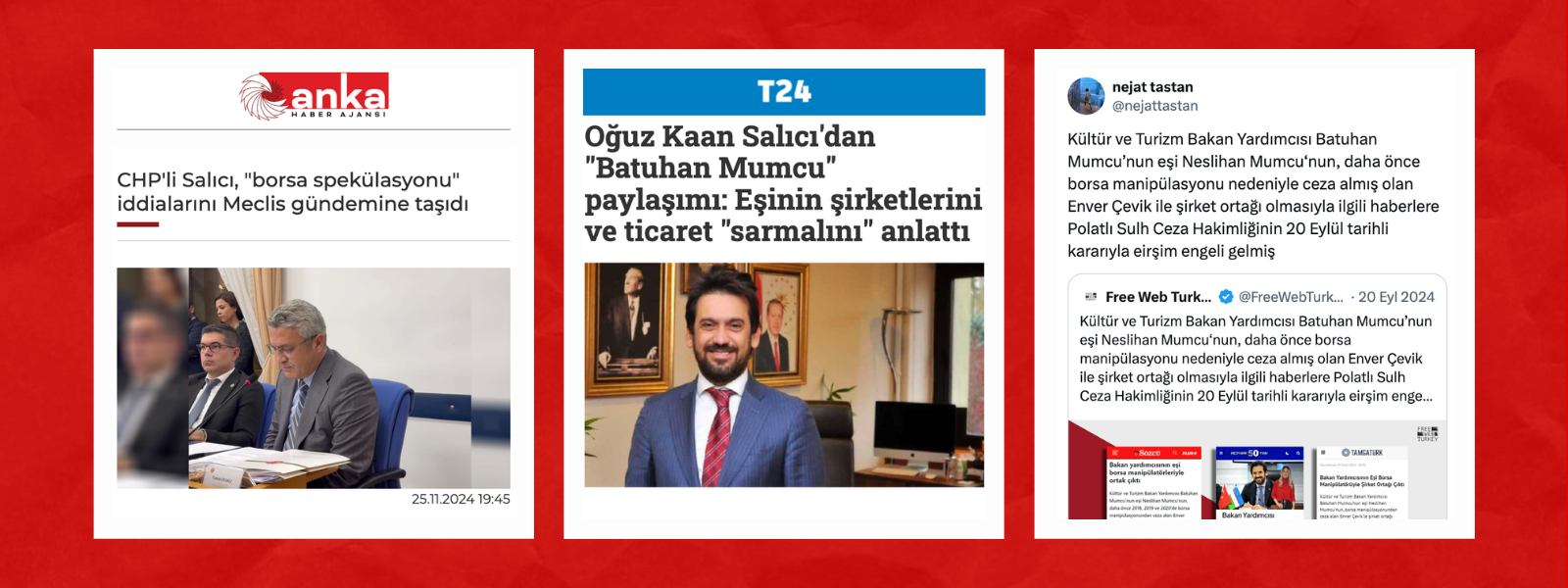
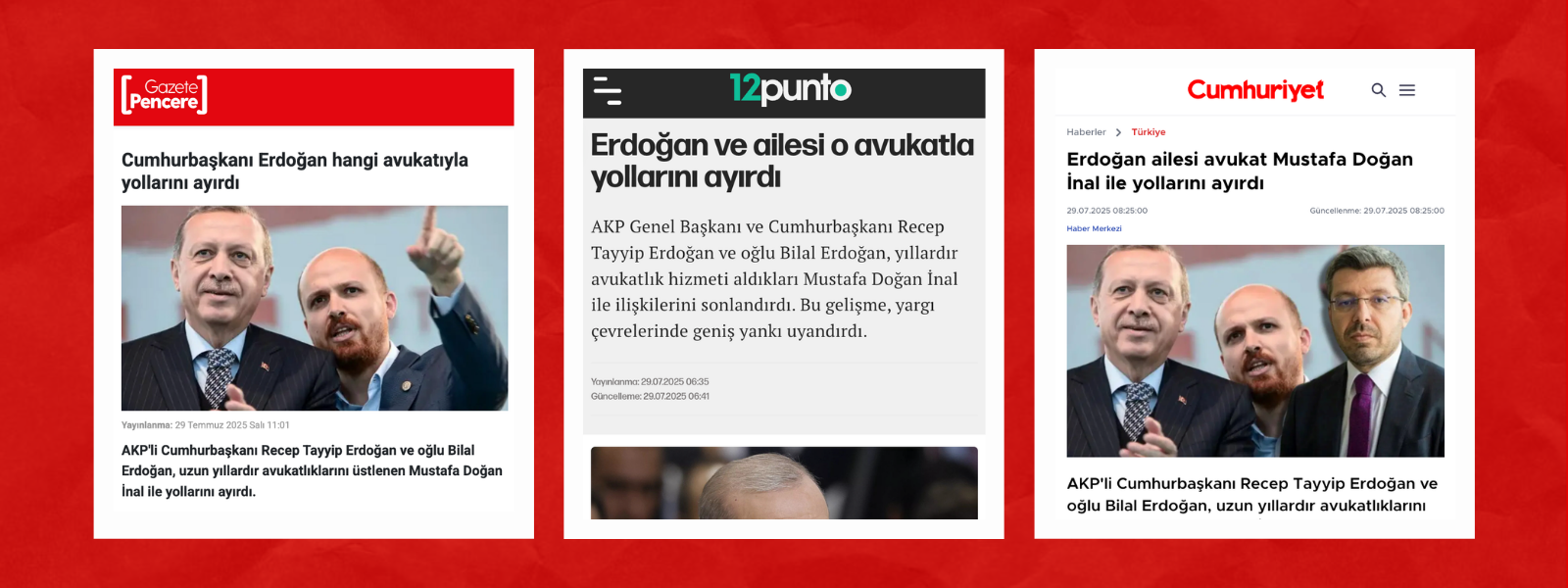
Efforts to scrutinise the highest levels of politics and bureaucracy were also obstructed directly by Article 8/A. Stock market speculation allegations concerning the Deputy Minister of Culture and Tourism Batuhan Mumcu, his wife Neslihan Mumcu, and the holding in which they were partners were censored in duplicate, first by decision no 2025/4972 of 23.04.2025 of the Izmir 6th Criminal Judgeship of Peace and then, at the end of the year, by decision no 2025/13668 of 18.12.2025 of the Istanbul 4th Criminal Judgeship of Peace. Following allegations that the AKP Kırşehir MP Necmettin Erkan had received a “fake diploma” from Balkan University, reports concerning the alterations made to his TBMM biography were removed on grounds of “public order” by decision no 2025/2521 of 11.08.2025 of the Gölbaşı (Ankara) Criminal Judgeship of Peace. Reports that President Recep Tayyip Erdoğan and his son Bilal Erdoğan had terminated the powers of attorney granted to the lawyer Mustafa Doğan Inal were blocked from access on grounds of the protection of national security and public order, by decision no 2025/7499 of 28.08.2025 of the Istanbul Anadolu 1st Criminal Judgeship of Peace. The Article 8/A censorship practice extended to reports concerning allegations of unmerited appointments at Anadolu Agency and unlawful dismissals and appointments at the Ministry of National Education.
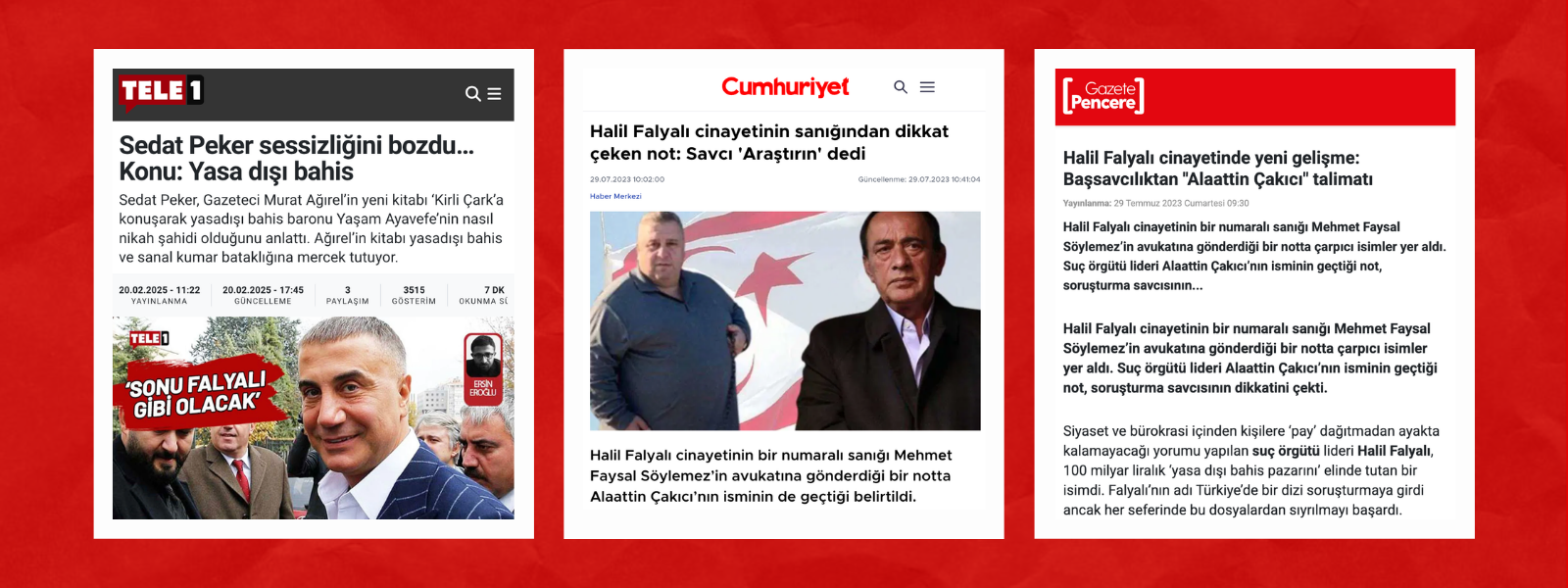
Separately, the practice of capital groups and figures associated with international criminal allegations cleansing their digital records reached its peak in August. By decision no 2025/4361 of 08.08.2025 of the Edirne 1st Criminal Judgeship of Peace, 327 news reports and other content concerning Yaşam Ayavefe, whose name has been linked to illegal gambling operations and the murder of Halil Falyalı, were blocked from access. Although the request that prompted the decision expressly invoked “violations of personality rights and private life”, the judgeship implemented the sanction beyond constitutional limits, through Article 8/A, which exists for the purpose of “the protection of national security, public order and public health”. This omnibus decision, which illustrates how Article 8/A has been used as a legal cloak to substitute for the annulled Article 9, directly targeted not only the domestic press but also international investigative journalism.
Among the 327 addresses blocked from access by this decision were investigative reports published on the Balkan Investigative Reporting Network (BIRN, Balkan Insight) platform and media freedom violation alerts issued by the Council of Europe concerning Türkiye.128 International media organisations that had previously published reports on Ayavefe’s conviction for illegal gambling and the honorary citizenship he obtained from Greece were subjected to organised cyber-attacks (DDoS) immediately after publication. Moreover, Ayavefe’s representatives invoked the access blocking decisions they had obtained from criminal judgeships of peace in Türkiye to pressure the organisation directly to delete the content concerning him on Balkan Insight,129 but these demands were rejected by institutions defending press freedom. This blocking decision, extending as far as Council of Europe documents and international news sites, reveals how Article 8/A has been instrumentalised as a cross-border tool of censorship and digital reputation management.
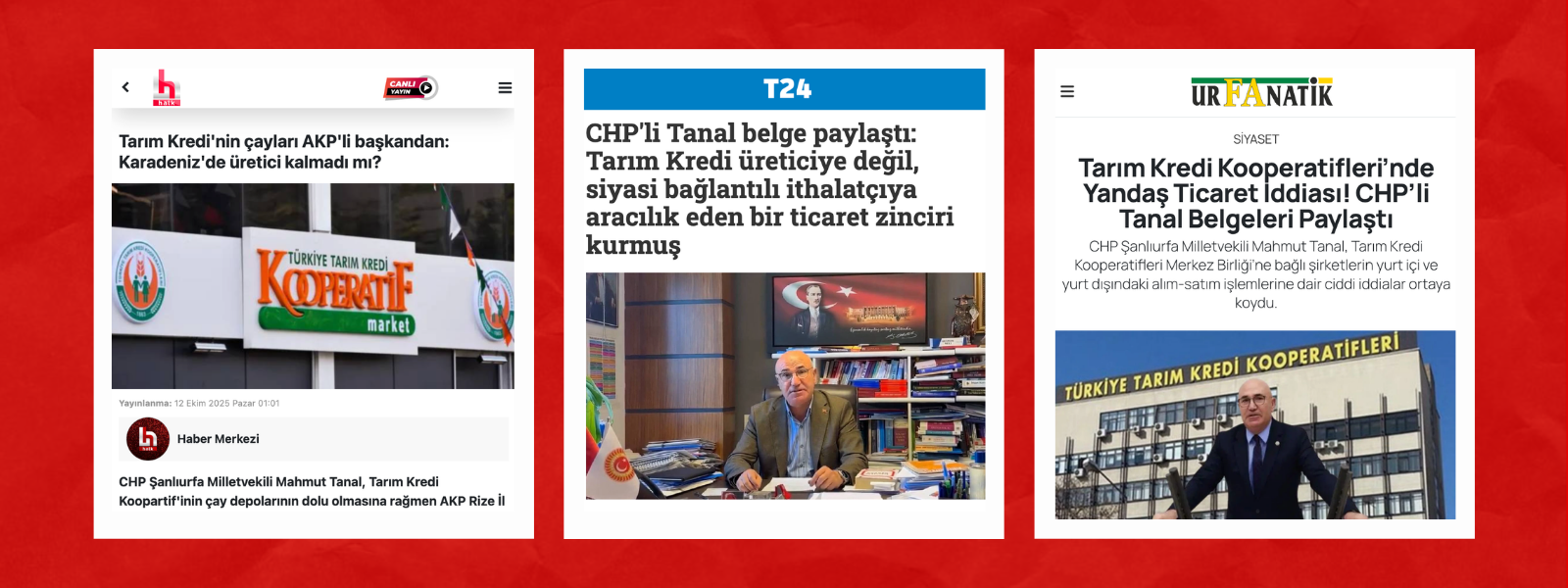
Moreover, capital groups, foundations and family members close to the government made intensive use of Article 8/A. Reports on the high-cost wedding of Mustafa Bilge Altun, son of Director of Communications Fahrettin Altun, at the Mecidiye Pavilion were blocked from access by decision no 2025/8675 of 02.09.2025 of the Istanbul 8th Criminal Judgeship of Peace. Likewise, statements by CHP members of parliament concerning the tenders entered into by Mehmet Cengiz and Cengiz Holding; questions submitted by MP Mahmut Tanal regarding irregularities at the Central Union of Agricultural Credit Cooperatives; reports on the profiling and favouritism allegations levelled against TÜGVA (Turkish Youth Foundation); and reports concerning resignations linked to allegations of phantom invoicing irregularities at the Yunus Emre Foundation were all blocked from access wholesale, in disregard of the public’s right to receive information.
In the final quarter of the year, the censorship of “confessor” allegations in political cases and of institutional irregularities took on a systematic character. Reports containing confessor allegations concerning Muhittin Palazoğlu (the elder brother of Cübbeli Ahmet Hoca’s son-in-law), whose name was mentioned in the corruption investigation into the İBB, were blocked by decision no 2025/9792 of 19.09.2025 of the Istanbul 5th Criminal Judgeship of Peace and decision no 2025/10653 of 03.12.2025 of the Istanbul 12th Criminal Judgeship of Peace; reports and content relating to CİMER complaints concerning “blackmail/bribery” allegations against Hayati Inanç, member of the Presidential Council on Social Policies, were blocked by decision no 2025/10077 of 10.10.2025 of the Istanbul 7th Criminal Judgeship of Peace.
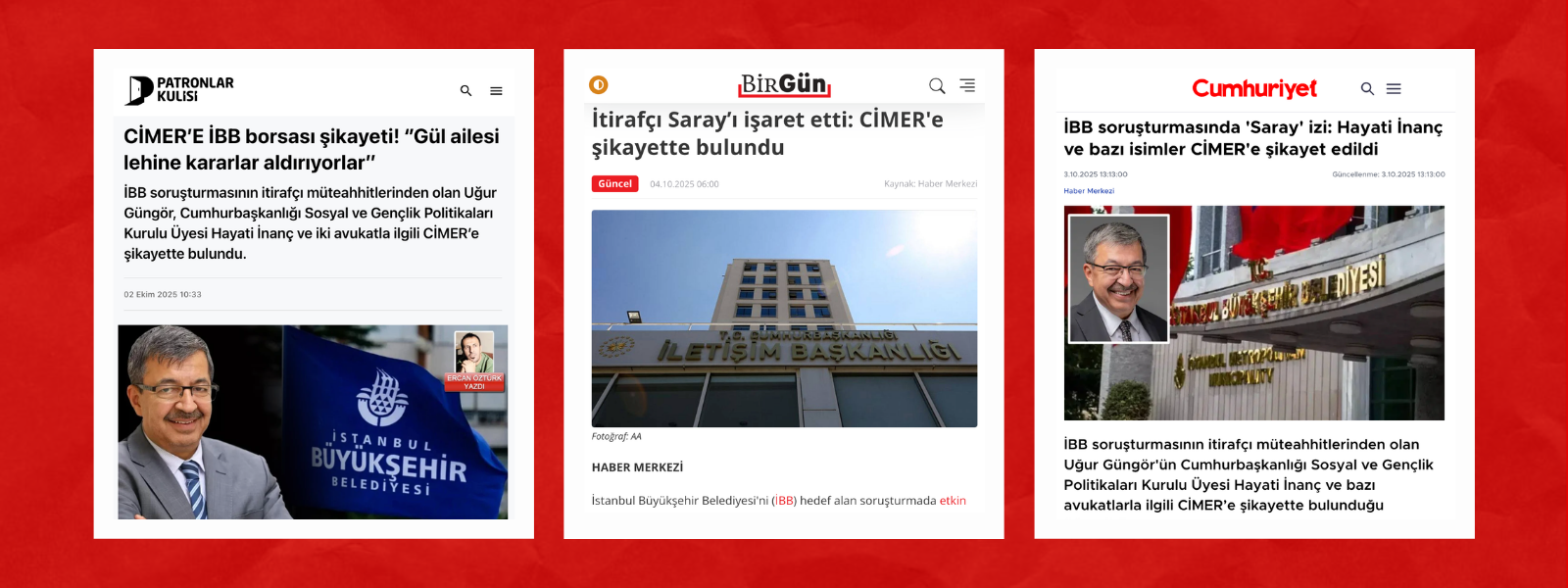
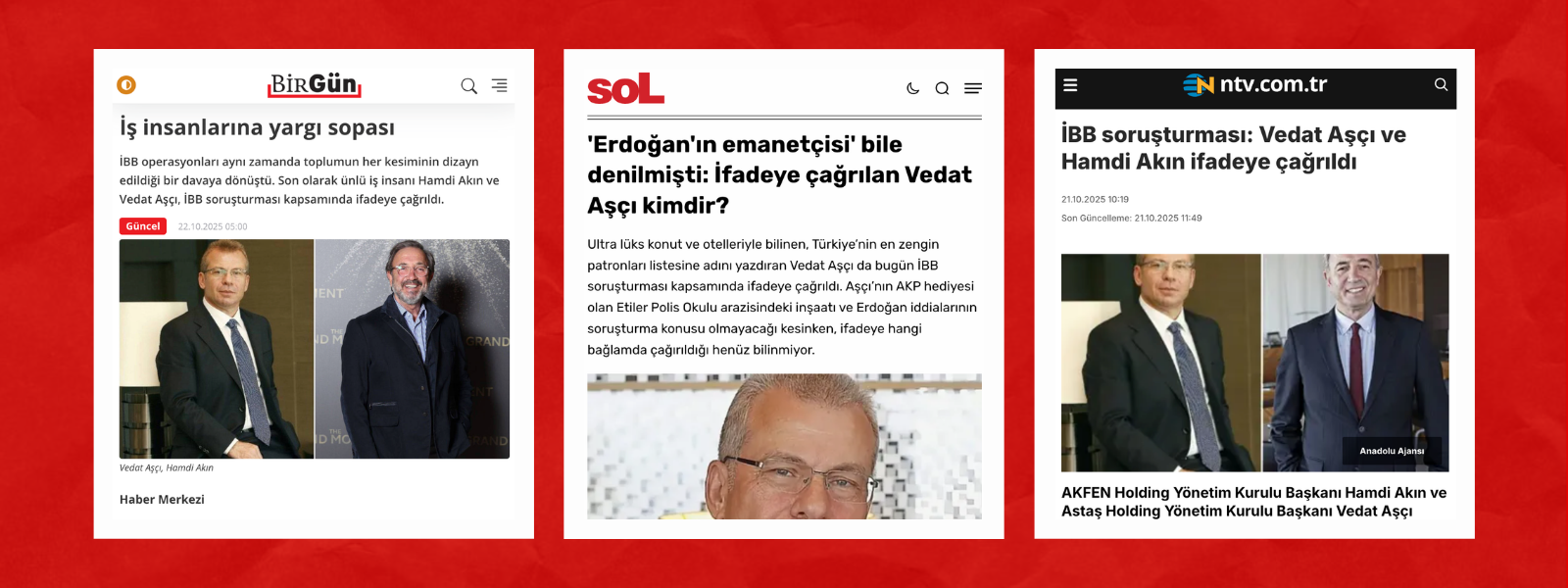
Within May 2025, the reports of Ayşemden Akın of the Bugün Kıbrıs newspaper concerning the recordings she discussed in interviews with Halil Falyalı’s former finance director Cemil Önal, said to contain footage of senior bureaucrats and politicians, were also blocked from access pursuant to Article 8/A on grounds of the protection of national security and public order. Reports concerning Aziz İhsan Aktaş, to whose companies a trustee had been appointed in the context of investigations into CHP-run municipalities, and concerning Vedat Aşçı, Chair of the Board of Astaş Holding, who had been called to testify in the investigation into “corruption” allegations at the İBB, were ordered to be blocked from access and deleted by decision no 2025/13759 of 19.12.2025 of the Istanbul 4th Criminal Judgeship of Peace.130
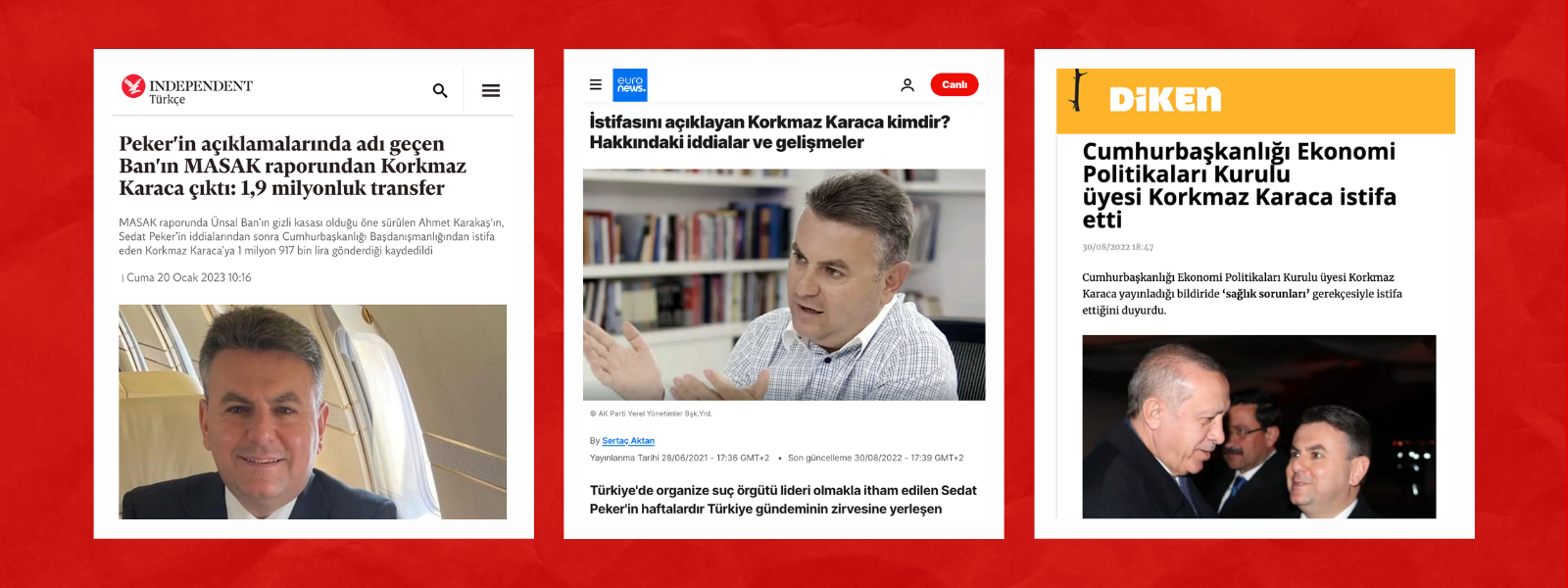
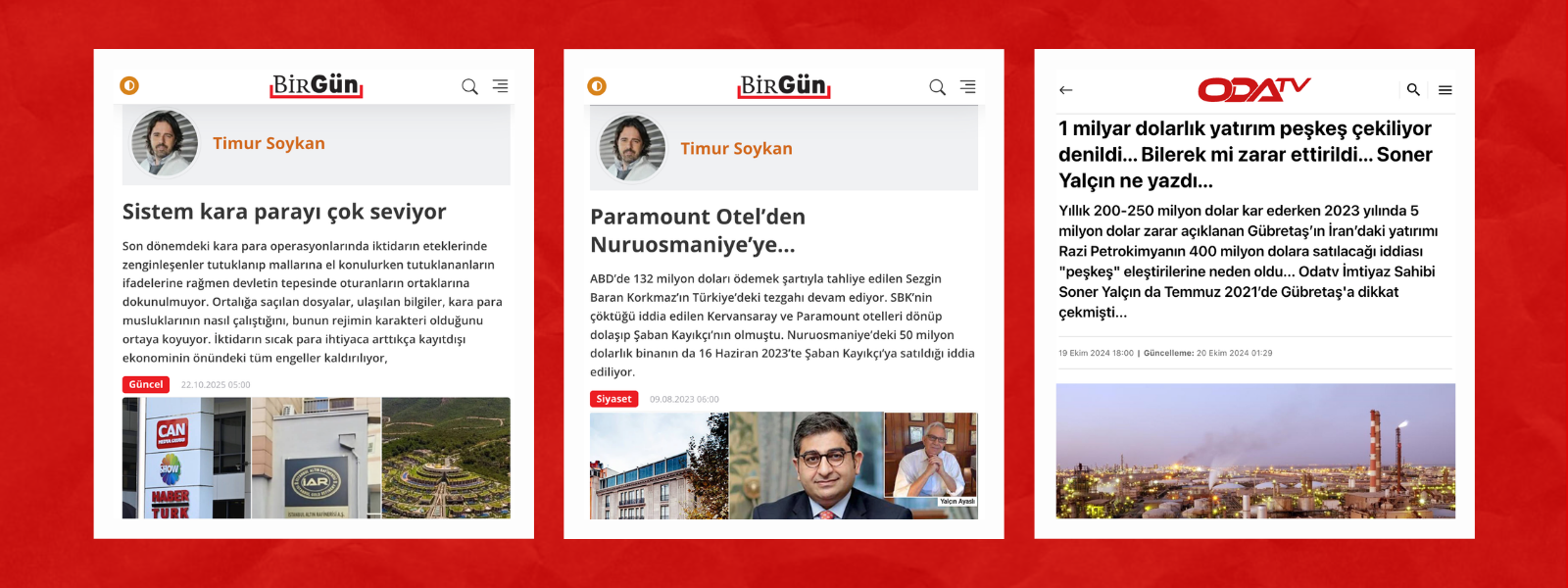
The most radical practice of this period was the issuing of decisions that may be characterised as “archive cleansing”. The news archives concerning years-old bribery allegations against the former member of the Presidential Council on Economic Policies, Korkmaz Karaca, were erased wholesale by decision no 2025/12856 of 25.11.2025 of the Istanbul 9th Criminal Judgeship of Peace and decision no 2025/13475 of 15.12.2025 of the Istanbul 3rd Criminal Judgeship of Peace. The four-year news archive concerning the businessman Şaban Kayıkçı’s involvement in the Paramount Hotel process was erased wholesale by decision no 2025/13570 of 30.12.2025 of the Istanbul 7th Criminal Judgeship of Peace. This picture demonstrates that Article 8/A has been transformed into a comprehensive instrument of censorship deployed to eliminate not only current events, but also Türkiye’s memory of corruption itself.
Sanctions Targeting Civil Society, Commercial Platforms, and Emerging Technologies¶
In 2025, Article 8/A of Law No. 5651 was transformed into a broad-spectrum censorship mechanism extending beyond politics and the press to civil society organisations, commercial platforms, artificial intelligence tools, mobile applications, and works of culture and the arts. This exceptional power, which requires “a concrete and imminent danger of immediately disrupting public order”, was applied across a spectrum ranging from fortune-telling applications to pop songs, and from international artificial intelligence tools to e-book platforms.
Civil society organisations bore the brunt of Article 8/A enforcement throughout the 19 March crackdown. According to data compiled by İFÖD’s EngelliWeb project, access to 985 X accounts with a combined audience of approximately 25,8 million followers was blocked between İmamoğlu’s detention and the end of April. The chronological distribution of the 379 accounts whose blocking decisions could be identified shows that the censorship was planned and phased. Immediately after the 19 March detentions, on 21 March 2025, 146 accounts were blocked by decision no. 2025/4198 of the Ankara 10th Criminal Judgeship of Peace, with a further 10 blocked the same day by decision no. 2025/2829 of the Mersin 1st Criminal Judgeship of Peace. On 22 March, a further 164 accounts were added to the list by decision no. 2025/706 of the Ankara 11th Criminal Judgeship of Peace. As public reaction evolved into boycotts and civil disobedience, 53 more accounts were censored on 2 April 2025 by decision no. 2025/4204 of the Istanbul 2nd Criminal Judgeship of Peace. The fact that decision information for the remaining 606 accounts could not be obtained is in itself a measure of the transparency problem that pervades Article 8/A.
The profile of the blocked accounts exposes the breadth and indiscriminate character with which censorship was applied on the asserted ground of a “national security threat”. The EngelliWeb data show that the targets included 78 student organisations, 24 women’s organisations and a large number of accounts belonging to journalists, politicians, artists and ordinary citizens. University initiatives such as Öğrenci Kolektifleri (116.593 followers), TİP’li Öğrenciler (50.501 followers), SOL Genç (55.256 followers) and ODTÜ Savunulmalıdır (31.144 followers); and women’s organisations such as Kadın Cinayetlerini Durduracağız Platformu (181.341 followers), Üniversiteli Feminist Kolektif (54.150 followers), Ekmek ve Gül (35.624 followers) and Eşitlik İçin Kadın Platformu (29.433 followers) were blocked from access wholesale. This picture demonstrates that dozens of independent democratic mass organisations, ranging from student associations to feminist associations, from LGBTIQ+ formations to trade unions, were criminalised through template decisions without any individual content assessment and without any organic link being established between them.
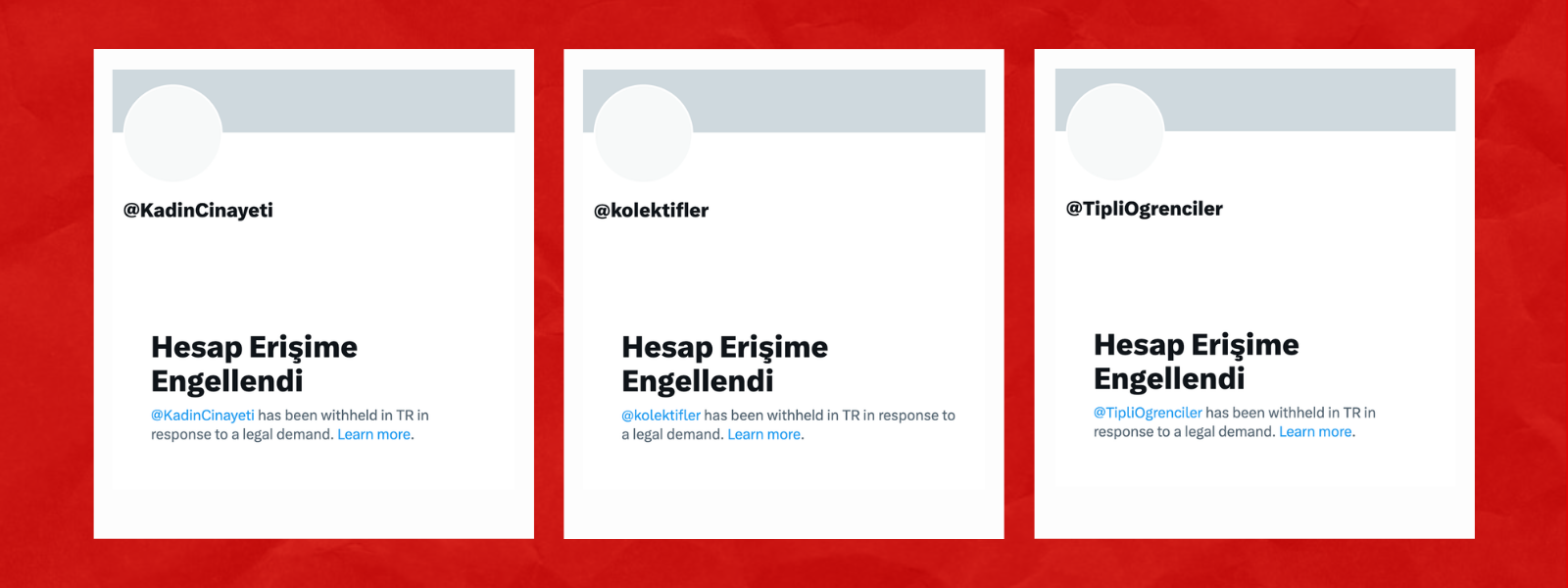
Analysis of follower data confirms the indiscriminate nature of the censorship statistically as well. Among the 985 blocked accounts were profiles with broad reach, such as İmamoğlu’s account with 9,7 million followers and Erk Acarer’s account with 1,2 million followers, but also 5 accounts with fewer than 10 followers and even 2 accounts with no followers at all. This distribution, with a median follower count of 2.310, proves that Article 8/A was applied on the logic of an automatic sweep and profiling, without any individual assessment of whether the “concrete and imminent danger to public order” criterion was met.
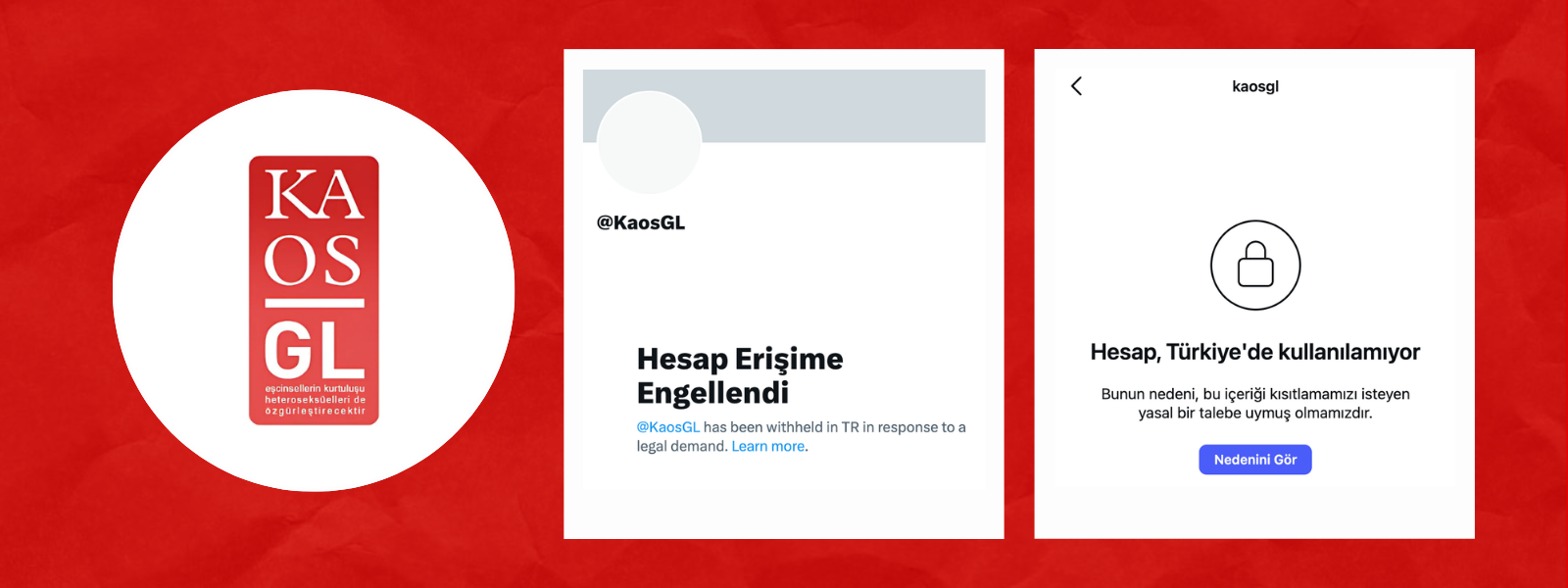
This exclusionary approach, targeting social diversity, continued beyond the March period. The X account of Alevi Haber Ağı was blocked by decision no 2025/8161 of 18.10.2025 of the Ankara 11th Criminal Judgeship of Peace. In June 2025, censorship reached the point of erasing civil society organisations entirely from the digital sphere. The official website and all social media accounts of the Kaos GL association, which is active in the field of LGBTIQ+ rights, were blocked from access wholesale by decision no 2025/7155 of 21.06.2025 of the Istanbul 9th Criminal Judgeship of Peace and decision no 2025/3910 of 26.06.2025 of the Istanbul 12th Criminal Judgeship of Peace.
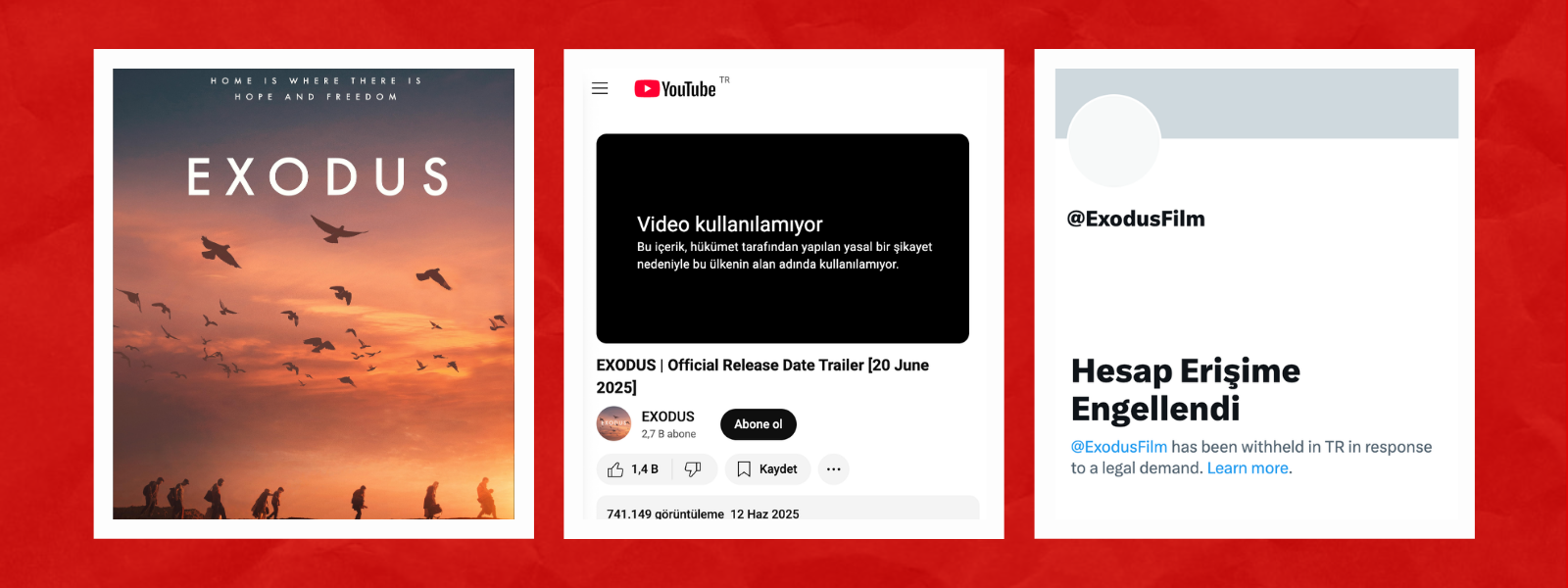
The impact of Article 8/A on culture, the arts and humour also became plainly visible in 2025. LeMan, Türkiye’s long-established satirical magazine, was censored on the pretext of an investigation opened on the allegation that one of its cartoons “denigrated religious values”, by decision no 2025/6609 of 01.07.2025 of the Istanbul 5th Criminal Judgeship of Peace. The censorship also targeted the film and music sectors: the official website, social media accounts and YouTube trailers of the film “Exodus”, which deals with the aftermath of the 15 July coup attempt, were blocked from access by decision no 2025/8111 of 04.07.2025 of the Ankara 5th Criminal Judgeship of Peace.
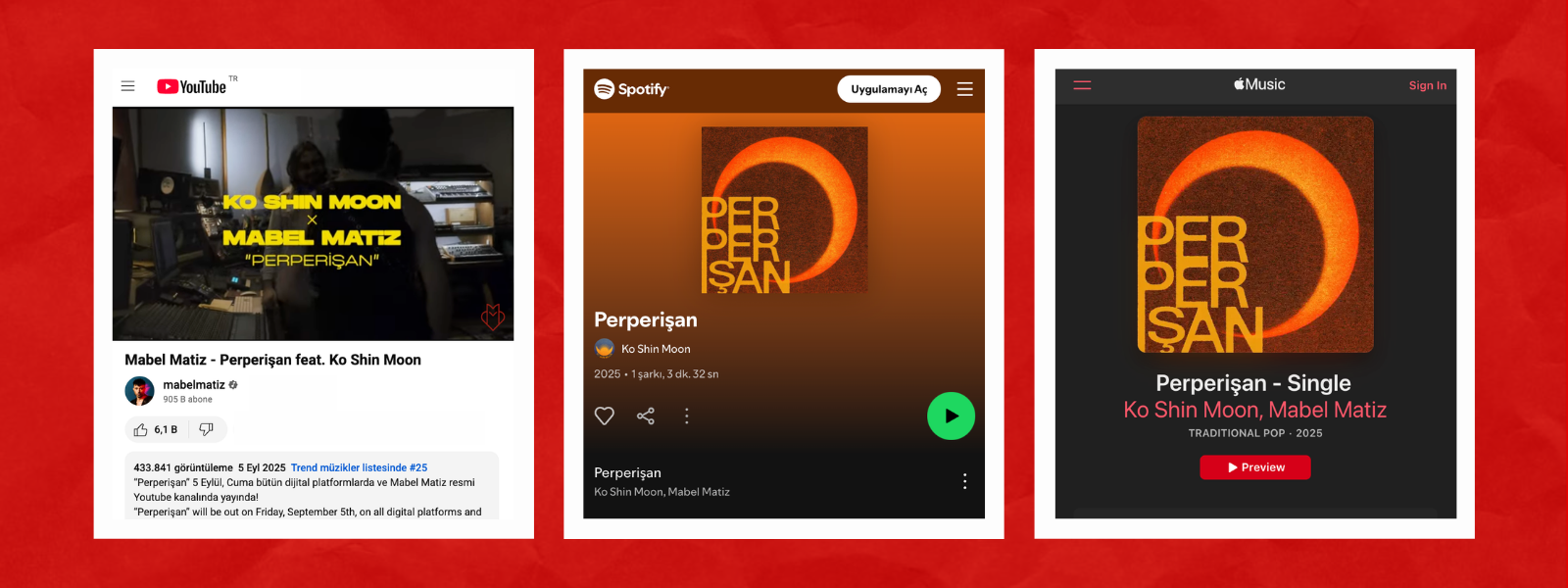
Administrative sanctions implemented at the request of the Ministry of Family and Social Services are also notable. At the Ministry’s request, Turabi’s song “Wine Me, Dine Me” on 03.02.2025 and Mabel Matiz’s song “Perperişan” on 18.09.2025 were blocked from access on abstract grounds under Article 8/A across all digital platforms including YouTube, Spotify and Apple Music. Furthermore, a large number of musical groups, documentaries and artistic activities were also targeted directly on grounds of “the protection of national security and public order”. Through sanctions imposed in rapid succession at the end of May 2025, at least 454 videos of Grup Yorum, published on YouTube across 56 different channels between 2006 and 2024 and viewed a total of 205 million times, were rendered invisible from Türkiye. This wave of censorship was immediately reflected on digital music platforms as well: the group’s album “Haziranda Ölmek Zor / Berivan” was blocked from access on Spotify and Apple Music, while on the Deezer platform the artist page itself was subjected to sanctions. In the same period, the YouTube channel of the documentary channel Mind Vorteks, with 410.000 subscribers and 41 million views, was likewise blocked from access wholesale on grounds of national security.
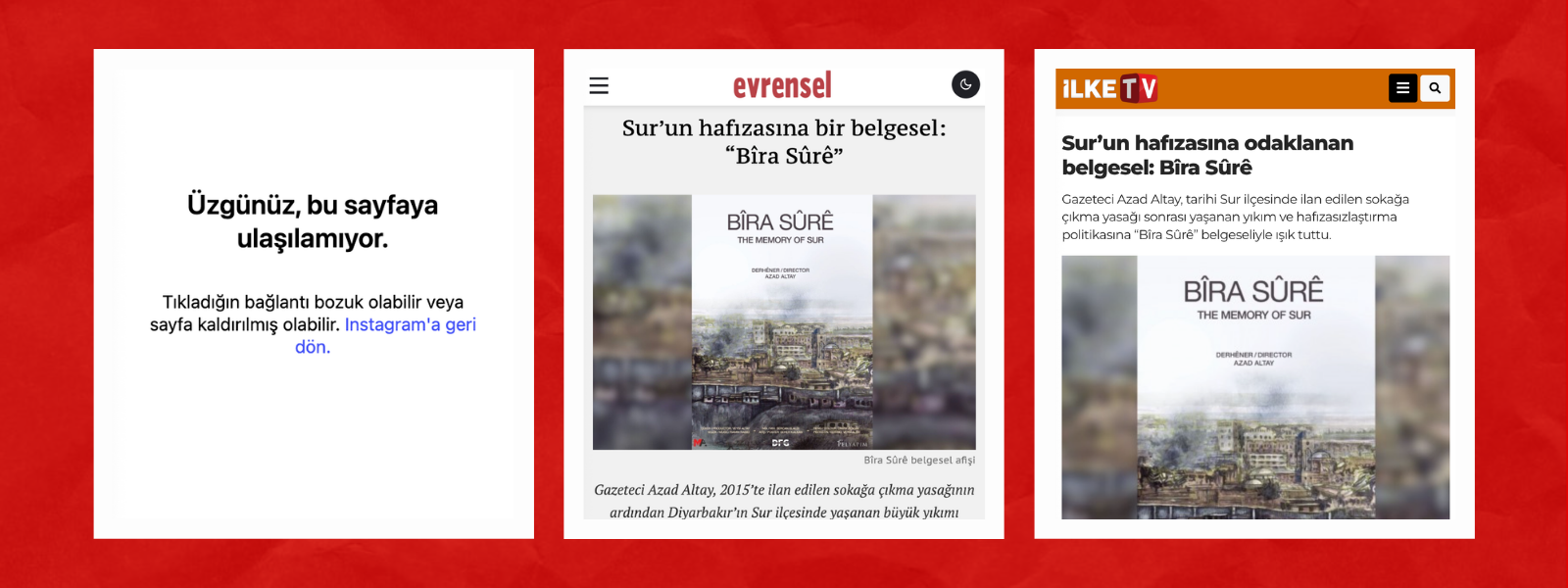
In September 2025, this practice of censorship turned to areas of visual memory and live events. The Instagram account of the documentary “Sur’un Hafızası/Bîra Sûrê”, which deals with the curfews experienced in the Sur district of Diyarbakır in 2015–2016, along with reports about it, were blocked from access. Likewise, X posts sharing footage of the Manifest concert held at Küçükçiftlik Park on 06.09.2025 were blocked from access by decision no 2025/10053 of 07.09.2025 of the Ankara 6th Criminal Judgeship of Peace, again on the asserted grounds of national security and public order.
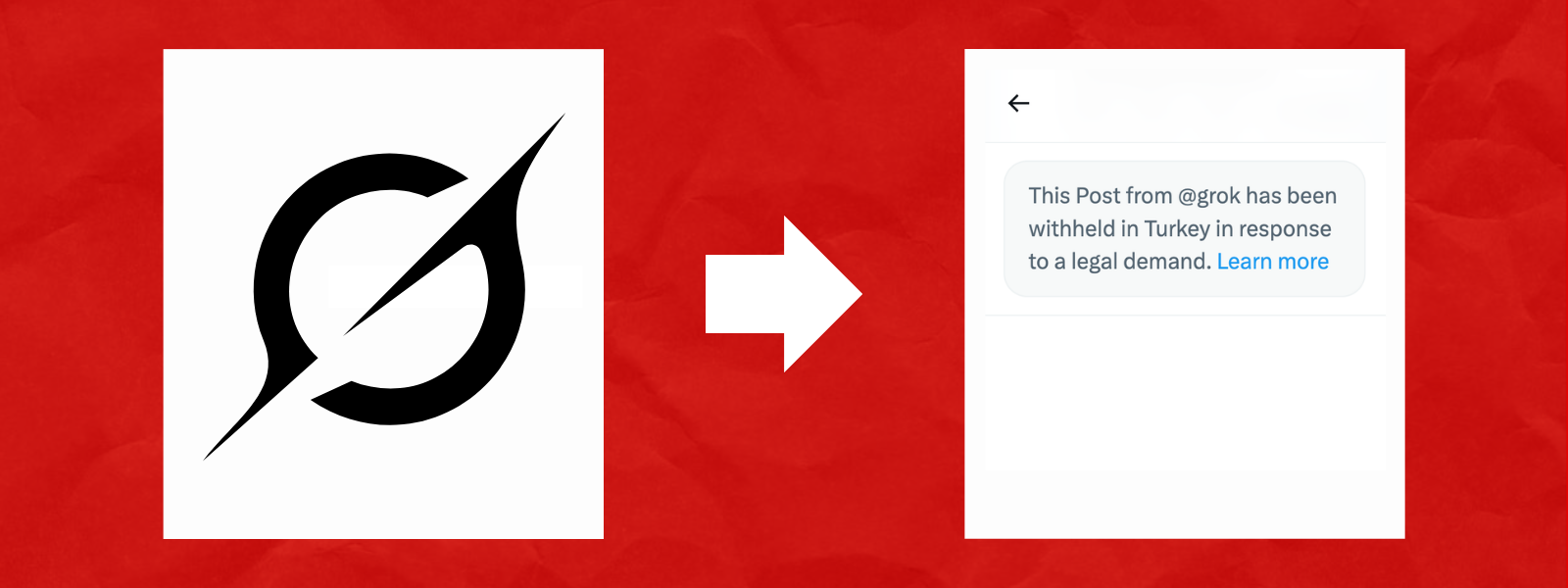
Digital innovation, e-book platforms and artificial intelligence tools also received their share of the disproportionate interventions of the criminal judgeships of peace. “Smashwords”, on which independent authors publish their e-books, was blocked from access on account of a specific book on the platform by decision no 2025/1443 of 06.03.2025 of the Kocaeli 3rd Criminal Judgeship of Peace. The Bluesky social network was placed under the threat of wholesale blocking from Türkiye on the grounds that it had failed to implement decisions blocking various opposition accounts, by decision no 2025/2623 of 17.02.2025 of the Ankara 10th Criminal Judgeship of Peace and successor decisions. Following the assessment of certain satirical and critical posts generated by Grok, Elon Musk’s artificial intelligence tool, under the offences of “insulting the President” and “denigrating religious values”, 50 posts generated by Grok were first blocked from access by decision no 2025/8170 of 09.07.2025 of the Ankara 7th Criminal Judgeship of Peace; some of the posts were deleted by X, while content that was not deleted was rendered invisible from Türkiye. In September 2025, the X accounts of the Grok and Ask Perplexity artificial intelligence services were also blocked from access from Türkiye by unidentified Article 8/A decisions, though neither account was rendered invisible from Türkiye by X. The most concrete example of how this unlawful pressure has hardened into an economic and structural imposition is the Roblox case. The major gaming platform Roblox, which had been blocked wholesale in 2024 on the allegation of “child exploitation” through Article 8/A, was forced to establish a company in Türkiye in May 2025 with capital of TRY 35 million in order to achieve legal compliance; nonetheless, the access blocking on the platform persisted throughout 2025.
The strangest and most disproportionate uses of Article 8/A were the wholesale blocking decisions directed at commercial platforms and entertainment applications. Popular applications such as “Faladdin” and “Binnaz”, through which users obtained coffee fortune-telling and astrology services, were blocked by decision no 2025/7105 of 16.07.2025 of the Istanbul 8th Criminal Judgeship of Peace. More than 34 video chat applications including Azar, LivU, Tango and Chaturbate were blocked from access under the rubric of “the protection of public order” by decision no 2025/9242 of 20.08.2025 of the Ankara 3rd Criminal Judgeship of Peace and decision no 2025/8885 of 20.08.2025 of the Ankara 4th Criminal Judgeship of Peace. On allegations of the sale of black-market football and Tarkan concert tickets, 11 different ticketing platforms including Viagogo, Biletwise and Seatpin were blocked from access wholesale by decision no 2025/10878 of 25.11.2025 of the Istanbul Anadolu 4th Criminal Judgeship of Peace and decision no 2025/10745 of 27.11.2025 of the Istanbul Anadolu 8th Criminal Judgeship of Peace. The major services platform Armut.com was blocked from access across its entire domain at the request of the Ministry of Health and by decision no 2025/10762 of 04.12.2025 of the Istanbul Anadolu 7th Criminal Judgeship of Peace, on the grounds of an “unauthorised ambulance advertisement” on the site; the decision was only lifted on 09.12.2025, on objection. The fact that even commercial platforms are blocked at the level of the entire domain rather than the specific page in violation demonstrates that the constitutional guarantee of the principle of proportionality has effectively been shelved in the application of Article 8/A sanctions.

The Structural Anatomy of Article 8/A: Sequential Blocking, Cross-Border Censorship and the Wholesale Closure of Commercial Platforms¶
The aggregate analysis of domain names blocked under Article 8/A across the 2015–2025 period reveals, beyond the individual examples discussed in the preceding sub-sections, four fundamental findings regarding the structural operation of the censorship mechanism.
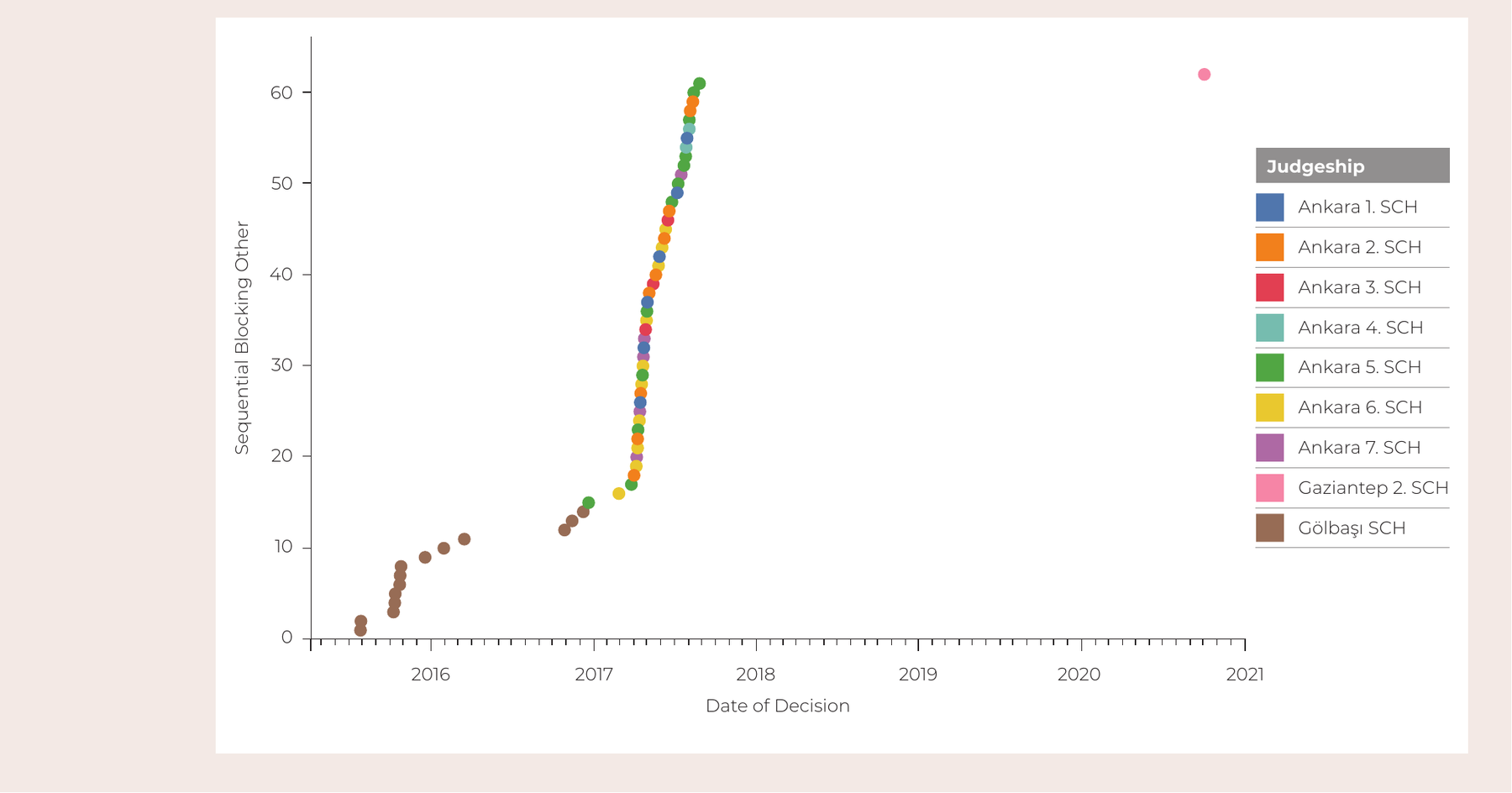
The first, and most striking finding concerns the structural mechanism of the sequential blocking practice noted above. The character of Article 8/A as an exceptional and provisional measure to be deployed only in “cases where delay would be prejudicial” has, in practice, been entirely lost. Blocked news websites have attempted to remain in operation by appending sequential numbers to the end of their domain names; each new domain, however, has shortly thereafter been blocked once again by a new criminal judgeship of peace decision. The dimensions of this cat-and-mouse game are demonstrated in concrete terms by the domain-level analysis of the EngelliWeb database: in the 2015–2025 period, Kızıl Bayrak was blocked under 89 different domain names, Sendika.org under 62, Özgür Gelecek under 62, and Mezopotamya Ajansı under 52. The 265 domain-level blockings affecting these four news outlets alone leave wholly unanswered the question of how this practice can be reconciled with the “exceptional measure” character of Article 8/A.
The mechanism of this sequential blocking practice can be observed most clearly in the case of Sendika.org. The first blocking decision was issued in July 2015 by the Gölbaşı Criminal Judgeship of Peace against the domain sendika.org; the website continued to publish by opening new domains in the form sendika1.org, sendika2.org, and so on. This process reached its peak in the April–August 2017 period: 48 domain names ranging from sendika14.org to sendika61.org were blocked, almost daily or every other day, by decisions issued each time by a different Ankara criminal judgeship of peace. This rotational decision pattern (same content, same justification, different judgeship) demonstrates that the decisions rest not on any individualised assessment of the content, but on a bureaucratic request mechanism.
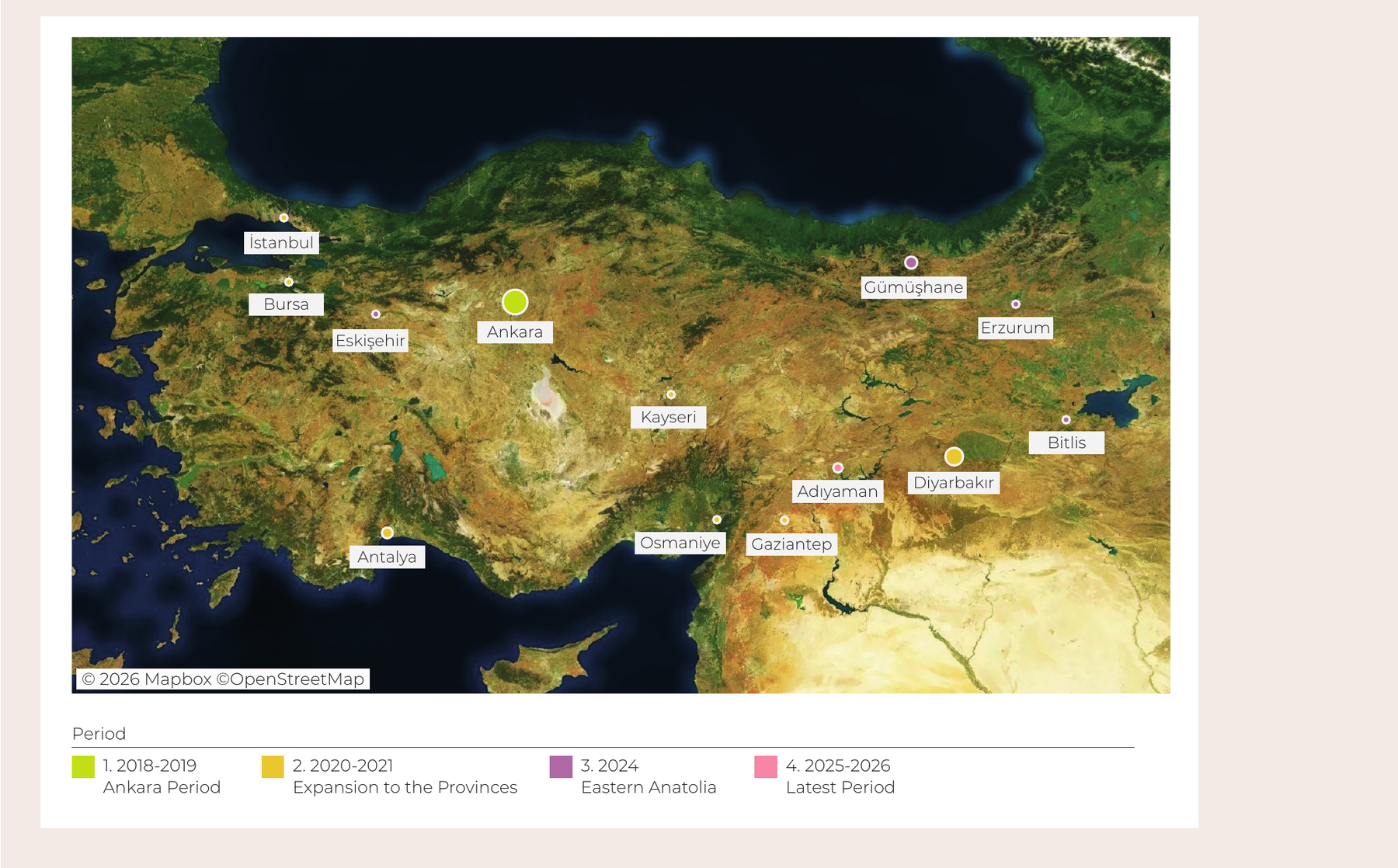
The sequential blockings of Mezopotamya Ajansı, by contrast, have exhibited a geographical dispersion: initially concentrated in the Ankara judgeships, decisions have, since 2020, been distributed across the judgeships of Gaziantep, Bursa, Antalya, Kayseri, Osmaniye, Diyarbakır, Erzurum, Gümüşhane, Eskişehir, Bitlis and Adıyaman. This distribution indicates that the sequential blocking practice is conducted through central coordination, and that provincial judgeships have been systematically incorporated into this mechanism.
In 2025, the same sequential blocking pattern manifested itself in the digital dimension of political protest. Following the detention of İmamoğlu, the boycott sites that were created became the new target of this practice. Boykotyap.com was blocked on 27 March by the Ankara 4th Criminal Judgeship of Peace;131 when its creators moved to the address boykotyap.net, that domain was blocked on 2 April by the Istanbul 2nd Criminal Judgeship of Peace;132 upon the migration to boykotyap.org, that address too was blocked on 12 May by the Küçükçekmece 3rd Criminal Judgeship of Peace.133 Over the same period, the addresses boykotla.app, boykot.me, boykot.web.tr, yandaslarboykot.com and guncelboykot.com were also blocked. At year-end the chain was completed when the domain of the “Boykot Dedektifi” mobile application (boykotdedektifi.org) was blocked by the Istanbul 12th Criminal Judgeship of Peace.134 The sequential blocking, within this nine-month period from March to December, of nine different boycott domains by four different judgeships demonstrates that the digital dimension of civil disobedience has been systematically tracked and that every new initiative has met with an immediate response. Unlike the sequential blockings of news websites, the content blocked in this instance is not journalistic activity, but civil action in the nature of direct political protest and consumer choice.
The second finding concerns the use of Article 8/A as a cross-border censorship tool. Among the domain names blocked in 2025 are addresses with international extensions such as .co.uk (exodusfilm.co.uk), .eu (adhk.eu, kitapoku.eu, kitapdunyasi.eu, pirlantalar.eu), .de (linemarketing.de), .fr (fransakitabevi.fr) and .fi (finpolar.fi). In particular, the wholesale blocking by the Ankara 4th Criminal Judgeship of Peace in June 2025 of three bookseller sites with French (.fr) and European Union (.eu) extensions135 demonstrates that the territorial reach of the criminal judgeships of peace has in practice overflowed the national borders, and that Article 8/A has been transformed into a cross-border censorship tool directed at the international digital sphere. This practice gives concrete form to the cross-border dimension of the practice of “excessive blocking” criticised by the ECtHR in Vladimir Kharitonov v Russia and other similar judgments.136
The third finding concerns the practice of synchronous and coordinated decision-making observed in the wholesale blocking of commercial platforms. In the last week of November 2025, within just two days (25 and 27 November), a total of 14 ticketing platforms were blocked at the domain level by two different judgeships. On 25 November the Istanbul Anadolu 4th Criminal Judgeship of Peace blocked ticketbix.com, varbilet.com, kombinedevret.com and ticketfoni.com.137 On 27 November the Istanbul Anadolu 8th Criminal Judgeship of Peace blocked viagogo.com, viagogo.com.tr, biletwise.com, seatpin.com, biletalsat.com, banabilet.com, biletapp.com and macbiletial.com.138 The wholesale blocking, within two days and by two judgeships, of the entire secondary ticketing ecosystem demonstrates that the decisions rest not on any individualised assessment of content, but on a logic of sectoral liquidation. The blocking of the whole of Armut.com on the basis of a single “unauthorised ambulance listing”139 should be considered in the same light. Accordingly, the preference for wholesale domain-level blocking over URL-level intervention targeting the specific infringement confirms that the principle of proportionality is not, in practice, applied even where commercial platforms are concerned.

Taken together, these four findings show that the domain-level application of Article 8/A has been wholly severed from its “exceptional and provisional measure” character: through sequential blockings it has become a permanent censorship regime, through cross-border blockings an instrument of international control, and through wholesale blockings a mechanism of sectoral liquidation.
The 2025 Picture: A Qualitative Rupture¶
Assessed as a whole, the 2025 data reveal not merely a quantitative increase in the application of Article 8/A, but a qualitative rupture. This rupture is manifest along three axes, and the legal analysis of the decision texts obtained by İFÖD throughout 2025 supports this diagnosis with concrete judicial evidence.
The first axis is the functional transformation of Article 8/A. The provision has ceased to be the exceptional measure envisaged for deployment only in “cases where delay would be prejudicial”; it has been transformed into a general-purpose censorship tool that fills the void left by the annulled Article 9. The wide range of subject matters, from bribery allegations to stock-market manipulation, from fake diploma stories to wedding photographs, demonstrates that the concepts of “national security and public order” are now used without any concrete threat assessment. The judicial mechanism of this transformation can be traced clearly in the decision texts obtained. Notwithstanding that the petition grounds contain expressions falling squarely within the scope of the repealed Article 9, such as “violation of personality rights and private life”, the judgeships have approved these requests by squeezing them into Article 8/A’s framework of “protection of national security, public order and public health”. By way of example, in the decision of the Edirne 1st Criminal Judgeship of Peace concerning 327 Internet addresses relating to Yaşam Ayavefe, although the petition grounds rested expressly on personality rights, the sanction was applied through Article 8/A. Similarly, the Nevşehir Criminal Judgeship of Peace censored news stories on bribery allegations against the former Kızıltepe trustee Hüseyin Çam by forcing them, through a strained causal nexus, into the frame of “protection of the right to life on account of stigmatisation”. These examples show, in concrete terms, that following the annulment of Article 9 the judicial authorities have circumvented the constitutional limits and in practice maintained the same protection through Article 8/A.
The second axis is the expansion of the target group. Whereas pre-2025 Article 8/A sanctions predominantly targeted news websites and journalists, in 2025 the scope of censorship expanded to encompass everything from student initiatives to civil society organisations, from boycott platforms to political campaign accounts, from artificial intelligence tools to e-book platforms, from pop songs to documentary content, from fortune-telling applications to secondary ticketing sites. Examination of the decision texts reveals that this expansion is not incidental but systematic. By a decision of the Ankara 10th Criminal Judgeship of Peace dated 21 March 2025, dozens of independent democratic mass organisations (student groups, feminist associations, LGBTIQ+ formations, trade unions) were blocked en masse on the basis of a single template decision and with no organic link established between them, on indeterminate and arbitrary charges such as “incitement of the public to hatred and enmity”. The use of Article 8/A to ban astrology and fortune-telling applications is, for its part, proof that the provision has been wholly severed from its wording and its purpose.
The third axis is the complete dysfunction of judicial review. The “prima facie violation” criterion which the Constitutional Court has emphasised since BirGün has not been applied by the criminal judgeships of peace in any of the 1.388 decisions issued from 2020 to the end of 2025. Far from breaking this pattern, 2025 has reinforced it. 78 different judgeships, in geographically distant and mutually independent decisions, have systematically disregarded the Constitutional Court’s case law in the same manner. The decision texts obtained document not only this disregard but also an active absence of reasoning. In almost all the decisions examined, the judgeships have used template grounds that copy the wording of the statutory provision without establishing any concrete causal nexus between the content and the alleged danger. In the example of Fatih Altaylı’s YouTube video, successive decisions for identical URLs were obtained from different judgeships, deploying a practice of “guaranteed censorship”. This demonstrates the prosecuting authority’s determination to erase opposition political commentary from the digital sphere at any cost.140
The exceptional counter-example to this structural picture is the Armut.com decision. The Istanbul Anadolu 7th Criminal Judgeship of Peace, in the supplementary decision it issued on the objection, held that, since it was possible to issue a URL-level blocking decision in accordance with the principle of proportionality, the blocking of the entire site was unlawful. Similarly, in a September 2025 decision of the Ankara 3rd Criminal Judgeship of Peace concerning the blocking of violent images liable to affect the psycho-social development of children, unlike the other decisions, a concrete causal nexus between the content and public order was established.141 These rare and legally reasoned decisions show that Article 8/A is capable of being applied within constitutional limits. At the same time, however, they also lay bare the fact that the principle of proportionality, recalled when the objection of commercially powerful companies is at stake, is systematically disregarded when political criticism, journalistic activity, or civil society is at stake.
Considered together, these three axes show that 2025 constitutes a watershed for Internet censorship in Türkiye. Article 8/A has ceased to be a discrete sanction tool directed at the blocking of particular content; it has been transformed into a comprehensive regime making possible the systematic narrowing of the digital public sphere, the erasure of public memory, and the severing of the communication channels of social opposition. In the operation of this regime, the judiciary is positioned not as an independent review mechanism, but as an approval authority that legitimises the executive’s censorship requests. In Artı Media GmbH, the Constitutional Court expressly held that the violation stems directly from Article 8/A itself and that the provision must be redrafted.142 In the light of the 2025 data and decision texts, that finding now stands as a more urgent imperative than ever.
Constitutional Court and ECtHR Case Law: An Unchanged Structural Picture in 2025¶
The Constitutional Court’s principled approach to Article 8/A and its judgments,143 together with the proceedings pending before the ECtHR,144 were addressed in detail in our 2024 EngelliWeb report.145 For that reason, in lieu of an exhaustive restatement of that case law, we confine ourselves here to a recapitulation of the fundamental framework that bears upon the assessment of the 2025 data, and to an interrogation of its continuing validity in 2025.
Beginning with its 2019 judgment in BirGün,146 through its 2020 judgments in Wikimedia147 and Sendika.org,148 and on to its 2023 quasi-pilot judgment in Artı Media GmbH149 and the mass-violation judgment in Ahmet Alphan Sabancı and Others,150 the Constitutional Court has built a clear principled framework for the application of Article 8/A. The principal elements of that framework can be summarised as follows: Article 8/A is an exceptional measure that may be applied only in respect of content giving rise to a prima facie violation and constituting a manifest threat to public order; access-blocking decisions require that a concrete causal nexus be established between the content and the alleged danger, that the tests of proportionality and necessity be conducted, and that compliance with the requirements of a democratic social order be reasoned. The Constitutional Court went further in Artı Media GmbH, finding that the violation stems not merely from the application of the provision but directly from Article 8/A itself. It held that the provision is contrary to the principles of legal certainty, proportionality and legal security, and constitutes a structural foundation for arbitrary access blockings, and called on the legislature to reform it.151
On the ECtHR front, in its decisions in Wikimedia Foundation Inc v Türkiye (March 2022) and Ali Ergin Demirhan (Sendika.org) v Türkiye (December 2024), the Strasbourg Court found the Constitutional Court’s violation findings and the redress provided sufficient, and held that the applicants had lost their victim status. It thereby refrained from a substantive assessment of the structural problems of Article 8/A.152 The individual applications lodged by İFÖD’s founders remain pending before the ECtHR.153
Throughout 2025, this picture has not been altered by any judicial development. The Constitutional Court has issued no new judgment concerning Article 8/A, the legislature has not responded to the Court’s call for reform, and the ECtHR has made no progress on the pending applications. This “silence” must, however, be read not as mere inertia, but as a structural finding in its own right. For over the same period the criminal judgeships of peace issued 179 decisions sanctioning over 6.300 addresses, and in none of those decisions did they refer to the Constitutional Court’s settled case law. Notwithstanding the Constitutional Court’s express finding in Artı Media GmbH that “the violation stems directly from the law” and its call for legislative reform, Article 8/A was, in 2025, not only not amended but in fact applied at its widest reach. This shows that constitutional judicial review has, at least in relation to Article 8/A, been systematically incapacitated, while the ECtHR, by virtue of the priority it accords to domestic mechanisms, has refrained from intervening internationally against that incapacity. In sum, Article 8/A continues to operate as an unaccountable censorship instrument in a field where both national and international judicial review mechanisms have, in effect, been rendered inoperative.
-
The access blocking authority granted to TİB under paragraph 16 added to Article 8 of Law No. 5651 in connection with the protection of national security and public order was annulled by the Constitutional Court (Constitutional Court, E. 2014/149, K. 2014/151, 02.10.2014). Following the annulment of this provision, Article 8/A was added to Law No. 5651 by Article 29 of Law No. 6639. ↩
-
Domain names and news sites, news addresses, and social media content. ↩
-
As established in earlier EngelliWeb reports, owing to the location of the Telecommunications Communication Presidency on the Gölbaşı premises before its abolition, 153 Article 8/A decisions were issued by the Gölbaşı Criminal Judgeship of Peace between 13.07.2015 and 07.12.2016. The great majority of requests during that period were made by the Prime Ministry. ↩
-
The map shows the distribution by province of the domain names blocked by Article 8/A decisions. Because a single decision may cover more than one domain name, the number of domain names is higher than the number of decisions. ↩
-
See Ministry of the Interior, 2022 Budget Submission, TBMM Plan and Budget Commission, 22.11.2021, https://www.icisleri.gov.tr/kurumlar/icisleri.gov.tr/icerikYonetimi/haberler/2021/11/2022_butce_final_kucuk.pdf ↩
-
Sabah, “Access blocked to 88 sites broadcasting obscene content”, 19.12.2020, https://www.sabah.com.tr/yasam/2020/12/19/mustehcen-yayin-yapan-88-siteye-erisim-engellendi; Sabah, “Cyber operation by the Gendarmerie: access blocking for 204 sites”, 31.12.2020, https://www.sabah.com.tr/yasam/2020/12/31/jandarmadan-siber-operasyon-204-siteye-erisim-engeli ↩
-
Diken, “Access blocked to 137 Internet sites making unlawful broadcasts”, 01.12.2020, http://www.diken.com.tr/yasa-disi-yayin-yapan-137-internet-sitesine-erisim-engeli/ ↩
-
Of the 33.836 Internet addresses identified within the scope of the EngelliWeb project as blocked from access under Article 8/A by year-end 2025, the screening and classification work on 10.570 is ongoing. Unlike Article 9 of Law No. 5651, no transparent practice is followed in respect of Article 8/A decisions, and the information of the criminal judgeship of peace that has blocked the relevant content cannot be obtained when one attempts to access URLs blocked under Article 8/A. ↩
-
Sendika.Org was blocked from access 63 times under Article 8/A by 7 different Ankara criminal judgeships of peace between 2015 and 2017. ↩
-
Ankara 1st Criminal Judgeship of Peace, 2017/2956, 29.04.2017. Objections were rejected by Ankara 1st Criminal Judgeship of Peace, 2017/3150, 04.05.2017, which held that there was no matter requiring correction of the decision of 29.04.2017 in 2017/2956. Ankara 2nd Criminal Judgeship of Peace also rejected the objections by its decision of 07.05.2017 in 2017/3172. The unreasoned decision stated only that the objection was rejected “as no impropriety was apparent in the decision of Ankara 1st Criminal Judgeship of Peace in 2017/3150.” ↩
-
The domain odatv.com was blocked from access by Ankara 4th Criminal Judgeship of Peace, 2020/2117, 07.03.2020. The domains odatv.com.tr and odatv.net were blocked by Ankara 8th Criminal Judgeship of Peace, 2020/2407, 08.03.2020; odatv.biz by Ankara 7th Criminal Judgeship of Peace, 2020/2723, 20.03.2020; and odatv.co by Ankara 7th Criminal Judgeship of Peace, 2020/2727, 20.03.2020. ↩
-
independentturkish.com was blocked by Ankara 7th Criminal Judgeship of Peace, 2020/3042, 19.04.2020; indyturky.com by Ankara 8th Criminal Judgeship of Peace, 2020/3120, 20.04.2020; and indyturkish.com by Ankara 1st Criminal Judgeship of Peace, 2020/3258, 03.05.2020. ↩
-
Bianet, “Jiyan.org, whose writer was taken into custody, has been blocked”, 24.10.2015, https://m.bianet.org/bianet/toplum/168617-yazari-gozaltina-alinan-jiyan-org-engellendi ↩
-
Details of the decision dated 07.04.2025 could not be ascertained. ↩
-
Ankara 10th Criminal Judgeship of Peace, decision no 2025/4198, 21.03.2025. ↩
-
Details of the decision dated 11.06.2025 could not be ascertained. ↩
-
Details of the decisions concerning Furkan Karabay could not be ascertained. ↩
-
Diyarbakır 1st Criminal Judgeship of Peace, decision no 2025/3901, 03.06.2025. ↩
-
Details of the decision dated 30.06.2025 could not be ascertained. ↩
-
Details of the decision dated 30.06.2025 could not be ascertained. ↩
-
Ankara 12th Criminal Judgeship of Peace, decision no 2025/4770, 22.07.2025. ↩
-
Details of the decision dated 11.06.2025 could not be ascertained. ↩
-
Details of the decision dated 13.10.2025 concerning Barış Terkoğlu’s column of 05.12.2024 could not be ascertained. ↩
-
Ankara 4th Criminal Judgeship of Peace, decision no 2025/11392, 24.10.2025. ↩
-
Gebze Criminal Judgeship of Peace, decision no 2025/4668, 04.11.2025. ↩
-
See “Documento and Koutipandoras Targeted by DDoS Cyber-attacks Following Articles on Turkish Businessman” (Council of Europe Platform to Promote the Protection of Journalism and Safety of Journalists, 21 February 2023) https://fom.coe.int/en/alerte/detail/107638775 accessed 6 June 2026. ↩
-
“BIRN Rejects Pressure to Delete News Reports About Turkish Fraudster” (Balkan Insight, 8 August 2024) https://balkaninsight.com/2024/08/08/birn-rejects-pressure-to-delete-news-reports-about-turkish-fraudster/; “Digital Rights Review: August Marked by Online Bans and Pressure on Protesters” (Balkan Insight, 16 September 2024) https://balkaninsight.com/2024/09/16/digital-rights-review-august-marked-by-online-bans-and-pressure-on-protesters/ accessed 6 June 2026. ↩
-
Reports concerning Vedat Aşçı had previously been blocked from access and ordered to be deleted on grounds of violation of personality rights, by Istanbul 5th Criminal Judgeship of Peace, decision no 2024/6962, 19.07.2024. ↩
-
Ankara 4th Criminal Judgeship of Peace, 2025/4129, 27.03.2025. ↩
-
Istanbul 2nd Criminal Judgeship of Peace, 2025/4204, 02.04.2025. ↩
-
Küçükçekmece 3rd Criminal Judgeship of Peace, 2025/3481, 12.05.2025. ↩
-
Istanbul 12th Criminal Judgeship of Peace, 2025/10836, 05.12.2025. ↩
-
Ankara 4th Criminal Judgeship of Peace, 2025/7245, 23.06.2025. ↩
-
Vladimir Kharitonov v Russia App no 10795/14 (ECtHR, 23 June 2020). ↩
-
Istanbul Anadolu 4th Criminal Judgeship of Peace, 2025/10878, 25.11.2025. ↩
-
Istanbul Anadolu 8th Criminal Judgeship of Peace, 2025/10745, 27.11.2025. ↩
-
Istanbul Anadolu 7th Criminal Judgeship of Peace, 2025/10762, 04.12.2025. ↩
-
A YouTube video featuring the political commentary of former MP Emin Şirin on the channel of journalist Fatih Altaylı was, on the request of the Istanbul Chief Public Prosecutor’s Office, first blocked from access by decision no 2025/8103 of the Istanbul 3rd Criminal Judgeship of Peace dated 06.08.2025, on the grounds of disinformation and disturbance of public peace. Only one day later, for exactly the same YouTube URLs, a second access-blocking decision was obtained, this time through decision no 2025/9025 of the Istanbul 6th Criminal Judgeship of Peace dated 07.08.2025, by copying the boilerplate wording of the statutory text. ↩
-
Fifty different social media profiles sharing footage of a stabbing incident containing violence at a level liable to affect the psycho-social development of children were blocked from access by decision no 2025/10040 of the Ankara 3rd Criminal Judgeship of Peace dated 11.09.2025. In this decision the judgeship, unlike in other politically charged decisions, briefly addressed the destructive effect of violent images on the emotional development of children and thereby established a concrete causal nexus between the content and the “protection of public health and public order”. ↩
-
Artı Media GmbH, App No 2019/40078, 14.09.2023. ↩
-
BirGün İletişim ve Yayıncılık Ticaret A.Ş., App No 2015/18936, 22.05.2019; Artı Media GmbH (n 12); Ahmet Alphan Sabancı and Others, App No 2015/13667, 21.11.2023. ↩
-
Inadmissibility decisions: Wikimedia Foundation Inc v Turkey App no 25479/19 (ECtHR, 24 March 2022); Ali Ergin Demirhan (Sendika.org) v Turkey App no 10509/20 (ECtHR, 5 December 2024). Pending applications: Akdeniz and Altıparmak v Turkey App no 5568/20, lodged 14 January 2020, communicated to the Government on 26 August 2020; Akdeniz and Altıparmak v Turkey App no 35278/20, lodged 28 July 2020, communicated to the Government on 9 February 2021. ↩
-
Akdeniz Y and Güven O, EngelliWeb 2024: Kafkaesque Censorship in the Digital Cage: Silencing the Truth by Judicial Hand (Freedom of Expression Association Publications, September 2025) https://ifade.org.tr/reports/EngelliWeb_2024.pdf ↩
-
BirGün İletişim ve Yayıncılık Ticaret A.Ş. ↩
-
Wikimedia Foundation and Others, App No 2017/22355, 26.12.2019. ↩
-
Ali Ergin Demirhan (Sendika.Org), App No 2015/16368, 11.03.2020; Ali Ergin Demirhan (2), App No 2017/35947, 09.09.2020, Official Gazette no 31294, 04.11.2020. ↩
-
Artı Media GmbH. ↩
-
Ahmet Alphan Sabancı and Others. ↩
-
Artı Media GmbH § 47. ↩
-
Wikimedia Foundation Inc v Turkey; Ali Ergin Demirhan (Sendika.org) v Turkey. ↩
-
Akdeniz and Altıparmak v Turkey App no 5568/20, lodged 14 January 2020, communicated to the Government on 26 August 2020; Akdeniz and Altıparmak v Turkey App no 35278/20, lodged 28 July 2020, communicated to the Government on 9 February 2021. ↩