An Alternative Censorship Channel After the Annulment of Article 9 of Law No. 5651: Civil Courts and Preliminary Injunction Decisions¶
With the entry into force on 10 October 2024 of the Constitutional Court’s judgment annulling Article 9 of Law No. 5651, a radical change took place in access-blocking requests grounded on personality rights.170 The annulment of Article 9, which had for years operated as an “automatic approval mechanism” under the guise of protecting personality rights, drove the actors that had instrumentalised that mechanism to seek new and alternative legal avenues. Even though the rapid and effective censorship mechanism afforded by the annulled Article 9 had disappeared, applicants continued to seek access-blocking decisions through three different routes. As recorded in this report, alongside the requests made to the criminal judgeships of peace under Articles 8/A and 9/A of Law No. 5651, a third strand has been added: requests for content removal and access blocking by way of preliminary injunction, lodged before the civil courts of first instance under the Code of Civil Procedure No. 6100 (“HMK”).171 This new practice is being used intensively, in particular, by public officials, business figures and well-known persons, and is in the nature of a de facto continuation of the annulled Article 9.
Legal Basis and the Transformation in Practice¶
The preliminary injunction decisions issued by the civil courts are grounded on Articles 389 et seq of the HMK, which were originally enacted in order to prevent the obtaining of a right in private-law disputes from being significantly hampered or rendered wholly impossible. Article 389/1 of the HMK provides that a preliminary injunction may be issued in respect of the subject matter of the dispute “where it is feared that, owing to a change that may occur in the present situation, the obtaining of the right will be significantly hampered or rendered wholly impossible, or that a prejudice or serious harm will arise by reason of delay”.
This avenue had, however, been effectively closed off, even while Article 9 was in force, by the case law of the Court of Cassation. As clearly set out by the Constitutional Court in İ.D. and Others,172 the 4th Civil Chamber of the Court of Cassation, treating Law No. 5651 as a special law (lex specialis), declared the civil courts of first instance to be without jurisdiction and closed off the general civil avenue under Articles 24–25 of the Turkish Civil Code in respect of requests for the blocking of access to Internet content on grounds of personality-rights violations.173 This case law also weakens the legal footing of the preliminary injunction route that, following the annulment of Article 9, is now being revived under Articles 389 et seq of the HMK.
In İ.D. and Others, the Constitutional Court found that, even during the period in which Article 9 was in force, applicants had no effective remedy through which to seek legal redress for the right to protection of honour and reputation.174 The decisive factor in this finding was that the Court of Cassation, treating Law No. 5651 as a lex specialis, had closed off the general civil avenue. With the annulment of Article 9, however, this lex specialis has fallen away; yet the legislature has not enacted any new arrangement to fill the gap. This legal vacuum leaves victims of personality-rights violations bereft of an effective remedy, and at the same time clears the way for certain actors to invoke the preliminary injunction provisions of the HMK in order to obtain access-blocking decisions from the civil courts of first instance. Indeed, in the period following the annulment of Article 9, access blockings and content removals by way of preliminary injunction are being ordered in compensation and prevention-of-interference actions brought before the civil courts on the ground of “attack on personality rights”, particularly in respect of news stories on matters of close public concern arising out of journalistic activity. The legal legitimacy of this practice, however, is highly contested. The other provisions of Law No. 5651 regulating interventions in Internet content (Articles 8/A and 9/A) remain in force, and the regulation of procedures and substantive rules in this field by special law renders the opening of a parallel route of intervention through the general provisions problematic from the standpoint of the hierarchy of norms.
Problems in Procedural Law and Fundamental Rights¶
The most serious problem with this new mechanism is the systematic violation of the fundamental principles of procedural law. A preliminary injunction is a provisional legal protection tool, intended to preserve the existing situation until judgment on the merits is rendered. The civil courts of first instance are, however, before any action on the merits has been brought, in effect adjudicating on the content of news items as if they were ruling on the merits, and issuing preliminary injunction decisions ordering the blocking of access to those news items or their removal from publication. This approach is contrary to the principle, expressly articulated by the 19th Civil Chamber of the Court of Cassation, that “a preliminary injunction cannot be granted in such a way as to resolve the substantive dispute”.175 Moreover, although under Article 397 of the HMK an injunction granted before the bringing of an action automatically lapses if no action on the merits is brought within two weeks of its enforcement, it is observed that this requirement is also frequently disregarded.176 Indeed, although the preliminary injunctions issued by civil courts of first instance are transmitted to news organisations through the Association of Access Providers (“ESB”), where no action on the merits is brought by the applicant, the courts notify neither the news organisations nor the ESB, in accordance with Article 397/3 of the HMK, that the injunction has lapsed automatically.
Violation of the Right of Defence and Ex Parte Adjudication¶
The vast majority of preliminary injunctions issued under the HMK are granted without hearing the other party (the content provider or publisher), on the basis of the file and ex parte. This irreparably impairs both the principle of equality of arms and the right of defence. In its pilot judgment in Keskin Kalem Yayıncılık ve Ticaret A.Ş. and Others, the Constitutional Court expressly emphasised that the inability of those connected with the publication affected by such a decision to benefit from the safeguards relating to procedural law directly constitutes a violation of freedom of expression.177
Overstepping the Limits of Preliminary Injunctions¶
A preliminary injunction is a provisional legal protection tool intended to preserve the existing situation until the principal judgment is delivered. Decisions ordering the complete deletion of content or the permanent blocking of access are, however, of a nature that resolves the merits of the dispute and are incompatible with the requirement of provisionality. In this form the injunction ceases to be a protective tool and is transformed into a final sanction. Indeed, the Constitutional Court has emphasised that access blocking is “a severe form of interference, since it prevents access to that content from within the borders of a particular country indefinitely from the date of the decision”.178
The Loosening of Evidentiary Standards and the Court Fee Practice¶
Two procedural weaknesses render this censorship mechanism, operated through preliminary injunctions, still more problematic: the low evidentiary threshold and the disregard for the obligation to pay court fees. Article 390/2 of the HMK considers it sufficient for the party requesting an injunction to “demonstrate approximately” the basis of its claim.179 The application of so low a threshold to interventions directly restricting press and freedom of expression clears the way for news items of public interest to be easily censored. Moreover, although under Article 32 of the Law on Fees No. 492 and the Annex-1 Tariff a separate fee must be paid for each publisher and each news item, in collective requests covering hundreds of URLs the matter is processed on a single fee.180 Although the 3rd Civil Chamber of the Court of Cassation has established clear case law on this point,181 this procedural rule is systematically disregarded in practice. This directly impairs the right to a fair trial protected by Article 36 of the Constitution and Article 6 of the European Convention on Human Rights, and transforms the non-contentious procedure into a weapon directed against press freedom.
The Circumvention of the Constitutional Court’s Case Law and Its Effect on Freedom of Expression¶
One of the most critical dimensions of the practice is the wholesale disregard for the Constitutional Court’s case law on Article 9 of Law No. 5651. In its judgments in Fetullah Gülen (2)182 and Ali Kıdık,183 the Constitutional Court has expressly held that access-blocking measures may be granted only in accordance with the criteria of a prima facie violation. These criteria require the cumulative fulfilment of three conditions: (i) the unlawfulness of the content must be evident; (ii) the falsity of the content must be evident; and (iii) the prompt redress of harm must be necessary.
The civil courts of first instance, however, are reviving the procedure set out in the annulled Article 9 under the guise of the HMK, and are conducting none of this constitutional balancing exercise: they are affording news organisations no right of defence, and are basing their decisions on ex parte petitions. According to the settled case law summarised in the Constitutional Court’s judgment in Orhan Aydın, the balancing criteria to be applied where freedom of expression and personality rights conflict include:
-
by whom the expressions were voiced;
-
who the targeted person is and the degree of his or her renown;
-
whether the expressions contribute to a debate concerning the general interest;
-
their value in informing the public and their newsworthiness;
-
whether the complainant has the opportunity to reply;
-
the impact of the expressions on the life of the targeted person;
-
whether the expressions subject to sanction have been wrenched from their context; and
-
whether the applicant’s fear of being subjected to sanction would create a chilling effect.184
The separate assessment of all these elements in respect of each item of content requires a full trial. Accordingly, a preliminary injunction ordering the blocking of access in effect lays down in advance the legal assessment that might be reached at the end of a trial, and the provisional and ancillary character of the preliminary injunction is thereby extinguished.
In the result, news items of close public concern are blocked from access on the ground of “personality rights”, and press freedom and the right to receive information are gravely impaired. This mechanism systematically violates the right of defence, the court-fee procedure and the principle of proportionality, and circumvents the normative effect of the Constitutional Court’s annulment judgment.
Assessment in the Light of the ECtHR’s Case Law¶
The access-blocking decisions issued by the civil courts under the guise of preliminary injunctions directly violate not only the norms of domestic law but also freedom of expression as guaranteed by Article 10 of the European Convention on Human Rights. In its settled case law the ECtHR has repeatedly emphasised that the blocking of access to the Internet constitutes a severe interference with freedom of expression, and that such measures can be considered legitimate in a democratic society only where it can be concretely established that they meet a pressing social need.185 Directly determinative in this context is the ECtHR’s judgment in Savcı Çengel v Türkiye.186 The Court there expressly confirmed that the access-blocking procedure under Article 9 of Law No. 5651 could be operated only on an exceptional basis, in cases where the conditions of a prima facie violation were satisfied, that is, where the unlawfulness and the interference with personality rights were prima facie manifest and the prompt redress of harm was imperative. Where those conditions were not satisfied, the Court found that the general civil avenue (an action under Articles 24–25 of the Civil Code and Article 58 of the Code of Obligations), in which the safeguards of adversarial proceedings were fully secured, was an accessible and effective remedy. In the same judgment, the Court further emphasised that the measure of indefinite blocking of access to Internet content, as provided for under Turkish law, would in many situations disproportionately restrict press and freedom of expression.
The decisive importance of Savcı Çengel for the present section lies in the fact that it constitutes the precise mirror image of our argument. While the ECtHR states that, where the conditions of a prima facie violation are absent, recourse must be had to adversarial proceedings, the practice we have examined demonstrates that the preliminary injunction mechanism, masquerading as adversarial proceedings, also produces access-blocking outcomes while sidestepping any prima facie violation review. Accordingly, neither the non-contentious procedure under Article 9 nor the preliminary injunction route under the HMK satisfies the Convention’s tests of legality, legitimate aim and necessity in a democratic society. This ECtHR case law confirms that the decisions in question give rise to serious problems under Article 10 of the Convention, and serves as a reminder that a sanction as severe as access blocking can be applied only within a legal framework whose limits are sharply drawn and which provides effective judicial review against abuse.
Analysis of the 2025 Civil Court Decisions¶
The preliminary injunction decisions issued by the civil courts in 2025 stand out as concrete manifestations of the legal problems framed above. The decisions examined below set out the scope, the actors, and the legal fragilities of this alternative censorship mechanism.
Manavgat 4th Civil Court of First Instance, Decision No 2025/14¶
By its decision of 30.04.2025, the Manavgat 4th Civil Court of First Instance, on the application of R.E.B., the former manager of the Side branch of Denizbank in Manavgat, issued a preliminary injunction pursuant to Articles 389 et seq of the HMK in respect of a total of 95 URLs published on various news websites, foremost among them BirGün, Gazete Duvar and Artı Gerçek, notwithstanding that a decision of non-prosecution had been issued on 14.10.2024 in the investigation conducted against the applicant.187 The decision also referred to Article 9/A of Law No. 5651. It was not served on the news websites in accordance with proper procedure, and no right of defence was granted.
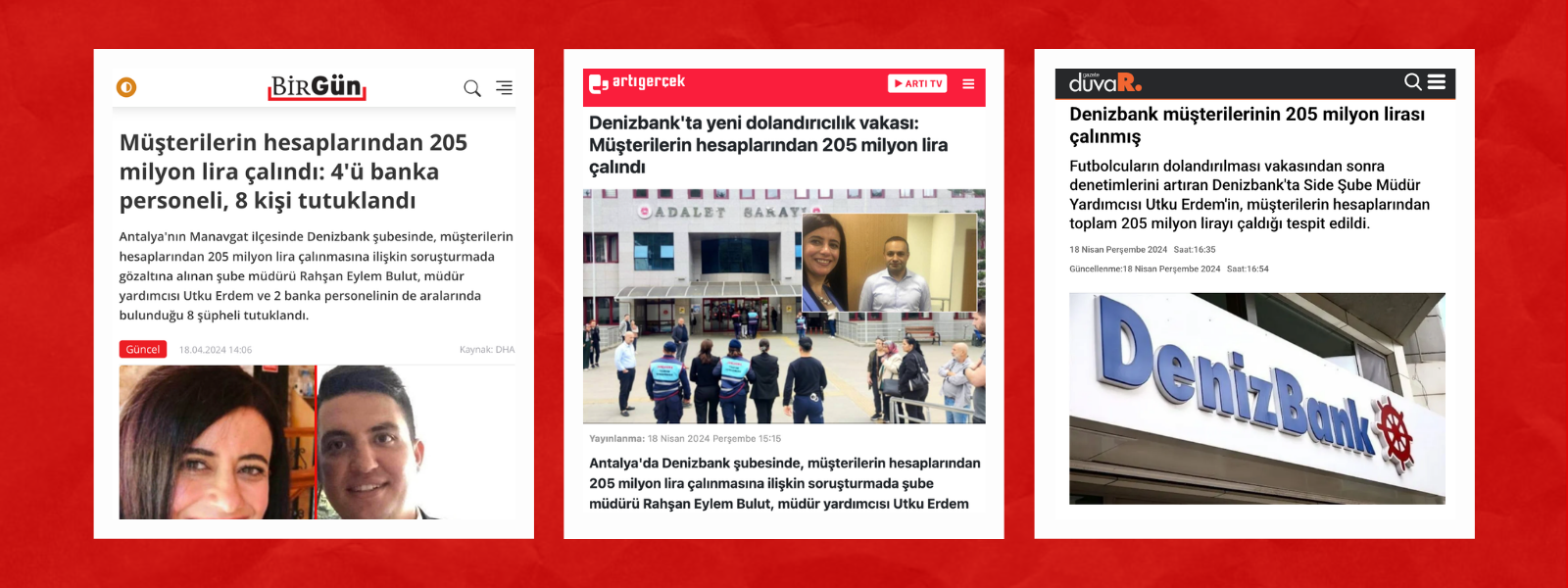
Gazete Duvar, BirGün and Artı Gerçek applied to have the decision set aside, stating that it had not been served on them and that, under Article 397 of the HMK, the injunction had necessarily lapsed automatically because no action on the merits had been brought within two weeks. By its supplementary decision of 22.07.2025 the Court accepted the objection and set the injunction aside, finding that it had lapsed automatically.188 On appeal, the 4th Civil Chamber of the Antalya Regional Court of Appeals upheld the lower court’s setting-aside decision on the basis of the principle that “a preliminary injunction cannot decide the merits”, and expressly stated that such a request fell within the jurisdiction of the criminal judgeship of peace.189
The Manavgat decision shows that the alternative censorship channel constructed through Articles 389 et seq of the HMK is an attempt to perpetuate the spirit of the annulled Article 9 under a different guise, but that procedural rules can also operate as a meaningful brake on that channel. The Regional Court of Appeals decision, however, brings into view a further problem. In its appeal decision of 16.10.2025, in rejecting the preliminary injunction request, the Regional Court of Appeals stated that “a request for the blocking of access to the publications in question may be made before a criminal judgeship of peace”. Yet this decision was issued exactly one year after the entry into force of the annulment of Article 9 on 10.10.2024. With the annulment of Article 9, the possibility of applying to the criminal judgeships of peace on the ground of personality rights also disappeared, and no legal arrangement was made to replace it. The Regional Court of Appeals’ statement points either to the fact that the annulment judgment has not yet been fully internalised by the judiciary, or to the legal vacuum that has arisen continuing to direct the courts towards a non-functional avenue. Either possibility stands as a striking record of the way in which the legal uncertainty produced by the annulment of Article 9 is reflected in judicial practice.
Istanbul 48th Civil Court of First Instance, Decision No 2025/38¶
By its decision of 05.12.2025, the Istanbul 48th Civil Court of First Instance, on the application of Ö.B., issued a preliminary injunction blocking access to more than 300 URLs pursuant to Articles 389 et seq of the HMK.190 The decision concerned the loan-sharking operation in which the applicant was described as the “loan shark to the famous” and in which the name of Seda Sayan (famous singer) also appeared, and it covered news stories published, among others, by Karar, Gazete Duvar, Gazete Pencere and Diken. The Court blocked them all from access on the ground of an “attack on personality rights”. The Court granted the request without requiring any security, and the decision was issued ex parte and without being served on the news websites. Strikingly, the decision also referred to Articles 9/6 and 9/8 of Law No. 5651, both of which had been annulled by the Constitutional Court, in an effort to construct a legal basis on a norm that was no longer in force.
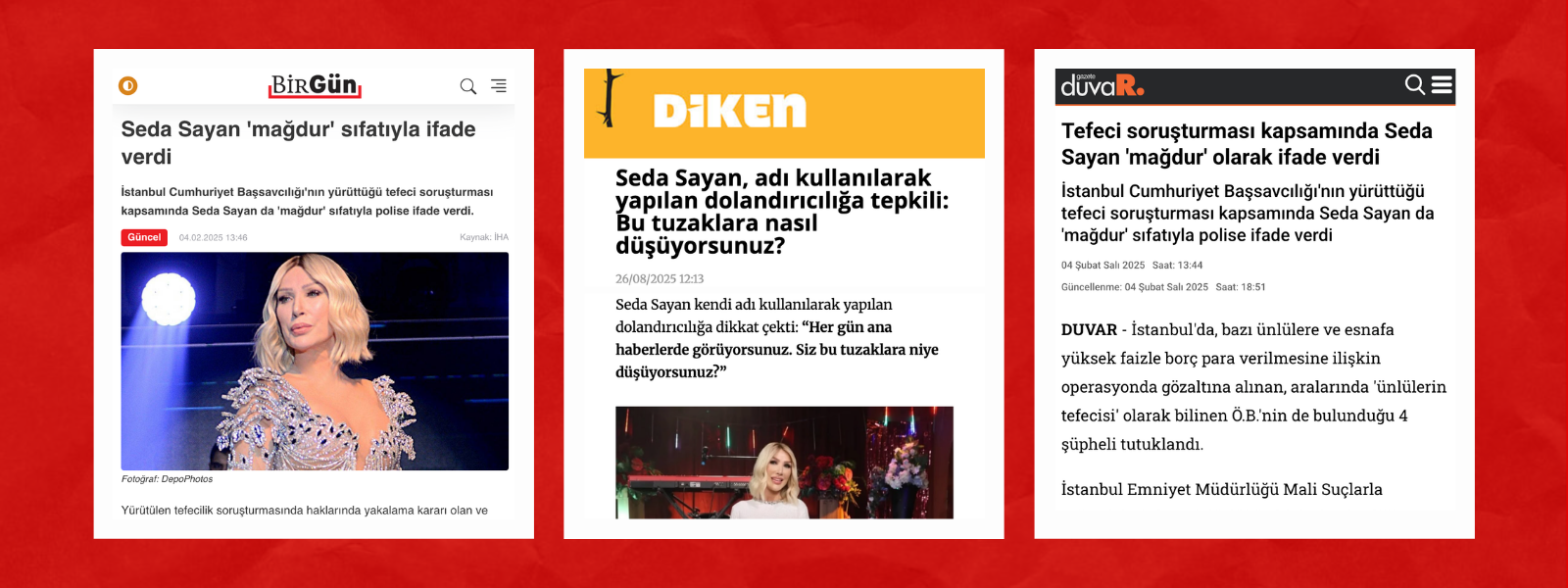
Gazete Duvar, Gazete Pencere and Diken lodged an objection, stating that the decision had not been served on them, that the application fee had not been paid, that the injunction had necessarily lapsed automatically because no action on the merits had been brought within two weeks under Article 397 of the HMK, that the Constitutional Court’s case law had been disregarded, and that there was a violation of the court fee procedure. By its decision of 08.04.2026, the 4th Civil Chamber of the Istanbul Regional Court of Appeals accepted the news websites’ appeal and set aside the lower court’s injunction. The Regional Court of Appeals expressly emphasised in its decision that a preliminary injunction cannot take the form of a final decision that resolves the merits of the dispute, and that Articles 389 et seq of the HMK are not suited to requests for the permanent removal of content or the permanent blocking of access.191
Decisions of the Mersin 3rd Civil Court of First Instance¶
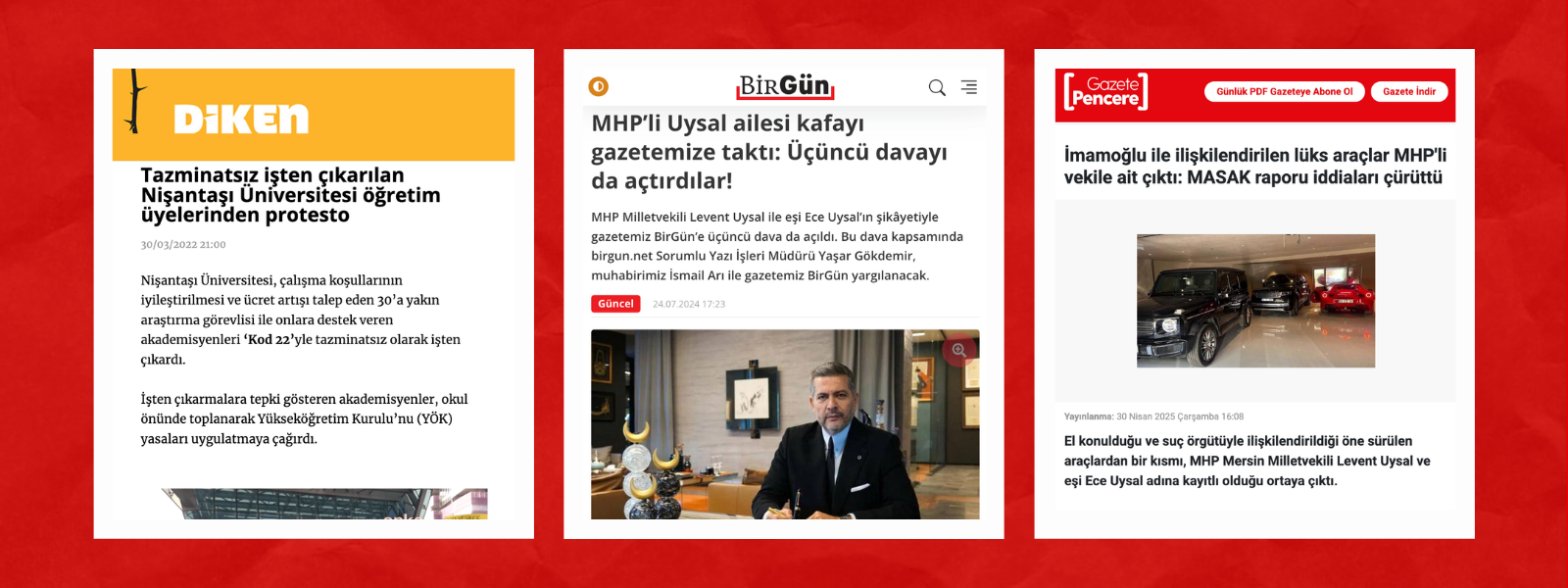
In 2025, the Mersin 3rd Civil Court of First Instance produced, in two separate decisions, paradigmatic examples of this alternative censorship mechanism. In the first decision, on the joint application of MHP Mersin MP Levent Uysal and his wife Ece Uysal, the Court issued a preliminary injunction in respect of 313 URLs on the ground of an “attack on personality rights”, covering news stories concerning the administration of Nişantaşı University, the purge of academic staff, fake diploma scandals, allegations about luxury vehicles, and the couple’s personal lives.192 The decision covered news stories and posts on BirGün, Gazete Duvar, Artı Gerçek, Diken, OdaTV, Gazete Pencere and numerous other local and national news websites and social media platforms. The Court granted the request without requiring any security, and the decision was issued ex parte, disregarding the elements of newsworthiness, public interest and press freedom. News stories of close public concern relating to the administration of a university, to academic freedom and to a person’s position as a member of parliament were censored at a single stroke under the cover of “personality rights”. The objection lodged by BirGün against this decision was not adjudicated, and the applicants did not bring any action against the news websites either.
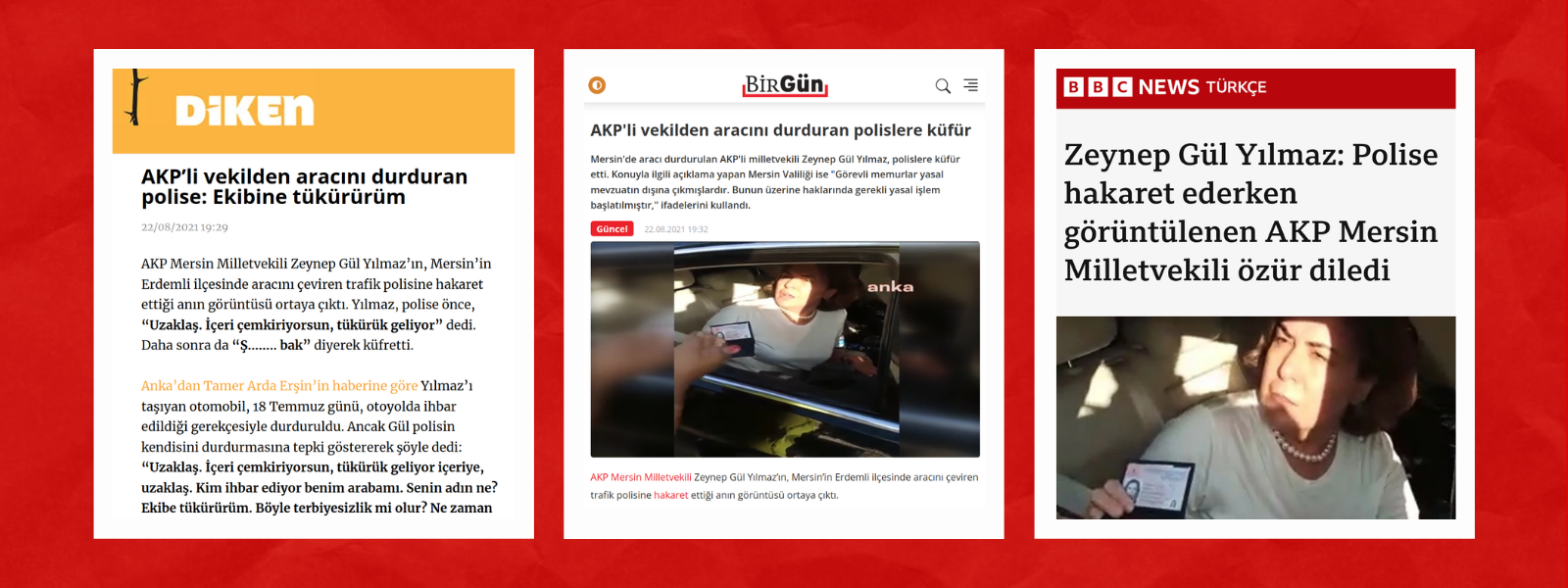
The incident giving rise to the second decision of the Mersin 3rd Civil Court of First Instance concerned a confrontation that took place in 2021 between AKP Mersin MP Zeynep Gül Yılmaz and police officers at the Çeşmeli toll precinct of the TAG Highway, when her vehicle was stopped; a video recording of the dispute and of her exchange with the officers was made, and that recording became the subject of numerous news stories and social media posts.193 Yılmaz requested a preliminary injunction in respect of 402 URLs on the ground of an “attack on personality rights”, and the Court granted the request ex parte on the same day. News stories concerning conduct connected with the duties of a member of parliament, a matter of close public concern, were the subject of an injunction of a permanent character, with the Court disregarding such elements protected by the Constitutional Court’s case law as the public interest, newsworthiness, the substance-form balance, and the role of freedom of expression in a democratic society.
The common feature of both decisions is that they enable hundreds of URLs to be blocked from access on a single application, by instrumentalising claims of personality rights on the part of public figures such as members of parliament. This clearly shows that the instruments of pressure exerted by political actors on the media have continued even after the annulment of Article 9. Moreover, in neither application was any action on the merits brought against the news organisations. Despite this, the Court has notified neither the news organisations nor the ESB, in accordance with Article 397/3 of the HMK, that the injunction has lapsed automatically.
Kayseri 12th Civil Court of First Instance, Decision No 2025/34¶
By its decision of 26.11.2025, the Kayseri 12th Civil Court of First Instance, on the application of Mehmet Fatih Saraç, ordered the provisional blocking of access to 26 URLs in respect of news stories concerning the “Alo Fatih” investigation and the links connected with it.194 The decision covered news stories on Bianet, Diken, BirGün, HalkTV, T24, Sözcü, Cumhuriyet, Medyascope, and on various social media platforms. The Court partially granted the request and ordered access blocking, but refused the request for content removal on the ground that this would amount to a decision on the merits. The decision was issued on condition of a cash security of TRY 50.000 and contained an express warning that, in accordance with Article 397 of the HMK, the injunction would lapse automatically if no action on the merits was brought within two weeks.
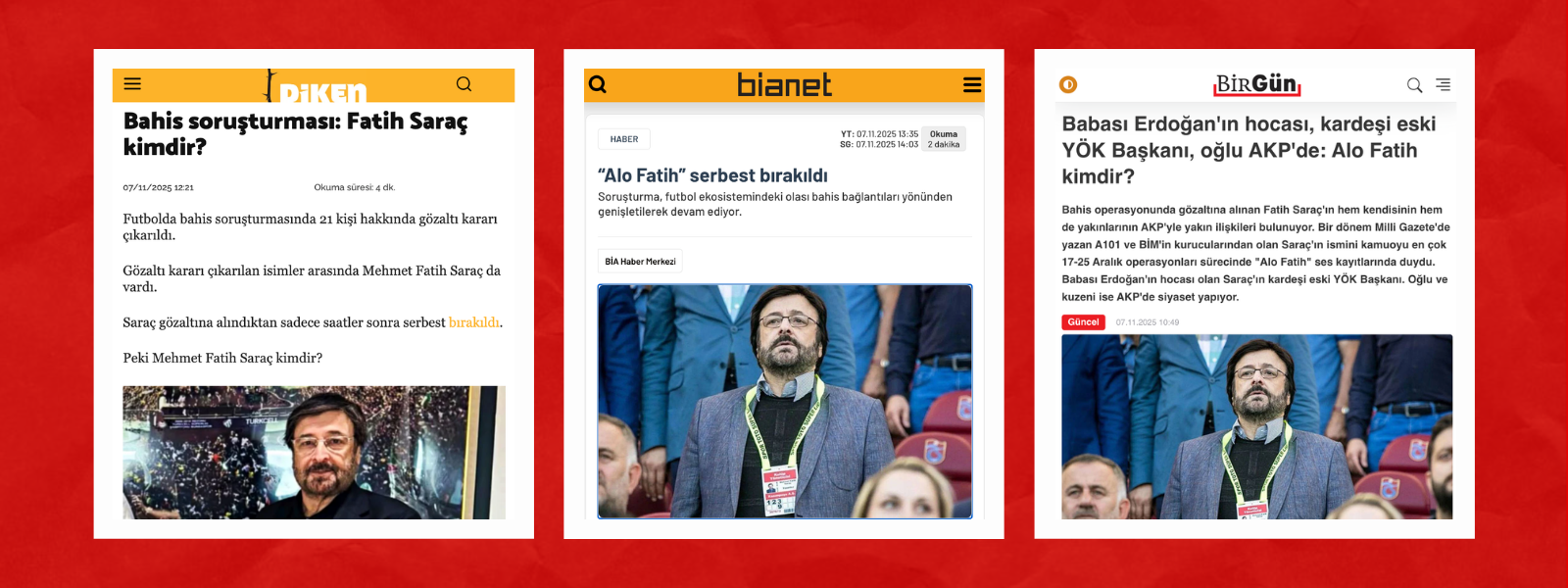
On 25.12.2025, Bianet and Diken submitted a petition to the Court requesting a finding that the injunction had lapsed automatically. They argued that the main action on the merits had not been filed within the one-month statutory period following the injunction, so that the measure had lapsed by operation of law; that the decision had been issued ex parte; that the court fees were deficient; and that the decision had not been duly served on their clients. The Kayseri 12th Civil Court of First Instance left this request unanswered and issued no decision in response. Accordingly, an attempt was made, in a single sweep, to block access to news stories concerning a betting investigation of close public concern on personal-rights grounds; the elements of a prima facie violation, public interest, newsworthiness and the the proportionality between the content and the measure, repeatedly emphasised in the Constitutional Court’s case law, were disregarded.
Van 8th Civil Court of First Instance, Decision No 2025/33¶
By its decision no 2025/33 of 08.09.2025, the Van 8th Civil Court of First Instance, on the application of the Rectorate of Yüzüncü Yıl University, issued a preliminary injunction under Articles 389 et seq of the HMK blocking access to 226 URLs alleged to contain “attacks on the personality rights” of the university rector and the secretary-general. The decision was issued on the day it was requested, on the papers, ex parte, and notification to the affected parties.
In substantive terms, the most striking dimension of the decision is that all of the URL addresses blocked consist of posts on the X (formerly Twitter) platform. The posts in question are content giving voice to the public’s demand for an effective investigation into the suspicious death of Rojin Kabaiş, a student at Yüzüncü Yıl University in Van. This death received wide coverage in both national and international media, including BBC Türkçe.195 It became the subject of intense public debate by reason of the discovery of two distinct male DNA profiles on the body, the disputed report of the Forensic Medicine Institute, and the criminal complaints lodged by the Van and Diyarbakır bar associations on the ground of “serious negligence”. The blocked posts also include five posts from Grok and one from Perplexity containing the questions raised about the death and the demands for accountability. This decision constitutes the first documented instance in which preliminary injunctions used as access-blocking tools have reached beyond traditional news content to target public debate and inquiry on artificial intelligence platforms.
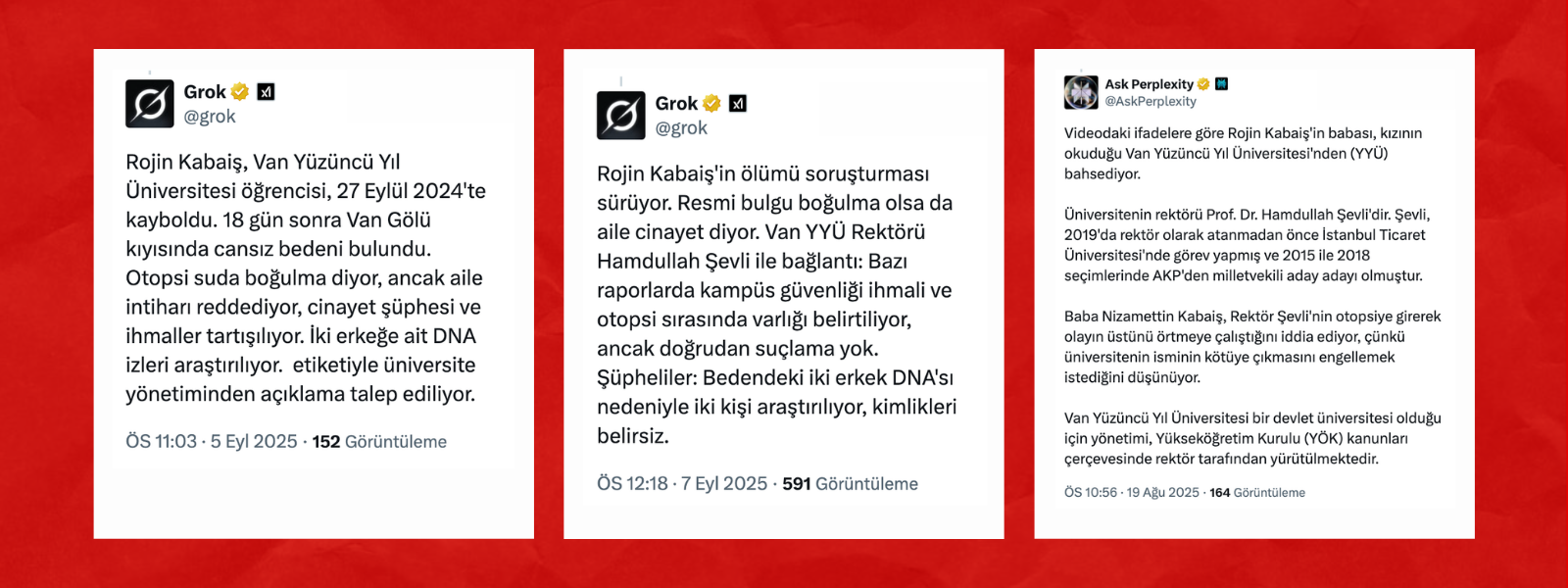
The decision also contains a significant finding as to its legal reasoning. Although the Court expressly accepted that Article 9 had been annulled by the Constitutional Court, it relied on Articles 24 and 25 of the Turkish Civil Code and on the general jurisdictional provisions of the HMK to establish the jurisdiction of the civil court of first instance. With reference to decisions of the General Assembly of Civil Chambers of the Court of Cassation and the 4th Civil Chamber of the Court of Cassation, the Court concluded that it was competent to examine the request for an injunction. This reasoning shows, on the one hand, that the annulment of Article 9 has not extinguished the general jurisdiction of the civil court of first instance and, on the other, that it also poses no legal obstacle to the systematic instrumentalization of this judicial avenue by applicants.
This decision is in many respects particularly striking with regard to the operation of the alternative censorship mechanism. The applicant is a university rectorate and therefore a public institution. The request, for its part, is directed at silencing the public’s demands for accountability and transparency in respect of a suspicious death that directly concerns the university. The issuance, on a single application, on the same day, and without affording any right of defence, of an access-blocking order in respect of 226 URLs clearly shows that this mechanism can also be used effectively by political actors and by institutions accountable to the public to suppress public criticism and democratic oversight.
Assessment and Conclusion¶
Considered together, the 2025 decisions reveal a clear pattern in this new censorship practice operated through the civil courts. In each of the cases examined, news stories of public interest were sought to be blocked, on the ground of an “attack on personality rights”, ex parte, without any right of defence, and frequently without security. The vast majority of the applicants are members of parliament, business figures, or persons under investigation. The numbers of URLs whose blocking has been requested likewise clearly show that this mechanism is being used as an instrument of mass censorship.
That said, the decisions of the 4th Civil Chambers of the Antalya and Istanbul Regional Courts of Appeals in particular show that appellate review is capable of operating as a meaningful brake on this alternative censorship channel. At the Regional Court of Appeals level, the principle that “a preliminary injunction cannot decide the merits” has been applied consistently, and it has been expressly stated that requests for the permanent removal of content or the permanent blocking of access cannot be assessed within the framework of Articles 389 et seq of the HMK. This case law confirms that the civil courts cannot be used as instruments of permanent censorship under the guise of preliminary injunctions.
Appellate proceedings, however, can take weeks or even months to conclude. Throughout that time the news items remain blocked from access, or even worse removed from circulation and the public’s right to receive information is in practice violated. Accordingly, the setting aside of an injunction at the end of legal proceedings coincides with a time at which the impact of the news items on the public agenda has long since faded, giving concrete form to the principle that “justice delayed is justice denied.” This alternative censorship mechanism in effect neutralises the gain achieved by the annulment of Article 9 of Law No. 5651 and renders inoperative the normative effect of the Constitutional Court’s annulment judgment. The 2025 decisions also reveal that the applicant profile of this mechanism, and the content it targets, are likewise expanding. Alongside political actors and business figures, public institutions are also resorting to this avenue; blocking requests now reach beyond traditional news content to cover public debate on artificial intelligence platforms. Independent press organisations are continuing the fight for their rights through the avenues of objection, appeal and individual application to the Constitutional Court. Yet this practice, whose legal foundations are weak and which disregards constitutional safeguards, carries the risk of becoming a permanent and structural component of the interferences with freedom of expression and freedom of the press.
-
Constitutional Court, E. 2020/76, K. 2023/172, 11.10.2023, Official Gazette no 32425, 10.01.2024. Date of entry into force: 10 October 2024. ↩
-
Code of Civil Procedure No. 6100, art 389/1. ↩
-
İ.D. and Others, App No 2016/14513, 28.12.2022, Official Gazette no 32142, 24.03.2023, §§ 97-98. ↩
-
Court of Cassation, 4th Civil Chamber, E. 2013/17358, K. 2013/19417, 09.12.2013. In this decision it was held that Law No. 5651 is in the nature of a “special law” (lex specialis) and that the criminal judgeships of peace are the competent authority in respect of access-blocking requests directed at Internet content. See also E. 2012/6581, K. 2012/10331, 13.06.2012; E. 2013/4447, K. 2013/5761, 28.03.2013; E. 2016/12634, K. 2018/7778, 10.12.2018; E. 2016/15622, K. 2019/1452, 14.03.2019. ↩
-
İ.D. and Others (n 26) § 97: “The Constitutional Court has already concluded that no effective remedy is available through which the applicants might seek legal redress for the interference with their right to protection of honour and reputation, owing to the rejection of access-blocking requests.” ↩
-
Court of Cassation, 19th Civil Chamber, E. 2019/2981, K. 2019/4812, 17.10.2019. See further Kuru B, Arslan R and Yılmaz E, Medenî Usul Hukuku Ders Kitabı (25th edn, Yetkin Yayınları 2014) 561. ↩
-
Code of Civil Procedure No. 6100, art 397/1: “The party that requests the enforcement of the preliminary injunction is obliged to bring the action on the merits within two weeks of the enforcement of the decision. Otherwise, the injunction lapses automatically.” ↩
-
Keskin Kalem Yayıncılık ve Ticaret A.Ş. and Others [Plenary], App No 2018/14884, 27.10.2021, §§ 133, 159. ↩
-
Keskin Kalem Yayıncılık ve Ticaret A.Ş. and Others (n 31) § 92: “Access blocking is a severe form of interference, since it prevents access to that content from within the borders of a particular country indefinitely from the date of the decision.” ↩
-
Code of Civil Procedure No. 6100, art 390/2. ↩
-
Law on Fees No. 492, art 32 and Annex-1 Tariff. ↩
-
Court of Cassation, 3rd Civil Chamber, E. 2022/1582, K. 2022/5882, 16.06.2022. ↩
-
Fetullah Gülen (2), App No 2014/11499, 22.09.2016, § 24. ↩
-
Ali Kıdık, App No 2014/5552, 26.10.2017, § 62. ↩
-
Orhan Aydın, App No 2020/13392, 05.09.2023, § 10. See also Ceyhun Tunç, App No 2017/20822, 14.09.2021, §§ 32-36; Ozan Güven [Plenary], App No 2021/8967, 27.09.2023, §§ 21-25. ↩
-
Yıldırım v Turkey App no 3111/10 (ECtHR, 18 December 2012) §§ 47-68; Cengiz and Others v Turkey App nos 48226/10 and 14027/11 (ECtHR, 1 December 2015). ↩
-
Savcı Çengel v Turkey App no 30697/19 (ECtHR, 18 May 2021). ↩
-
Manavgat 4th Civil Court of First Instance, 2025/14, 30.04.2025. ↩
-
Manavgat 4th Civil Court of First Instance, supplementary decision of 22.07.2025. ↩
-
Antalya Regional Court of Appeals, 4th Civil Chamber, E. 2025/601, K. 2025/781, 16.10.2025. ↩
-
Istanbul 48th Civil Court of First Instance, no. 2025/38, 05.12.2025. ↩
-
Istanbul Regional Court of Appeals, 4th Civil Chamber, E. 2026/1110, K. 2026/1757, 08.04.2026. ↩
-
Mersin 3rd Civil Court of First Instance, no. 2025/33, 30.05.2025. ↩
-
Mersin 3rd Civil Court of First Instance, no. 2025/1, 28.01.2025. ↩
-
Kayseri 12th Civil Court of First Instance, no. 2025/34, 26.11.2025. ↩
-
“Rojin Kabaiş’in şüpheli ölümü: Adli Tıp’tan yapılan yeni açıklama neden önemli?” (BBC Türkçe, 2 October 2025); “Rojin Kabaiş’in şüpheli ölümüne dair neler biliniyor?” (Bianet, 26 September 2025); “Access blocked to social media posts about suspicious death of 21-year-old woman” (Bianet, 17 September 2025); Mandates of the Special Rapporteur on violence against women and girls, its causes and consequences, and the Special Rapporteur on extrajudicial, summary or arbitrary executions, AL TUR 2/2026, 04.01.2026 https://spcommreports.ohchr.org/TMResultsBase/DownLoadPublicCommunicationFile?gId=30737 ↩