The Turkish Football Federation and Access Blocking Practices
The Turkish Football Federation (TFF), which was granted access-blocking authority in 2021, blocked 16.821 domain names and 9.908 distinct IP addresses from access during 2025. Across the 2022–2025 period as a whole, the TFF has been identified as having blocked a total of 122.638 websites and domain names and 55.512 IP addresses from access.
The access-blocking authority of the TFF was conferred by the Supplemental Article 1 entitled “Protection of Broadcasting Rights”, added by Article 29 of Law No. 7346 on 21.12.2021 to Law No. 5894 on the Establishment and Duties of the Turkish Football Federation. Under that provision, where it is determined that broadcasts of football matches taking place within the borders of the Republic of Türkiye have been unlawfully made available on the Internet, the TFF Board of Directors may issue a decision to block access to the broadcast, section or part to which the infringement relates (in URL form or otherwise). By a logic parallel to that of Law No. 5651, where it is technically impossible to block access to the infringing content, or where the infringement cannot be prevented in that way, a decision blocking access to the entire website may be issued. Furthermore, where it is determined that football matches taking place outside the borders of the Republic of Türkiye have been unlawfully broadcast, an access-blocking decision may be issued on the application of the holder of the broadcasting rights.
The law also provides that the Board of Directors may delegate its authority under this article to persons serving in an administrative unit to be established within the Federation. To that end, the TFF Board of Directors has set up an administrative unit within the Federation to carry out the work and procedures relating to access blocking. The procedures and principles governing the operation of that unit were to be regulated by a directive to be issued by the Board of Directors. The Directive on the Prevention of Unlawful Football Broadcasts, prepared on this basis, was adopted at the Board of Directors’ meeting no 15 of 04.08.2022 and was published on the Federation’s official website on 08.09.2022, when it entered into force.229
That said, the structure and personnel of the administrative unit to which the Board of Directors has delegated its authority have not been adequately clarified even by the published directive. Article 4(1) of the directive merely states that “the Administrative Unit shall consist of a sufficient number of Authorised Person(s) to be determined by the TFF Board of Directors, together with technical and administrative personnel”. The number and identities of the “authorised persons” vested with the power to examine access-blocking applications, to decide upon them, and to transmit those decisions to the Association of Access Providers (ESB) are not, however, disclosed by the TFF to the public.
Moreover, the access-blocking decisions taken and transmitted to the ESB for enforcement are also not published by the TFF. While the law provides a one-week avenue of objection to the criminal judgeship of peace against these decisions, which are unpublished and largely unknown to the public, it contains no arrangement as to how that objection procedure is to be operated in the specific case of TFF decisions. Since the procedure by which the addressees of the decision are to be made aware of it is not secured, that objection avenue cannot be characterised as an effective remedy. The law also provides no limit on the validity period of access-blocking decisions. This omission lays a legal basis for blocking decisions taken on grounds of allegedly unlawful broadcasts to continue to be enforced, indefinitely and arbitrarily, even after those broadcasts have ended.
Constitutional Review of the Authority Granted to the TFF: The CHP Application
The access-blocking authority granted to the TFF was brought before the Constitutional Court by way of a norm-review application lodged by the CHP, the main opposition party. The application argued that the provision in question violated Articles 13, 26, 28, 35, 36 and 153 of the Constitution. It emphasised that conferring on the TFF, a legal person governed by private law, the direct authority to issue access-blocking decisions constituted a severe interference with freedom of expression and freedom of the press. It stated that the provision did not satisfy the conditions of substantive certainty and legal foreseeability required by the criterion of being “prescribed by law”, and that it opened up a field of arbitrary intervention to administrative authorities and autonomous structures.
One of the principal grounds of the application was that the procedural safeguards set down in the Constitutional Court’s pilot judgment in Keskin Kalem230 and in contemporary case law such as the ECtHR’s judgment in Vladimir Kharitonov v Russia231 found no place in this provision. The application further stated that the administrative unit established within the TFF lacked guarantees of impartiality and independence; that no opportunity for adversarial proceedings or for defence prior to the decision was afforded to parties whose rights were interfered with; and that this administrative procedure, expected to be applied during the ninety-minute broadcast of a match, was incapable of serving the aim it was said to pursue (the protection of broadcasting rights), and accordingly did not even satisfy the suitability criterion, a sub-element of the principle of proportionality. The application finally stated that confining judicial review to a subsequent avenue of objection (before the criminal judgeships of peace) inverted the presumption in favour of freedom and made restriction the rule; that the legislature had disregarded the grounds set out in the Constitutional Court’s prior annulment judgments concerning Article 9 of Law No. 5651; and that this constituted an open breach of the principle that the Constitutional Court’s judgments are binding, as regulated in Article 153 of the Constitution. Annulment of the rule was accordingly sought.
The Constitutional Court’s Annulment Judgment No 2025/134
By its judgment of 17.06.2025,232 the Constitutional Court held, by a majority, that the access-blocking authority granted to the TFF Board of Directors by the Supplemental Article 1 added to Law No. 5894 was contrary to Articles 13 and 26 of the Constitution, and annulled it. The principal ground of the judgment is that mass communication and the Internet environment are, within the framework of Article 26 of the Constitution, the most dynamic field of freedom of expression, and that every interference with that field is required not only to rest on a law in the formal sense but also to carry, in the substantive sense, the elements of foreseeability and certainty.
The Constitutional Court expressly emphasised that censorship powers conferred on administrative authorities must contain safeguards protective against arbitrary application. According to the Court, although the TFF is defined as an autonomous organisation subject to the provisions of private law, it is by virtue of its features (such as licence issuance, the imposition of disciplinary sanctions, and the enjoyment of public privileges) a structure that in fact exercises public power and bears the character of a public legal personality. Notwithstanding this, the composition of the Board of Directors and of the administrative unit within the TFF that would apply a sanction as severe as access blocking, directly affecting the access to information of millions of users, the qualifications of their members, and their procedures of operation, are not regulated by law. These matters have been left entirely to status documents and directives to be issued by the institution itself. Moreover, the judgment also establishes that the supervisory authority of the Ministry of Youth and Sports does not extend to these censorship operations. The delegation of the power of interference with freedom of expression to an administrative structure whose legal qualifications and oversight mechanisms remain obscure has, by this judgment, also been formally recorded in legal terms as one of the most concrete findings attesting to the Kafkaesque uncertainty in the construction of the digital obedience regime in Türkiye.
A Further Confirmation of the Structural Dysfunction of the Criminal Judgeships of Peace
One of the most critical legal findings of the Constitutional Court’s judgment is the renewed confirmation of the structural dysfunction of the criminal judgeships of peace, indicated as the avenue of objection against the TFF’s administrative censorship decisions. In developing this finding, the Court made direct reference to its earlier Plenary judgment in Artı Media GmbH,233 concerning the application of Article 8/A of Law No. 5651. As emphasised in that judgment, the avenue of objection to the criminal judgeships of peace under the provisions of the Code of Criminal Procedure against the access-blocking decisions of administrative authorities falls wholly short of guaranteeing the rights to equality of arms, to adversarial proceedings, and to be heard.
The Constitutional Court openly set out that the criminal judgeships of peace are unable to ensure the effective participation of the parties in the proceedings, are unable to remedy the procedural deficiencies at the initial stage of the interference, and lack the instruments required to conduct a proportionality review consistent with the requirements of a democratic social order. The absence in the law of any provision for the service of the TFF’s decisions on the addressee also renders the starting point of the one-week period for objection uncertain. In sum, this administrative access-blocking procedure, applied without judicial approval and left to the automatic approval mechanism of the criminal judgeships of peace alone, was found wholly contrary to the Constitution, since it did not even provide the minimum procedural safeguards required by the principle of legality.
The Dissenting Opinions and Their Assessment
The four members who dissented argued that the detection of the infringement does not carry any technical complexity; that broadcasting rights have a commercial and proprietary dimension; that the urgency intrinsic to the nature of football matches makes it necessary to delegate authority to smaller decision-making units within the institution; and that the uncertainties referred to in the proceedings subjected to judicial review do not fall within the scope of the norm at issue. This approach, however, confines the question of freedom of expression to a merely commercial matter of “pirate broadcasting”. It wholly ignores the severe rights violations and the danger of disproportion that wholesale site blockings, justified by the inability to perform URL-level blockings, would generate. Moreover, the ground of “urgency”, which has been raised repeatedly under many provisions of Law No. 5651 and has been consistently rejected by the Constitutional Court’s case law, is reactivated in the reasoning of the dissent.
The Effective Date of the Annulment Judgment and the Continuation of the Unconstitutional Blocking Practice
The Constitutional Court decided that the annulment provision would enter into force nine months after its publication in the Official Gazette on 14.10.2025,234 namely on 14.07.2026. This is a settled but contested judicial practice that lays the legal ground for a censorship mechanism whose unconstitutionality has been formally recorded by the Court to remain in existence for a further nine months and to continue producing violations difficult to redress.
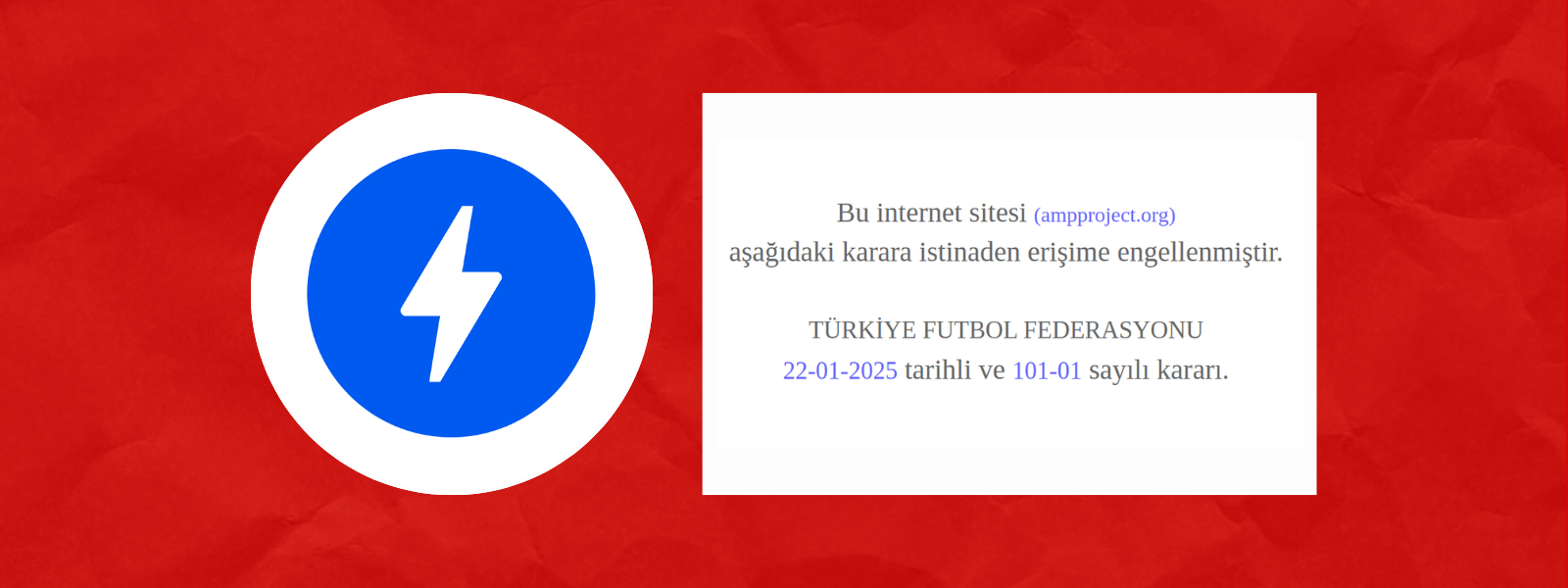
The problems borne by the TFF in terms of the principles of transparency and proportionality go beyond an abstract legal debate. The concrete cases of 2025 clearly show what those problems mean in practice. The first example is the blocking of the domain ampproject.org of the open-source AMP (Accelerated Mobile Pages) project developed by Google, which enables the rapid loading of web pages, particularly on mobile devices. By its decision no 101-01 of 22.01.2025, the TFF blocked access to that domain. Considering that the AMP infrastructure is an Internet backbone service supporting millions of websites, that it has no specific connection with pirate football broadcasting, and that this blocking inevitably also brings within its scope a large number of unrelated content, the decision in question constitutes an example that openly violates the principle of proportionality. The sanction was lifted approximately 16 hours later, following the strong reactions generated by our EngelliWeb announcement.235 That retreat, however, does not alter the fact that the decision was taken and applied without passing through any judicial or administrative review.
The second example occurred only six weeks after the Constitutional Court’s annulment judgment was published in the Official Gazette. By its decision no 067-01 of 25.11.2025, the TFF blocked access to the pages.dev domain belonging to the Cloudflare Pages service on the ground of illegal match broadcasting. Cloudflare Pages is a hosting infrastructure with no content of its own. Accordingly, tens of thousands of independent websites published under the pages.dev domain were directly affected by this decision. That the blocking was carried out by an authority whose unconstitutionality had been formally recorded by the Court, and that the same domain had moreover previously been blocked, on 29.05.2023, by BTK decision no 490.05.01.2023.-269077 on the ground of illegal betting (and then lifted a short time later), shows that this practice is not incidental but indicative of a systemic structure.

Indeed, these two examples reflect not an exceptional weakness of oversight, but a structural pattern. From the date on which the Constitutional Court’s annulment judgment was published in the Official Gazette (14.10.2025), the TFF has continued to issue access-blocking decisions, and, exercising this authority whose unconstitutionality had been formally recorded by the Court, has, throughout the 2025–26 football season, blocked more than 11.000 domain names from access. As of June 2026, the date on which we write this report, the legislature has, notwithstanding the Constitutional Court’s judgment, made no amendment to Supplemental Article 1 of Law No. 5894. Nor is there in existence any legal mechanism that would prevent the Federation from continuing to issue blocking decisions until the entry into force of the annulment provision on 14.07.2026. This picture has itself become a symbol of how, in Türkiye, constitutional review has been transformed not into a functional safeguard, but into the cloak of legitimacy of censorship.
-
See https://www.tff.org/Resources/TFF/Documents/TALIMATLAR/Yasa-D%C4%B1s%C4%B1-Futbol-Yayinlarinin-Onlenmesi-Talimati.pdf ↩
-
Keskin Kalem Yayıncılık ve Ticaret A.Ş. and Others [Plenary], App No 2018/14884, 27.10.2021. ↩
-
Vladimir Kharitonov v Russia App no 10795/14 (ECtHR, 23 June 2020). ↩
-
Constitutional Court, E. 2024/75, K. 2025/134, 17.06.2025. ↩
-
Artı Media GmbH [Plenary], App No 2019/40078, 14.09.2023. ↩
-
Constitutional Court, E. 2024/75, K. 2025/134, Official Gazette no 33047, 14.10.2025. ↩
-
EngelliWeb, “AMP erişime engellendi”, 22.01.2025 https://ifade.org.tr/engelliweb/amp-erisime-engellendi/ ↩