Abdullah Kaya and Others: The Limited Application of the Pilot Judgment
General Framework and Data Set
Following its pilot judgment in Keskin Kalem Yayıncılık ve Ticaret A.Ş. and Others,89 the Constitutional Court, by its judgment of 22.11.2023 in Abdullah Kaya and Others,90 joined 503 individual applications and held that the applicants’ freedom of expression guaranteed under Article 26 of the Constitution and right to an effective remedy guaranteed under Article 40 of the Constitution had been systematically violated. The substance of the joined applications was not made public by the Constitutional Court; only the application numbers were disclosed. Within the scope of the EngelliWeb project, comprehensive research has been conducted to compile detailed data on all 503 applications. These data cover 392 distinct criminal judgeship of peace decisions, 117 different judgeships, 220 different requesters, and the ten-year distribution of applications from 2014 to 2023.91
Application Years and Applicants
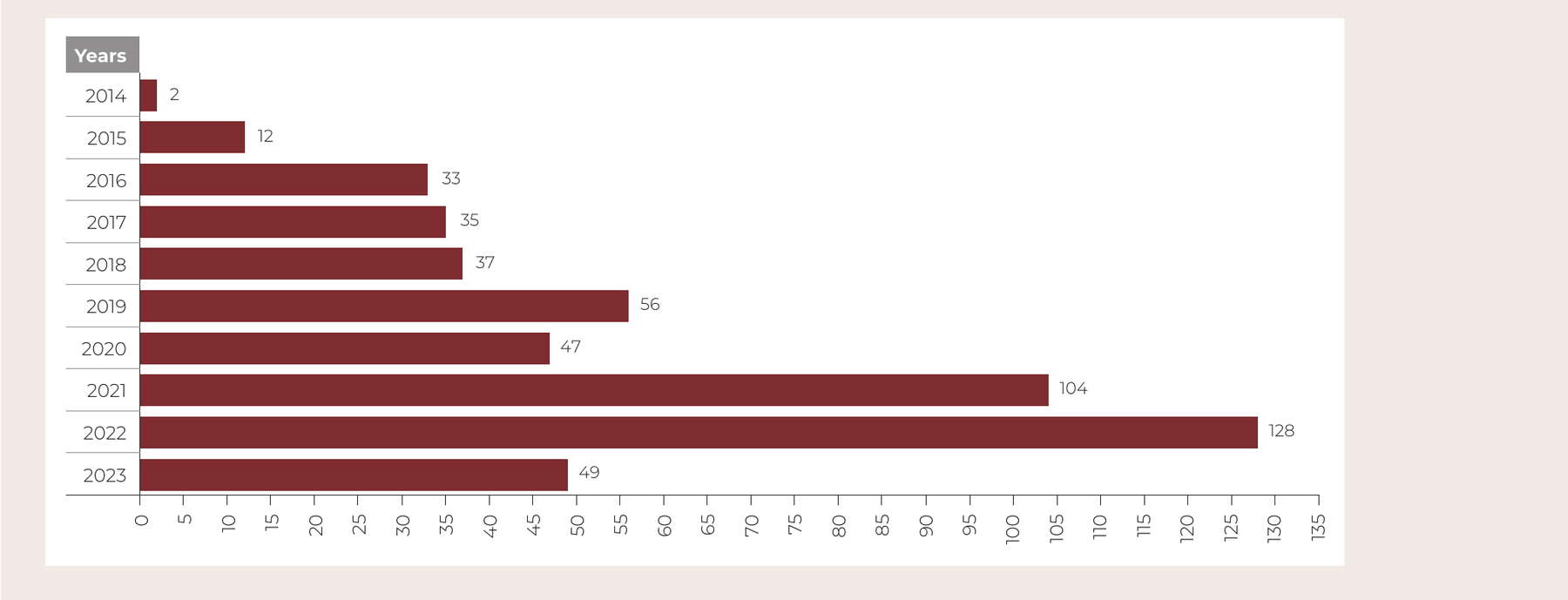
The distribution of the 503 applications by year reveals both how the mechanism expanded over time and how long the Constitutional Court kept the applications pending: 2 applications were made in 2014, 12 in 2015, 33 in 2016, 35 in 2017, 37 in 2018, 56 in 2019, 47 in 2020, 104 in 2021, 128 in 2022 and 49 in 2023. The fact that more than half of the applications (281) are concentrated in 2021–2022 shows that censorship practices under Article 9 gained momentum in those two years and that, correspondingly, applications to the Constitutional Court also rose. By contrast, the fact that the earliest application dates from 2014 plainly demonstrates that some applicants pursued their efforts to vindicate their rights for nearly a decade.
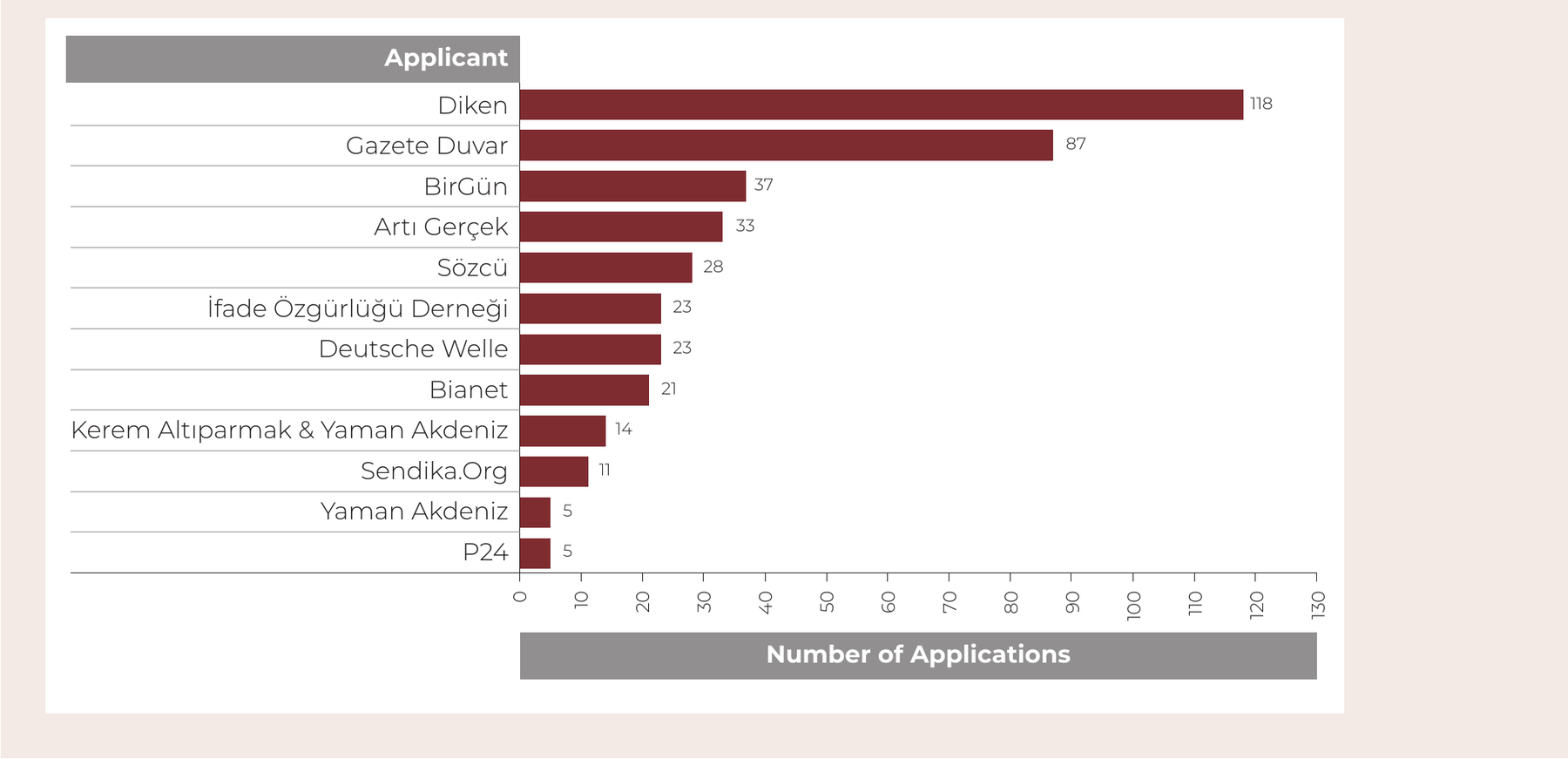
As regards the profile of applicants, it can be seen that the overwhelming majority of the 503 applications subject to the Abdullah Kaya and Others judgment were made by independent and opposition media organisations. Diken ranks first with 118 applications, followed by Gazete Duvar with 87 applications in second place, BirGün with 37 in third, Artı Gerçek with 33 in fourth, and Sözcü with 28 in fifth. The Freedom of Expression Association and Deutsche Welle share sixth place with 23 applications each, and Bianet ranks seventh with 21 applications. The 14 joint applications by Freedom of Expression Association founders Kerem Altıparmak and Yaman Akdeniz, and the 11 applications by Sendika.Org, are also included within the joint violation judgment. This distribution concretely demonstrates that Article 9 has systematically targeted independent and critical journalistic activities, and that the censorship mechanism has concentrated on specific publishing organisations.
Those Who Requested: The Political Establishment’s Map of Censorship
Examination of the requesters of the criminal judgeship of peace decisions underlying the 503 applications brings into sharp relief by whom, and how, Article 9 has been instrumentalised. In total, 220 different requesters were identified; among them, President Recep Tayyip Erdoğan ranks first, with 28 individual applications concerning decisions issued upon his request. He is followed by his son, Necmeddin Bilal Erdoğan with 26 applications, his son-in-law, Berat Albayrak with 22 and Serhat Albayrak with 14. In fifth place is Metin Güneş, the owner of Met-Gün İnşaat, with 13 applications, followed by Nurettin Yıldız and Turkcell İletişim Hizmetleri A.Ş. with 11 each. Other requesters on the list include Mustafa Doğan İnal (10), the Ministry of Family and Social Services (9), Ömer Faruk Aydıner and Erdal Can Alkoçlar (8 each), former Presidential Director of Communications Prof. Dr Fahrettin Altun (5), the Grand National Assembly of Türkiye and Abdurrahim Boynukalın (4 each) and Binali Yıldırım (3).
When the requests of the Erdoğan family and its close circle are considered separately, the scale of the picture becomes still more pronounced. The 66 requests made by President Erdoğan (20), Necmeddin Bilal Erdoğan (20), Berat Albayrak (11), Serhat Albayrak (7), Sümeyye Erdoğan Bayraktar (3), Ahmet Burak Erdoğan (2), Emine Erdoğan (1), Ali Erdoğan (1) and Şeyma Erdoğan Karagöz (1) underlie a total of 98 applications. In other words, approximately one fifth (19,5%) of the 503 applications underlying the Abdullah Kaya and Others judgment rest on censorship decisions issued solely on the requests of the President and his family.92 This proportion demonstrates beyond dispute that Article 9 has been used systematically not for the protection of personality rights, but for the purpose of exempting the political establishment’s circle from criticism.
Retrial: The General Picture
Remedying the violations identified by the Constitutional Court in Abdullah Kaya and Others legally requires the criminal judgeships of peace concerned to conduct retrials. The data compiled within the scope of the EngelliWeb project, however, reveal that this obligation has largely been left unfulfilled.

Of the 392 distinct criminal judgeship of peace decisions corresponding to the 503 applications,93 retrials have been conducted in only 173 (44,1%). In the remaining 219 distinct decisions (55,9%), no retrial proceedings have been initiated. On an application basis, retrial files were identified in only 216 of the 503 applications (42,9%); no action was taken in 287 (57,1%). Accordingly, notwithstanding the Constitutional Court’s express findings of violation of freedom of expression and the right to an effective remedy, more than half of the decisions remain de facto unimplemented.
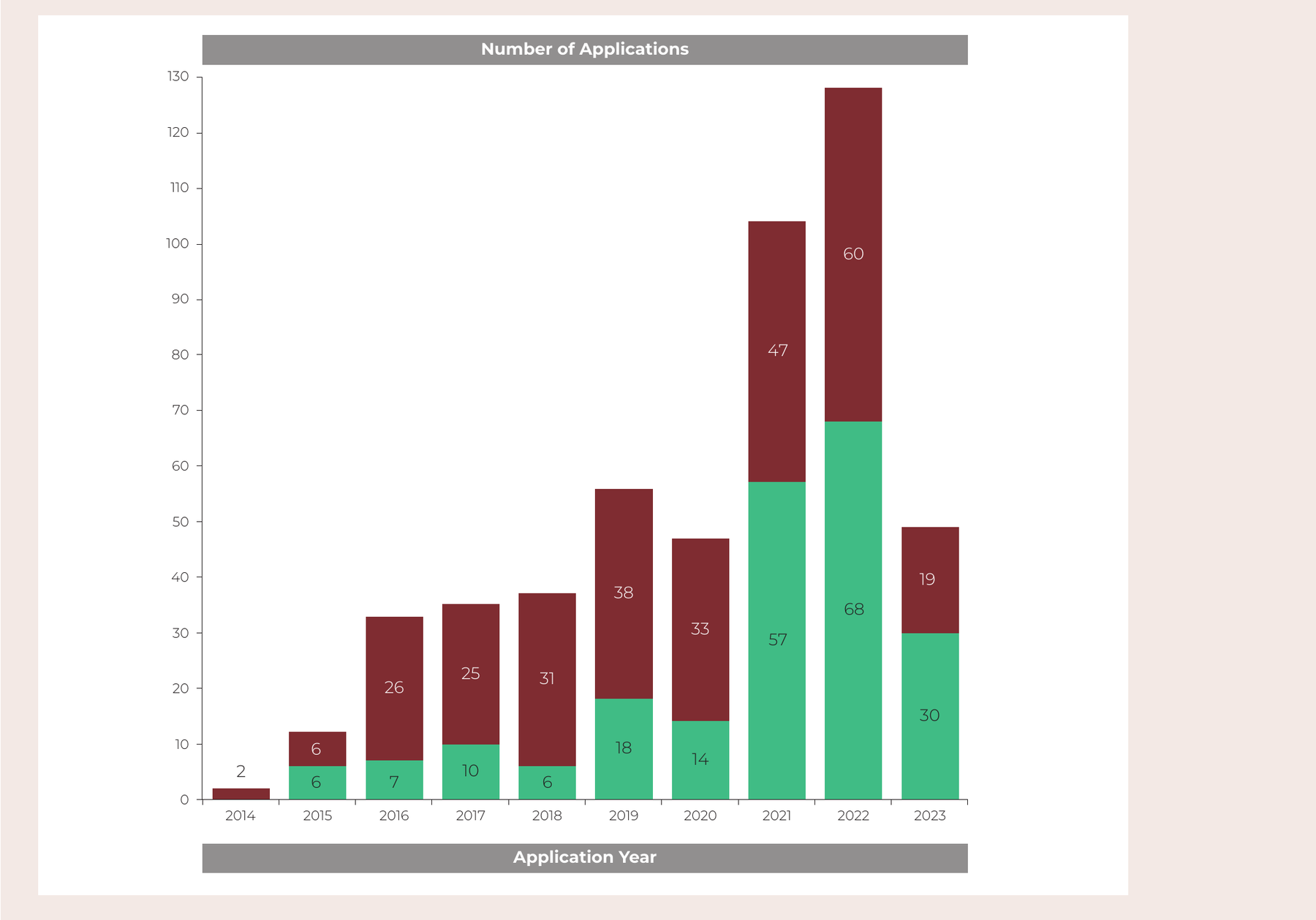
Examination of retrial rates by year of application reveals an additional structural problem. In applications made during the 2014–2018 period, the average retrial rate was 22,1%; in the 2019–2020 transition period, 31,1%; whereas in the 2021–2023 period, the rate rose to 55,2%. This gradual increase suggests that the criminal judgeships of peace, in applying the Constitutional Court’s judgment, have practised a kind of “selective limitation period”. Older decisions have been left outside the scope of retrial on the ground of the length of time elapsed, or without any justification given at all. Yet the binding nature of Constitutional Court judgments does not vary by reference to the date on which the judgment was rendered; the obligation to remedy an identified violation retains its validity independently of the date of the application. This practice becomes all the more meaningful when one considers that a significant proportion of the earlier-dated applications relate to news items directly connected with the 17–25 December investigations and with requests by the President and his family. The fact that the politically most sensitive decisions are at the same time the earliest in date, and that these decisions have been systematically left outside the scope of retrial, strongly suggests that the judgeships’ non-compliance does not arise from mere bureaucratic oversight, but from deliberate choice.
Geographic Distribution: Istanbul’s “Total Resistance” Picture
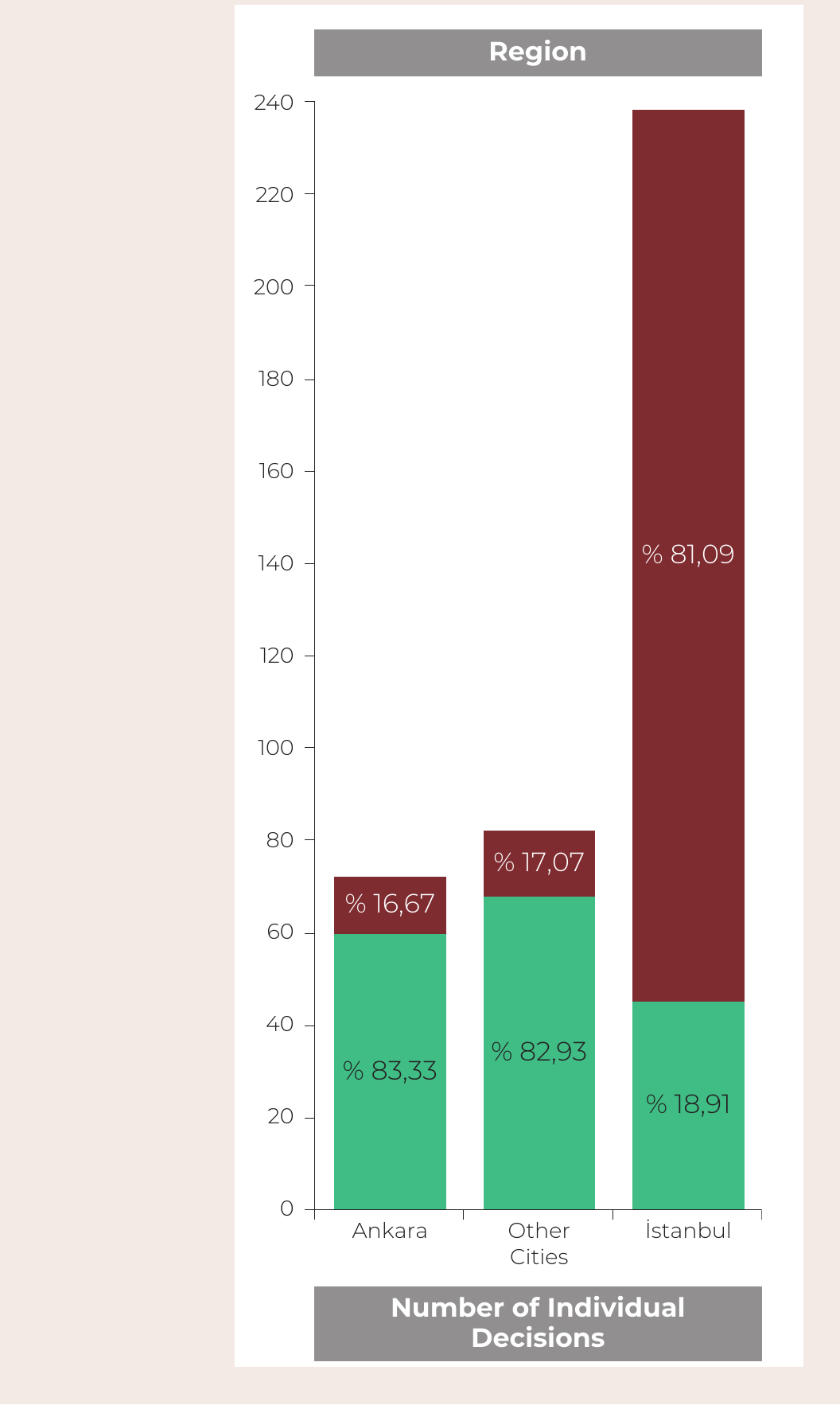
The geographic distribution of retrial rates constitutes perhaps the most striking dimension of the data. A dramatic differentiation is observed among three principal geographic clusters.
Across Istanbul (including the Çağlayan, Kartal/Anadolu, Bakırköy and Büyükçekmece courthouses), of 232 distinct decisions, retrials were conducted in only 43 (18,5%); in 189 decisions (81,5%), the Constitutional Court’s judgment remained de facto unimplemented. By contrast, at judgeships in Ankara, retrials were conducted in 60 of 72 distinct decisions (83,3%), with non-compliance identified in only 12 decisions (16,7%). At judgeships in other cities, retrials were conducted in 70 of 88 distinct decisions (79,5%).94 These data show that Istanbul’s judgeships have displayed an organised and systematic resistance against Constitutional Court judgments, whereas Ankara and the other cities have, to a large extent, complied.
The differentiation among the courthouses within Istanbul is also highly striking. Of 104 distinct decisions issued by the 14 criminal judgeships of peace at the Istanbul Çağlayan Courthouse, no retrial was conducted in 103 (99,0%). With the sole exception of one retrial that took place at the Istanbul 8th Criminal Judgeship of Peace, all judgeships at the Çağlayan Courthouse have effectively rejected the Constitutional Court’s judgment. The Istanbul 1st (10 decisions), 3rd (12 decisions), 4th (14 decisions), 5th (9 decisions), 6th (7 decisions), 7th (6 decisions), 9th (12 decisions), 10th (8 decisions), 11th (5 decisions), 14th (4 decisions), 12th (3 decisions), 2nd (3 decisions) and 13th (1 decision) Criminal Judgeships of Peace are the judgeships with a retrial rate of zero.95
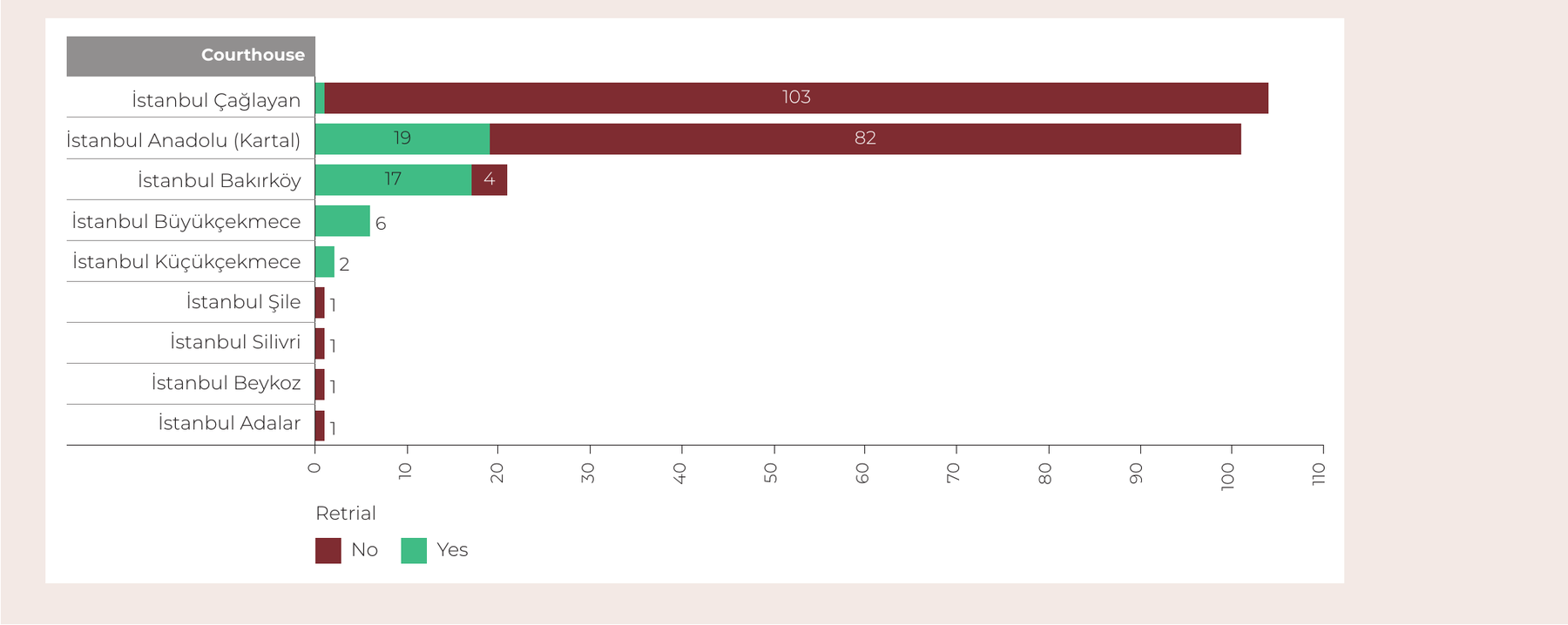
At the Istanbul Anadolu (Kartal) Courthouse, of 101 distinct decisions, no retrial was conducted in 82 (81,2%). The Istanbul Anadolu 4th Criminal Judgeship of Peace stands out as both the judgeship with the most violation findings issued against it (27 distinct decisions and 37 individual applications) and as a judgeship that has conducted no retrials at all. Similarly, the Istanbul Anadolu 6th Criminal Judgeship of Peace (16 decisions), the Istanbul Anadolu 8th Criminal Judgeship of Peace (11 decisions), the Istanbul Anadolu 3rd Criminal Judgeship of Peace (9 decisions) and the Istanbul Anadolu 1st Criminal Judgeship of Peace (6 decisions) have conducted no retrials at all.96
At the Bakırköy and Büyükçekmece courthouses, the picture takes the opposite shape from that of Istanbul as a whole. Of 27 distinct decisions, retrial was not conducted in only 4 (14,8%); retrials were conducted in the remaining 23 decisions.97 This differentiation shows that even among courthouses within the boundaries of the same province there is a serious inconsistency as regards compliance with Constitutional Court judgments, and that non-compliance is concentrated in specific courthouses.
In total, 18 criminal judgeships of peace across Istanbul have conducted no retrial at all despite the Constitutional Court’s express violation findings. The decisions of these 18 judgeships cover 152 distinct decisions in total. The fact that all of these judgeships are located at the Istanbul Çağlayan and Istanbul Anadolu (Kartal) courthouses suggests that the non-compliance reflects, beyond individual judges’ preferences, an institutional and structural mechanism of resistance.
The Erdoğan Family’s Requests and Retrial: Absolute Immunity
Examination of the retrial data by reference to the requesters lays bare the most striking dimension of the situation. Not a single retrial has been conducted in any of the 28 individual applications concerning decisions issued upon the request of President Recep Tayyip Erdoğan.98 This represents a compliance rate of 0% and shows that decisions in which the Constitutional Court has identified a violation of freedom of expression are, when the requester is the President, rendered de facto untouchable by the criminal judgeships of peace. The fact that all of the decisions issued upon President Erdoğan’s requests were issued by Istanbul judgeships further confirms this finding. Of the decisions subject to these applications, 4 were issued by the Istanbul Anadolu 8th Criminal Judgeship of Peace, 3 by the Istanbul Anadolu 4th Criminal Judgeship of Peace, 3 by the Istanbul 9th Criminal Judgeship of Peace, 2 by the Istanbul 11th Criminal Judgeship of Peace, 2 by the Istanbul 4th Criminal Judgeship of Peace, 2 by the Istanbul 1st Criminal Judgeship of Peace, 1 by the Istanbul Anadolu 6th Criminal Judgeship of Peace, 1 by the Istanbul 5th Criminal Judgeship of Peace, 1 by the Istanbul 3rd Criminal Judgeship of Peace and 1 by the Istanbul Anadolu 1st Criminal Judgeship of Peace. Among the applicants in respect of these decisions are Diken with 13 applications, BirGün with 5, Artı Gerçek with 3, Sözcü with 2, and one application each by Deutsche Welle, Bianet, Gazete Duvar, Sendika.Org and the journalist Mehmet Altan.
When the Erdoğan family as a whole is considered, the picture deepens further. Of 66 requests, retrials were conducted in only 7 (10,6%). The detailed distribution by family member is as follows: of Necmeddin Bilal Erdoğan’s 16 requests, only 4 resulted in retrial; of Berat Albayrak’s 11 requests, only 1; of Serhat Albayrak’s 7 requests, only 1. Ali Erdoğan’s single request resulted in retrial. No retrial has been conducted in any of the requests made by Sümeyye Erdoğan Bayraktar (3 requests), Ahmet Burak Erdoğan (2 requests), Emine Erdoğan (1 request) or Şeyma Erdoğan Karagöz (1 request).99
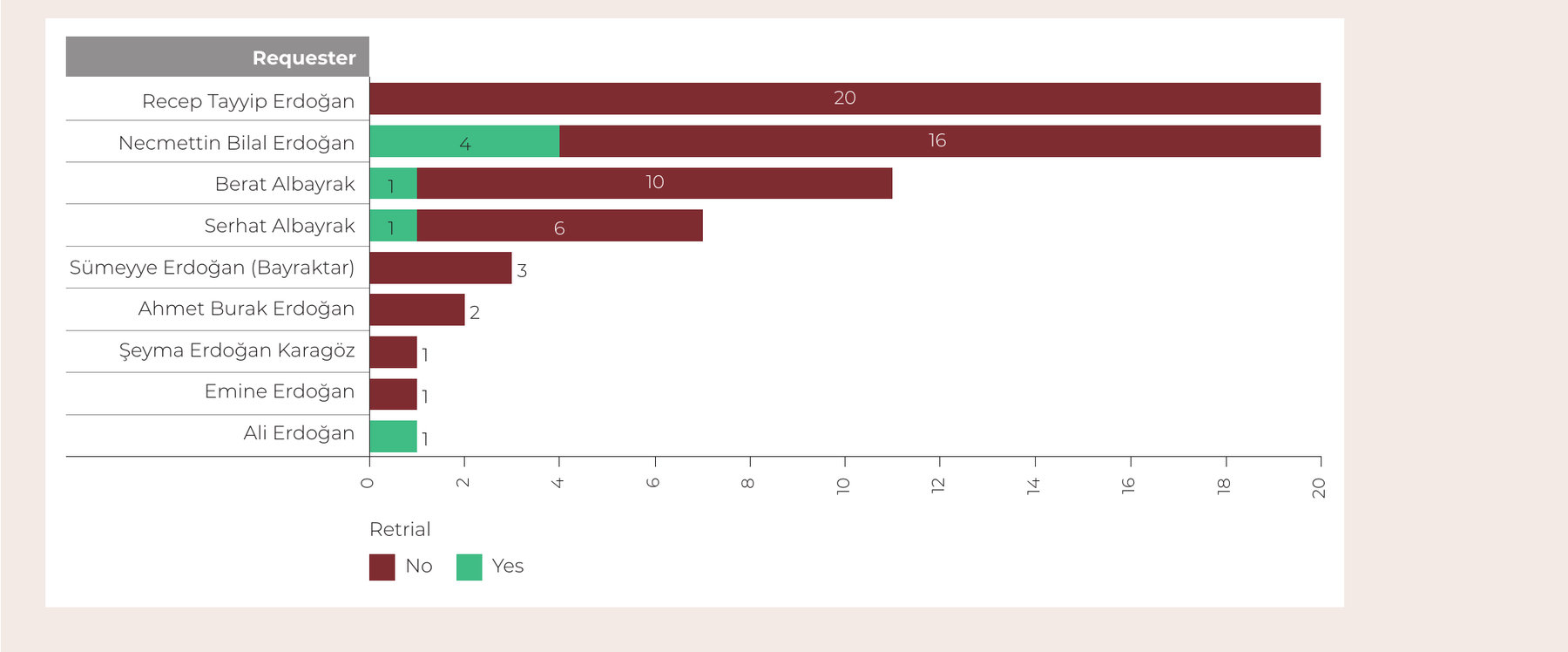
These data concretely show that the Constitutional Court’s violation findings cannot, de facto, be implemented where the requester is an actor connected to the political establishment, and that access blockings have acquired “untouchable” status. The almost complete preservation of decisions issued upon the requests of the President and his family shows how far the criminal judgeships of peace have departed from the principles of independence and impartiality, and constitutes a strong presumption that these decisions are sustained by political rather than legal motivations.
The Profile of Requesters in Decisions Without Retrial
Examination of the requesters in the 287 applications without retrial reveals that actors connected to the political establishment are markedly concentrated in this category. In applications without retrial, requesters by number of applications concerning decisions issued upon their requests are, in order: President Erdoğan (28), Berat Albayrak (19), Necmeddin Bilal Erdoğan (18), Metin Güneş, owner of Met-Gün İnşaat (13), Serhat Albayrak (12), Nurettin Yıldız (11), Mustafa Doğan İnal (9), Turkcell (8), Erdal Can Alkoçlar (7), Korkmaz Tağma (6), Prof. Dr Fahrettin Altun (5), Türkiye Youth and Education Service Foundation (5), İHH Humanitarian Relief Foundation (4), Abdurrahim Boynukalın (4), Istanbul Medipol University (4) and Binali Yıldırım (3).100
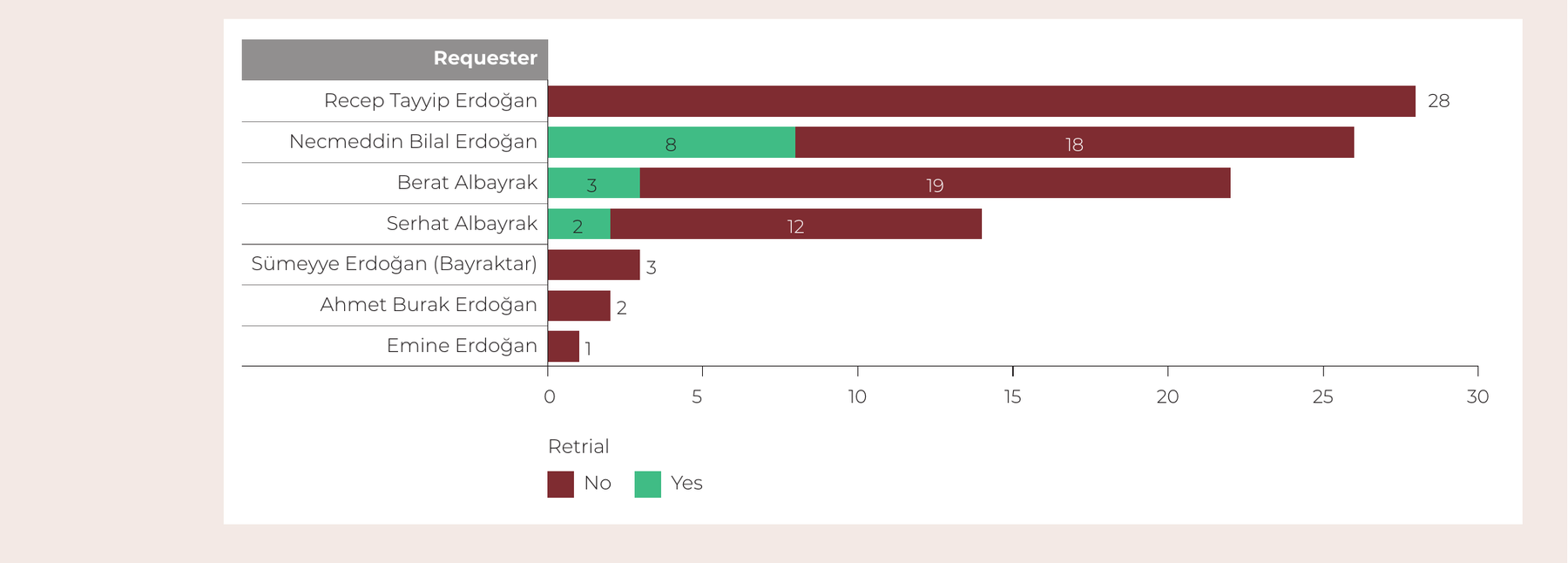
By contrast, the profile of requesters in applications in which retrial has been conducted is notably different. In this category, names such as the Ministry of Family and Social Services (8), Sinan Aslan (5), Ömer Faruk Aydıner (5), Ümit Kalko (4), Doğan Çelik (4), Ömer Yahşi (4), Platform Turizm Taşımacılık A.Ş. (4), Hamza Yerlikaya (3) and Hacım Çiftçi (3) come to the fore. From the Erdoğan family, retrials were conducted in only 8 applications concerning decisions issued upon Necmeddin Bilal Erdoğan’s request and in 3 concerning Berat Albayrak’s requests. Even where the family’s requests are concerned, this shows that compliance has remained limited and selective.
Comparison of these two lists indicates that retrial decisions are shaped not by legal assessment, but by the political weight of the requester. Decisions issued upon the requests of high-level political actors such as President Erdoğan, Fahrettin Altun and Binali Yıldırım are rendered de facto “untouchable”, while retrials may be conducted in respect of decisions issued upon the requests of those with a relatively lower political profile. This selectivity plainly demonstrates that whether or not Constitutional Court judgments are implemented is not a legal but a political decision.
The Position of Applicants in Relation to Retrial
Assessment of the retrial status of the applications underlying Abdullah Kaya and Others from the perspective of the applicants also reveals a noteworthy picture. Of the 118 applications made by Diken, the publishing organisation with the largest number of applications, only 45 (38,1%) have been the subject of retrial; in 73 applications (61,9%), no action has been taken. While Gazete Duvar’s figure of retrials in 52 of its 87 applications (59,8%) is comparatively higher, the fact that 35 applications still remain unimplemented is noteworthy. The position of BirGün newspaper is particularly striking: of 37 applications, retrial has been conducted in only 6 (16,2%); in 31 applications (83,8%), the Constitutional Court’s judgment has been de facto unimplemented. Similarly, retrial has been conducted in 16 of Artı Gerçek’s 33 applications (48,5%), and in only 6 of Sözcü’s 28 applications (21,4%).
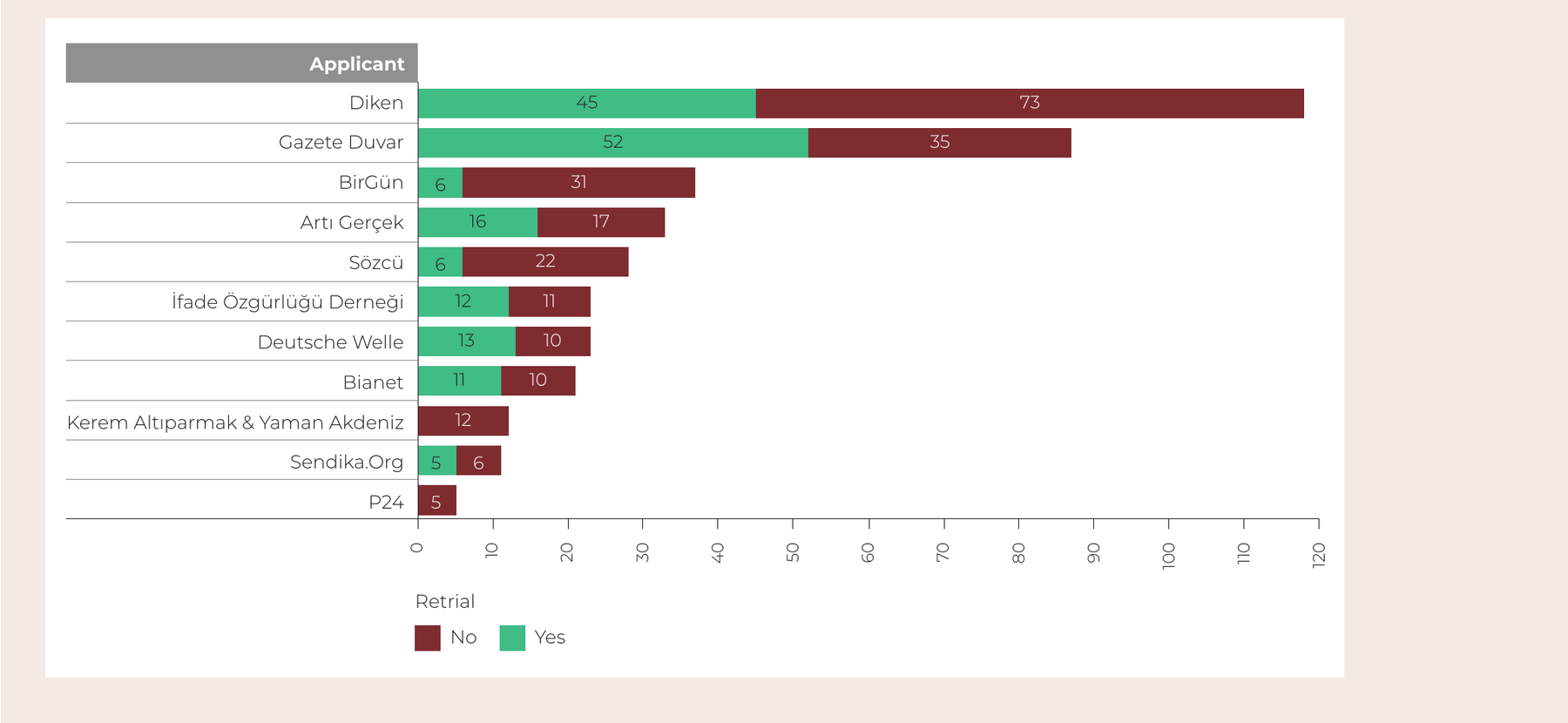
Of the 12 joint applications by Kerem Altıparmak and Yaman Akdeniz, no retrial has been conducted in any. Of the 23 applications of the Freedom of Expression Association, including those of its own founders, retrial has been conducted in only 12 (52,2%). Similar rates apply for Deutsche Welle (13 of 23, 56,5%) and Bianet (11 of 21, 52,4%).
These data reveal that retrial rates vary significantly from applicant to applicant. That variation arises not from the legal position of applicants, but from which judgeships and upon whose request the decisions underlying the applications were issued. Indeed, the great majority of the applications of publishing organisations with low retrial rates, such as BirGün and Sözcü, relate to decisions issued by the Istanbul Çağlayan and Istanbul Anadolu judgeships. This shows that, even from the perspective of the victims of censorship, the remedying of the violation remains contingent on an accidental geographic distribution, and that the cost of the failure to implement Constitutional Court judgments effectively is borne predominantly by independent and opposition media organisations.
The Financial Dimension
Within the scope of Abdullah Kaya and Others, the Constitutional Court awarded the applicants a total of TRY 6.557.000 in non-pecuniary damages, TRY 1.109.200 in attorney’s fees and TRY 288.864 in court fees.101 The payment of these awards, however, constitutes only the financial dimension of the remedy for the violations. The principal aim, namely the obligation to lift the access blockings and to conduct retrials, has largely not been fulfilled. The compensatory payments thus do not amount to remedy of the interferences with freedom of expression, but only to a symbolic price of the continuing violation.
Structural Assessment
Assessed as a whole, these data point well beyond individual judges’ errors or isolated instances of non-compliance, to a structural and systematic mechanism of resistance. The 99% non-compliance rate at the Istanbul Çağlayan Courthouse, the 81,2% resistance at the Istanbul Anadolu Courthouse, the 100% immunity in respect of President Erdoğan’s requests and the 83,2% protection rate in respect of the Erdoğan family’s requests: none of these figures can be explained as accidental deviation.
Comparatively, the fact that Ankara judgeships comply with Constitutional Court judgments at a rate of 83,3% and other cities at 79,5% shows that the retrial mechanism is technically capable of being applied. Accordingly, the non-compliance of Istanbul judgeships arises not from technical impossibility, but from deliberate choice.
This state of affairs places seriously in question the character of the individual application mechanism as an effective domestic remedy for freedom of expression. Although Constitutional Court judgments bind “the legislative, executive and judicial organs, the administrative authorities, and real and legal persons” under Article 153 of the Constitution, the criminal judgeships of peace’s de facto rejection of that binding force renders one of the fundamental operating principles of the constitutional order inoperative. While the pilot judgment mechanism is an important instrument for identifying structural problems, the data here clearly prove that it has remained ineffective in remedying the identified violations.
In conclusion, Abdullah Kaya and Others stands as concrete proof of how the joint violation judgment rendered by the Constitutional Court after a decade of neglect has been frustrated at the level of implementation. The censorship regime sustained through the criminal judgeships of peace has rendered constitutional guarantees inoperative; the non-implementation of Constitutional Court judgments has, particularly before the Istanbul judgeships, ceased to be exceptional and become a structural practice. On this picture, so to speak, “the mountain has laboured and brought forth a mouse”; the violation findings obtained after long years of struggle have not been able to abolish the censorship mechanism, serving only the function of a legal entry in the register.
The Practical Effect of the Annulment Decision and the Emerging Legal Vacuum
The practical effect of the annulment decision has remained confined to the period after its entry into force on 10.10.2024. Up to that date, the criminal judgeships of peace continued to issue decisions under Article 9, and the ESB continued to implement them. More importantly, uncertainty arose as to the legal status of the thousands of decisions previously issued. No legal arrangement or case law has emerged on how these subsisting decisions are to be handled, on whether access blockings will be lifted automatically or whether they are to be annulled by way of application. The TBMM did not enact any new law before the date on which the annulment decision entered into force or as at the date of publication of this report.
The implementation of the Constitutional Court’s violation findings has also largely failed. Retrial processes in respect of the 503 applications under Abdullah Kaya and Others have either not been initiated at all or have deliberately been interpreted in a restrictive manner. Some judgeships have confined themselves to removing the content of the individual applicant, while maintaining the measure in respect of other news items featuring in the same decision. Others have, in the weeks following the Constitutional Court’s judgment, issued fresh sanction decisions for the same content, thereby effectively perpetuating the rights violation. This picture demonstrates that the individual application mechanism is progressively losing its character as an effective domestic remedy for freedom of expression.
The Legacy of Article 9: Censorship Migrates
With the annulment of Article 9, the censorship mechanism has not disappeared; only its legal label has changed. After the annulment, allegations of violation of personality rights have begun to be processed through three different channels: applications made to criminal judgeships of peace under Article 8/A of Law No. 5651 on the grounds of “public order” and “national security”; requests submitted to BTK and subsequently to criminal judgeships of peace under Article 9/A on the ground of “violation of privacy”; and preliminary injunction decisions sought from civil courts under the Code of Civil Procedure (“HMK”).102 Yet Article 8/A is essentially an arrangement designed for limited grounds such as the right to life, national security, public order and the prevention of the commission of crime, and is not a provision intended to protect personality rights. Article 9/A, although envisaged as an arrangement specific to and limited in scope to the privacy violations, has begun to be interpreted in an expansive manner to substitute for the broad field of interference that Article 9 had provided. This transformation is examined in detail in the relevant sections of the report.
In conclusion, Article 9 of Law No. 5651, having departed over its ten-year course of application from its purpose of protecting personality rights, was transformed into a systematic instrument of censorship. It functioned, through the template decisions of the criminal judgeships of peace, as an automatic approval mechanism. The Constitutional Court’s belated annulment was unable to undo the sanctions applied to 49.533 news items; retrial processes have largely remained inoperative. The annulment of Article 9, rather than putting an end to rights violations, has paved the way for the migration of the censorship mechanism to alternative channels such as Article 8/A, Article 9/A and preliminary injunctions.
-
Keskin Kalem Yayıncılık ve Ticaret A.Ş. and Others, App No 2018/14884, 27.10.2021, Official Gazette no 31712, 07.01.2022. ↩
-
Abdullah Kaya and Others, App No 2016/1430, 22.11.2023. ↩
-
There are 16 applications for which the year of application could not be identified. The 519 rows in the table arise from the fact that some applications relate to more than one criminal judgeship of peace decision. ↩
-
This figure is calculated by taking into account only the President and his immediate family members together with the Albayrak family. When pro-government businesspeople, foundations and public institutions are included, the figure rises further. ↩
-
The number of distinct decisions (392) is lower than the number of applications (503) because a single decision may concern more than one applicant. Retrial rates have been calculated both on a distinct-decision basis and on an application basis. ↩
-
Istanbul: no retrial was conducted in 189 of 232 distinct decisions (81,5%); Ankara: no retrial was conducted in 12 of 72 distinct decisions (16,7%); other cities: no retrial was conducted in 18 of 88 distinct decisions (20,5%). ↩
-
Istanbul 8th Criminal Judgeship of Peace, with a single retrial out of 10 distinct decisions, is the sole exception at the Çağlayan Courthouse. ↩
-
Judgeships at the Istanbul Anadolu Courthouse that conducted retrials: Istanbul Anadolu 10th Criminal Judgeship of Peace (5/5), Istanbul Anadolu 2nd Criminal Judgeship of Peace (4/5), Istanbul Anadolu 7th Criminal Judgeship of Peace (5/9), Istanbul Anadolu 5th Criminal Judgeship of Peace (4/11), Istanbul Anadolu 9th Criminal Judgeship of Peace (1/2). ↩
-
All four decisions at the Bakırköy Courthouse for which no retrial was conducted are attributable to the Bakırköy 5th Criminal Judgeship of Peace. ↩
-
Distribution of decisions by judgeship: Istanbul Anadolu 8th Criminal Judgeship of Peace (7), Istanbul Anadolu 4th Criminal Judgeship of Peace (5), Istanbul 9th Criminal Judgeship of Peace (5), Istanbul 11th Criminal Judgeship of Peace (2), Istanbul 4th Criminal Judgeship of Peace (2), Istanbul 1st Criminal Judgeship of Peace (2), Istanbul Anadolu 6th Criminal Judgeship of Peace (2), Istanbul 5th Criminal Judgeship of Peace (1), Istanbul 3rd Criminal Judgeship of Peace (1), Istanbul Anadolu 1st Criminal Judgeship of Peace (1). ↩
-
These data were compiled within the scope of the EngelliWeb project by obtaining the retrial files of each application from the judgeships concerned. ↩
-
Rows for which the identity of the requester could not be determined in applications without retrial have not been included in this analysis. ↩
-
These figures reflect the aggregate amounts awarded in the Constitutional Court’s judgment. The average non-pecuniary damages per application amount to approximately TRY 17.030, and the average attorney’s fee approximately TRY 2.205. ↩
-
These developments are examined in detail in the “Article 8/A of Law No. 5651”, “Article 9/A” and “Civil Courts and Preliminary Injunction Decisions” sections of this report. ↩