Bandwidth Throttling Practices
Internet censorship practices in Türkiye have, in recent years, undergone a radical evolution from visible interventions such as access blocking toward methods, such as bandwidth throttling, that are difficult to detect and stealthy in character. Bandwidth throttling is, rather than the wholesale cutting of Internet traffic, the operation of reducing the speed of data flow, by artificial interventions, to levels at which it is rendered dysfunctional (in particular, by 50 to 95 per cent). The method does not absolutely halt Internet traffic; but it forces the data flow into so radical a bottleneck that, by reason of the resulting packet losses and high latency, communication is de facto rendered impossible.
The most dangerous aspect of this method is the “invisible” character of the censorship. When throttling is applied, the user is not confronted with a “Legal Warning Screen” or a court order, as in access-blocking decisions. Instead, interfaces load but content does not flow, and videos freeze. Users assess the access problem they experience not as State intervention but as a shortcoming of their own hardware, a local network problem, the crash of the platform’s own server, or a technical malfunction on the part of the service provider. In this way, the political cost of the censorship is removed from the State and is offloaded onto the user, who is “experiencing a technical problem”, or onto the operator, who is “providing inadequate service”.
Bandwidth Throttling Sanctions and Practices Under Article 60(10) of Law No. 5809
The most fundamental error made in the historical analysis of bandwidth throttling practices in Türkiye is treating August 2016, the date on which the process acquired a statutory footing (Article 60(10) of Law No. 5809), as a “year zero”. The 2015–2016 period is a critical threshold at which Internet restrictions in Türkiye began to be used as a systematic policy instrument. The distinctive feature of that period is that the Internet outages were focused geographically on particular regions and were generally applied in synchrony with political events. In particular, one year before the amendment of Law No. 5809, with the end of the Solution Process (Çözüm Süreci), the reduction of Internet speed on mobile networks from 3G to 2G (Edge) level during the operations in the Eastern and Southeastern Anatolia Regions, and the application of long-duration regional outages, were reflected in the agenda of the Turkish Grand National Assembly (TBMM) and in public reports.
The legal basis of the throttling sanction is Article 60(10) of the Electronic Communications Law No. 5809. This provision was added to that Law by Decree-Law No. 671 in the aftermath of the 15 July 2016 coup attempt, and was subsequently made permanent when it was adopted unchanged by Article 22 of Law No. 6757.
Under this regulation, on one or more of the grounds set out in Article 22 of the Constitution, “in cases where delay would be prejudicial”, the Presidency may decide directly on the taking of a measure and may confer authority on BTK for the implementation of that measure. The President of BTK, in turn, communicates the measure thus notified to it immediately to all operators, access providers, data centres and content/hosting providers. The decision must be implemented within at most two hours. Approval by the criminal judgeship of peace is also required within 24 hours; otherwise the implementation lapses ipso jure.266
This regulation enables throttling practices to be applied rapidly by way of an administrative decision. However, public access to the decisions of the criminal judgeships of peace issued in the course of implementation, and to the content of those decisions, is largely obstructed. That such practices, which produce serious consequences for Internet freedom, are carried out in a manner devoid of transparency and with judicial review rendered ineffective greatly impairs, in particular, access to public information at moments of crisis.
The Chronology of Bandwidth Throttling Practices
The table below presents the chronological breakdown of the throttling measures applied in Türkiye from 2015 to the present. As can clearly be seen, the administration had recourse to throttling long before it had any statutory authority. In numerous critical cases before the statutory regulation of 15 August 2016, the administration de facto applied the throttling measure notwithstanding that it had no statutory authority to do so.
| Date | Event / Ground | Duration / Scope | Legal Basis Status |
|---|---|---|---|
| 15 July 2015 | End of the “Solution Process” | Regional (East/Southeast) | NONE (de facto application) |
| 22 July 2015 | Suruç Attack (20 July) | Regional (Southeast) | NONE (de facto application) |
| 25 July 2015 | Operation Martyr Yalçın in Syria | 40 hours (national) | NONE (de facto application) |
| 10 October 2015 | Ankara Train Station Bombing | 12 hours (national) | NONE (de facto application) |
| 17 February 2016 | Ankara Merasim Street Attack | Not specified (national) | NONE (de facto application) |
| 13 March 2016 | Ankara Güvenpark Attack | Not specified (national) | NONE (de facto application) |
| 19 March 2016 | İstiklal Avenue Attack | Not specified (national) | NONE (de facto application) |
| 28 June 2016 | Atatürk Airport Attack | Not specified (national) | NONE (de facto application) |
| 15 July 2016 | 15 July Coup Attempt | 2 hours (national) | NONE (de facto application) |
| 15 August 2016 | Article 60(10) of Law No. 5809 (Decree-Law No. 671) | Statutory basis entered into force | |
| 20 August 2016 | Gaziantep Attack | Not specified (national) | YES (Law No. 5809) |
| 4 November 2016 | Detention of HDP Deputies | Not specified (national) | YES (Law No. 5809) |
| 19 December 2016 | Assassination of the Russian Ambassador | Not specified (national) | YES (Law No. 5809) |
| 27 February 2020 | Idlib Attack | 16 hours (national) | YES (Law No. 5809) |
| 13 November 2022 | Istiklal Avenue Attack | 8 hours (national) | YES (Law No. 5809) |
| 8 February 2023 | Kahramanmaraş Earthquakes (6 February) | 10 hours (national) | YES (Law No. 5809) |
| 23 October 2024 | TUSAŞ Attack | 16 hours (national) | YES (Law No. 5809) |
| 19 March 2025 | Detention of Ekrem İmamoğlu | 42 hours (regional/Istanbul) | YES (Law No. 5809) |
| 7 September 2025 | Police Cordon of CHP Istanbul Provincial Headquarters | 21 hours (regional/Istanbul) | YES (Law No. 5809) |
Practices Between 2022 and 2024
13 November 2022: Istiklal Avenue Attack
Following the bomb attack that took place on 13.11.2022 in Taksim, Istanbul, a broadcasting ban decision was issued on the basis of Article 7 (entitled “Broadcasts in Extraordinary Periods”) of Law No. 6112 on the Establishment of Radio and Television Enterprises and Their Broadcasting Services. Immediately thereafter, serious disruptions were experienced in access to social media platforms. The implementation lasted approximately eight hours in practice, and access was significantly restricted by a systematic bandwidth throttling measure targeting social media services. It was determined that, in respect of this implementation, the Presidency’s decision had not been submitted to the approval of the criminal judgeship of peace.
Applications submitted to the Presidency and to BTK under the Right to Information Law No. 4982, with a view to ascertaining the legal framework of the implementation and the content of the decision, were left unanswered. The matter was accordingly carried to the courts. The content of the decision and the ground for its application were withheld from the public, exposing a form of practice incompatible with the principle of transparency and laying the ground for administrative arbitrariness.
8 February 2023: 6 February Earthquakes
Following the earthquake of magnitude 7,7 whose epicentre lay in the Pazarcık district of Kahramanmaraş on 06.02.2023, a second earthquake of magnitude 7,6, centred in Elbistan, occurred on the same day. After this great disaster, while the Twitter platform was beginning to be used effectively in the coordination of search-and-rescue and aid activities, a bandwidth throttling measure was applied by BTK on 08.02.2023. Throughout this implementation, which lasted approximately 10 hours, communication between earthquake survivors and volunteers in particular was severely disrupted, and search-and-rescue activities were impaired.267
In a freedom-of-information request submitted to BTK under the Right to Information Law No. 4982 in relation to the throttling implementation, the decision taken by the Presidency, the request letter sent by BTK to the criminal judgeship of peace, and the judgeship’s approval decision were requested. In refusing the application, BTK fell back on abstract grounds such as “combatting disinformation” and impliedly maintained that the documents requested carried the security classification “Restricted”.
The Ankara 15th Administrative Court, by its decision of 15.02.2024, unanimously upheld the claim and annulled the defendant administration’s action.268 In its decision, the Court included the finding that “there is no compliance with the law in the contested action by which the request was rejected without the ground on which the requested information and documents were said to be confidential and to carry the security classification ‘restricted’ being indicated”. BTK, without providing the requested information and documents, lodged an appeal on 17.04.2024. BTK’s appeal was rejected by decision no E. 2024/917, K. 2024/2233 of the Ankara Regional Administrative Court, 12th Administrative Chamber, dated 13.11.2024, and the first-instance court’s decision became final.269 Notwithstanding the final judgment, the information and documents requested in relation to the throttling implementation have not been provided to the applicant by BTK. Accordingly, an individual application was lodged with the Constitutional Court, alleging violation of freedom of expression and the freedom to seek a legal remedy. The application is pending.270
23 October 2024: TUSAŞ Attack
On 23.10.2024, an attack was carried out against the facilities of Turkish Aerospace Industries Inc. (TUSAŞ), located in the Kahramankazan district of Ankara, in which five people lost their lives. The attack, claimed by the PKK, caused great public resonance. Immediately afterwards, on the basis of Article 60(10) of the Electronic Communications Law No. 5809, a bandwidth throttling implementation lasting approximately 17 hours and targeting the X, YouTube, Instagram, Facebook, TikTok and Telegram platforms was initiated by BTK.
In the freedom-of-information request submitted after this intervention, the administration, departing from the “direct refusal” tactic of the previous cases, became the scene of a new “partial response” strategy, which appears formally to meet the right while substantively rendering it irrelevant. In its response of 18.11.2024 to the said application, BTK, instead of providing copies of the requested documents, confined itself to notifying only the dates and reference numbers of the decisions.271 In the action brought against this new refusal of the administration, the Ankara 22nd Administrative Court, by its decision of 28.10.2025, annulled the action.272 The administration, however, notwithstanding this open annulment decision, has not shared the requested documents and lodged an appeal on 13.12.2025.273 BTK’s appeal was rejected by the Ankara Regional Administrative Court, 12th Administrative Chamber, dated 13.05.2026, and the first-instance court’s decision became final.274 Notwithstanding the final judgment, the information and documents requested in relation to the throttling implementation have not been provided to the applicant by BTK.
2025 Bandwidth Throttling Practices
19 March 2025: Detention of Ekrem İmamoğlu
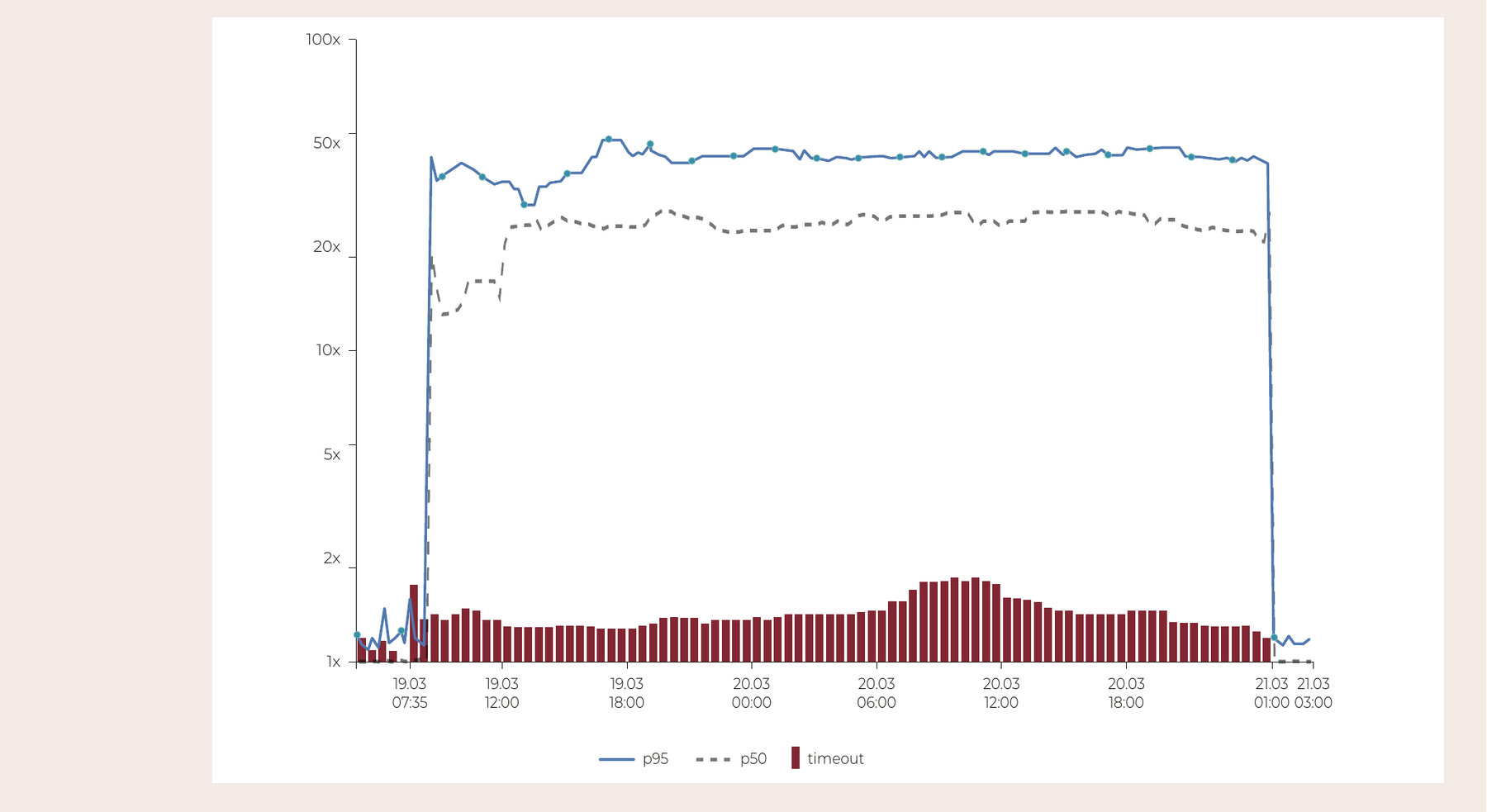
During the public protests that began with the detention of the Mayor of the Istanbul Metropolitan Municipality, Ekrem İmamoğlu, on 19 March 2025, a bandwidth throttling measure was applied across Istanbul for approximately 42 hours against the X (Twitter), Instagram, Facebook, TikTok, YouTube, Twitch, WhatsApp, Telegram and Signal platforms.275 Going beyond grounds such as “terror” or “disaster”, this implementation, which directly targeted the communications of the political opposition, constitutes the clearest indication that the authority in Article 60(10) of Law No. 5809 has been instrumentalised, under the cover of the concept of “public order”, as a direct tool of political intervention. The scope of the throttling is striking when compared with prior implementations: the targeting also of encrypted communications applications such as Signal shows that the State has broadened its censorship spectrum from social media platforms alone toward encrypted communications applications.
In the freedom-of-information request made with a view to clarifying the judicial and administrative foundations of this political censorship practice, BTK copied verbatim the “formal compliance” tactic used in the TUSAŞ case. In its response of 24.04.2025, the Authority, referring to Article 9 of Law No. 4982, instead of providing copies of the requested Presidential decision and the criminal-judgeship-of-peace approval decision, confined itself to notifying only the dates and reference numbers of the decisions.277 The content, ground and scope of the decisions were, once again, withheld from the applicant on the asserted basis of the security classification “Restricted”.
This strategy of the administration was, once again, found unlawful by the courts. The Ankara 22nd Administrative Court, in its decision of 30.10.2025, reaching the conclusion that “there is no compliance with the law in the contested action established in such a way as to reject the request without the ground on which the requested information and documents were said to be confidential and to carry the security classification ‘restricted’ being indicated”, annulled the administrative action.278 The administration, however, notwithstanding this clear judicial decision, has persisted in not sharing with the public the documents of this politically-charged censorship implementation, and has lodged an appeal against the decision.279
7 September 2025: Police Cordon of the CHP Istanbul Provincial Headquarters
Following the placing of the CHP Istanbul Provincial Headquarters under a police cordon on 7 September 2025, a bandwidth throttling measure was applied, with effect from 23:45, against the X, Instagram, YouTube, TikTok, Facebook, WhatsApp, Telegram and Signal platforms.280 The implementation, lasting approximately 21 hours, is in the nature of a continuation of the 19 March 2025 implementation.
This implementation, too, was carried onto the agenda of the Turkish Grand National Assembly. In the written parliamentary questions of 11.09.2025 submitted by CHP MP for Sivas Ulaş Karasu and CHP MP for Istanbul Ali Gökçek, the legal basis and grounds for the throttling were asked.281 As in the prior implementations, the responses given to the questions contained no concrete information, and were dispatched by the administration with standard and boilerplate texts.
In the freedom-of-information request submitted with a view to accessing the legal foundations of the implementation, BTK, in turn, copied verbatim the “partial response” strategy it had systematised in earlier cases. In its response, the Authority confined itself to notifying only the identification of the decision. It stated that the measures had been “determined by the decision of the Presidency’s Secretariat General, General Directorate of Security Affairs”, and that they had been “approved by decision no 2025/10155 D. of the Ankara 6th Criminal Judgeship of Peace dated 08.09.2025”. Copies of the requested Presidential decision and the criminal judgeship of peace approval decision were, once again, not provided to the applicant.
The most striking dimension of BTK’s response is that the administration now openly demonstrates its awareness of the judicial decisions previously rendered against it, yet does not alter its conduct. The Authority, in its response, expressly cited the Ankara 15th Administrative Court’s decision of 15.02.2024 and the Ankara 22nd Administrative Court’s decisions of 28.10.2025 and 30.10.2025, and accepted that the reasoning of those decisions was “of the same character and consists in the failure to specify the ground of the security classification in the administrative actions”. In other words, the administration concedes that it is aware of the courts’ open findings that “there cannot be confidentiality without grounds”, but, instead of complying with those decisions, asserts that the ground of the security classification “lies within the institutional competence of the institution from which the decisions emanate”, and transfers the responsibility to the Presidency. This stance shows that the administration is pursuing a deliberate and intentional strategy of de facto resistance; it has entered into a systematic spiral of unlawfulness, in which it is compelled to accept judicial decisions but refrains from implementing them.
Against this refusal of the administration, an action seeking the annulment of the administrative action concerning the non-provision of the information and documents requested under the Right to Information Law No. 4982 was brought before the Ankara 17th Administrative Court.282 The action is currently pending.
Throttling Sanctions Under Law No. 5651
In Turkish law, throttling is regulated as a sanction not only under the Electronic Communications Law No. 5809 but also under Law No. 5651.283 Supplemental Article 4 of Law No. 5651 envisages three different bandwidth throttling mechanisms directed at social network providers:
Breach of the Obligation to Designate a Representative (Supplemental Article 4(2))
Under this regulation, introduced by Law No. 7253 in 2020, foreign-origin social network providers with daily access exceeding one million users in Türkiye are obliged to designate an authorised representative in Türkiye. Where this obligation is not fulfilled, a graduated “punishment ladder” is envisaged, beginning with administrative fines, extending to advertising bans and finally to bandwidth throttling. If, within three months of the imposition of the advertising ban, the obligation is still not fulfilled, the President of BTK may apply to the criminal judgeship of peace to request bandwidth throttling, first at the rate of 50 per cent and, if resistance continues, at the rate of 90 per cent.
Refusal to Share Information on Perpetrators (Supplemental Article 4(5))
Introduced by Law No. 7418, which entered into force in October 2022, this regulation has made the throttling sanction a coercive tool of criminal procedure. In investigations of the catalogue offences listed in the Turkish Criminal Code and of the offence of “publicly disseminating misleading information” (Article 217/A), where the information requested by the prosecutor or the court (user identity, IP address, and so forth) is not provided by the social network provider’s representative in Türkiye, the prosecutor or the court may apply directly to the Ankara Criminal Judgeship of Peace to request bandwidth throttling at the rate of 90 per cent.
Breach of the Obligations to Execute Administrative Decisions and to Remove Content (Supplemental Article 4(10))
Where the requirements of the content-removal and/or access-blocking decisions issued by the President of BTK are not implemented, the platform may be subjected first to an advertising ban of up to six months, and thereafter to bandwidth throttling at the rate first of 50 per cent and then of 90 per cent. This regulation envisages the rendering inoperative of the entire platform on account of the failure to remove individual items of content.
The common denominator of the three mechanisms summarised above is the logic of collective punishment: the price of the failure to fulfil a platform-level obligation is imposed, the principle of proportionality having been entirely shelved, on the freedom of expression, the right to receive information and the freedom of communication of millions of users wholly unconnected with the matter.
Over-the-Top (OTT) Services and the Throttling Sanctions Under Law No. 5809
Similarly, within the framework of Law No. 5809, throttling sanctions are also envisaged in respect of over-the-top service providers.284 The articles added to Law No. 5809 by Law No. 7418 in 2022 introduced the over-the-top (OTT) services regulation publicly known as the “WhatsApp Law”. The new paragraphs 16 and 17 added to Article 60 of the Law envisage, for non-compliant OTT services, first an administrative fine of up to TRY 30 million, and, in the event of non-payment or of the failure to provide information, the throttling of Internet traffic bandwidth by 95 per cent. Although this regulation has not yet been applied owing to the lack of secondary legislation, the draft regulation put out for public consultation by BTK in March 2025 shows that this threat may at any moment become concrete.
That said, the administrative sanctions defined under Law No. 5651 and Law No. 5809 were not applied in the course of 2025.
Assessment
As all of the examples above show, bandwidth throttling practices in Türkiye are systematically conducted in secret, the administration’s access interventions remain closed to judicial review, and the public is not informed about the grounds for these interventions, which directly affect the right to receive information. By contrast, the Constitutional Court has expressly stated that documents relating to such interventions “concern the public interest” and that their “informational value is very high”.285 Notwithstanding this, the information and documents requested are systematically kept secret by BTK in defiance of the judicial decisions.
The 2025 practices, in turn, lay bare that throttling has now been transformed, beyond “national security” grounds such as terrorist attacks or natural disasters, into an institutionalised “crisis-management tool” directly targeting political protests and the communications of the political opposition.286 Indeed, in a recent judgment of the Constitutional Court, the failure of the administration to provide the information requested notwithstanding a final judicial decision was unanimously held to violate the freedom of expression guaranteed by Article 26 of the Constitution.287 That judgment emphasises that the administration’s withholding of information without offering relevant and sufficient grounds is not consistent with the requirements of a democratic social order.
-
Article 60(10), entitled “Authority of the Authority and Administrative Sanctions” (Added: 15.08.2016–Decree-Law No. 671/Article 25; adopted unchanged: 09.11.2016–Law No. 6757/Article 22) In cases where delay would be prejudicial, on the basis of one or more of the grounds enumerated in Article 22 of the Constitution, the Presidency shall determine the measures to be taken and shall communicate them to the Authority for implementation. The President of the Authority shall communicate the decision concerning the measures deemed necessary by the Presidency immediately to all operators, access providers, data centres and to the relevant content and hosting providers. The requirements of that decision shall be carried out immediately and at the latest within two hours of the notification of the decision. That decision shall be submitted within twenty-four hours to the approval of the criminal judge of peace. The judge shall give a decision within forty-eight hours; otherwise the decision shall lapse ipso jure. ↩
-
“Twitter yasağına isyan ettiler” (HalkTV, 09.02.2023) https://halktv.com.tr/yasam/twitter-yasagina-isyan-ettiler-718220h ↩
-
Ankara 15th Administrative Court, E. 2023/794, K. 2024/186, 15.02.2024. ↩
-
Ankara Regional Administrative Court, 12th Administrative Chamber, E. 2024/917, K. 2024/2233, 13.11.2024. ↩
-
Constitutional Court, App No 2025/4356, 23.01.2025. ↩
-
In its response no 416541118 of 18.11.2024 to the freedom-of-information request, BTK stated: “The measures determined by the decision of 23.10.2024 of the Presidency’s Directorate of Administrative Affairs, General Directorate of Security Affairs, on the ground that the images shared on the Internet relating to the terrorist attack carried out on 23.10.2024 against the TUSAŞ facilities in the Kahramankazan district of Ankara would create fear, panic and turmoil in society, were approved by decision no 2024/14342 of the Ankara 3rd Criminal Judgeship of Peace dated 23.10.2024, within the scope of Article 60(10) of Law No. 5809.” ↩
-
Ankara 22nd Administrative Court, E. 2025/23, K. 2025/1644, 28.10.2025. ↩
-
Ankara Regional Administrative Court, 12th Administrative Chamber, Appeal No 2025/1376. ↩
-
Ankara Regional Administrative Court, 12th Administrative Chamber, E. 2026/130, K. 2026/1130, 13.05.2026. ↩
-
Freedom of Expression Association, EngelliWeb Announcement, “Bant Genişliği Daraltılan Platformlar” (19.03.2025) https://ifade.org.tr/engelliweb/bant-genisligi-daraltilan-platformlar/ (accessed 07.03.2026). ↩
-
Within the framework of the EngelliWeb project, the access performance of widely-used social media, messaging and video platforms such as X, Instagram, Facebook, WhatsApp, Telegram, Signal, YouTube, TikTok and Twitch has been measured. The chart shows how much access to those platforms slowed in comparison with normal periods: 1x denotes normal access speed, while 50x denotes a latency approximately fifty times higher than normal. The line’s remaining at a high level throughout the problem window indicates that, rather than a temporary and isolated disruption in access to those platforms, a widespread and pronounced slowdown was experienced. ↩
-
In its response of 24.04.2025 to the freedom-of-information request, BTK shared the identification of the decision in the following terms: “…within the scope of Article 60(10) of the Electronic Communications Law No. 5809; the measures determined by the decision of 19.03.2025 of the Presidency’s Secretariat General, General Directorate of Security Affairs, were approved by decision no 2025/3720 of the Ankara 7th Criminal Judgeship of Peace dated 19.03.2025… the implementation was terminated by decision of 21.03.2025…”. ↩
-
Ankara 22nd Administrative Court, E. 2025/839, K. 2025/1669, 30.10.2025. ↩
-
Ankara Regional Administrative Court, 12th Administrative Chamber, Appeal No 2025/1478. ↩
-
Freedom of Expression Association, EngelliWeb Announcement, “Bant Genişliği Daraltılan Platformlar” (07.09.2025) https://ifade.org.tr/engelliweb/bant-genisligi-daraltilan-platformlar-3/ (accessed 24.04.2026). ↩
-
Written question of Ulaş Karasu, CHP Member of Parliament for Sivas, of 11.09.2025 on the throttling that followed the cordon around the CHP Istanbul Provincial Headquarters (File No 7/34122), and the response thereto (31.10.2025); written question of Ali Gökçek, CHP Member of Parliament for Istanbul, of 11.09.2025 on throttling across Istanbul (File No 7/34120), and the response thereto (31.10.2025). ↩
-
Ankara 17th Administrative Court, E. 2026/328. ↩
-
Law No. 5651, Supplemental Article 4(2), (5) and (10). ↩
-
Electronic Communications Law No. 5809, art 60(16)-(17). ↩
-
Yaman Akdeniz (2) [Plenary], App No 2016/6815, 15.02.2023. ↩
-
Y Akdeniz, “Invisible Censorship: Bandwidth Throttling Sanctions in Turkish Law and the Freedom of Information Impasse,” (unpublished draft, 2026). ↩
-
Yaman Akdeniz (3), App No 2022/4380, 02.07.2025. ↩