Domain Names, URLs, News Articles and Content Blocked from Access in 2025¶
General Assessment of Domain Name Blocking Practices¶
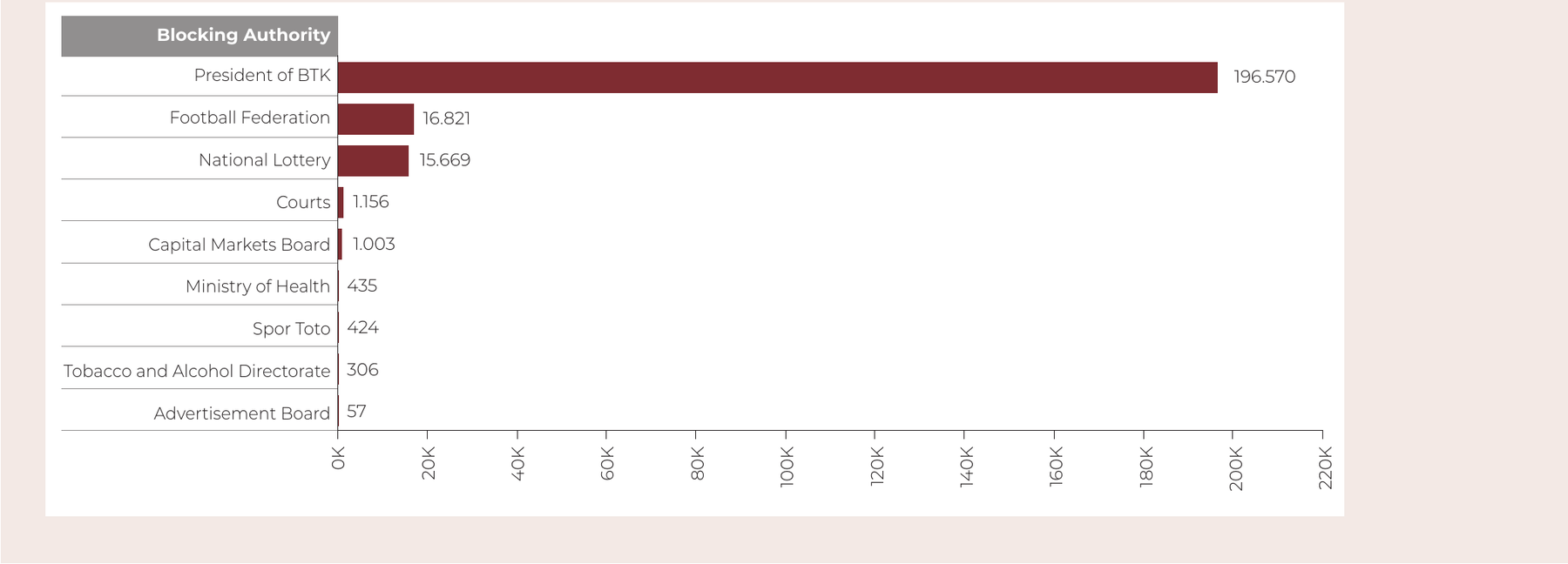
Within the scope of the EngelliWeb project, as far as we have been able to identify in 2025, a total of 232.441 domain names were blocked from Türkiye. As shown in Figure 2, the great majority of these blockings —196.570 domain names (84,6%) — were blocked by the President of BTK under Article 8 of Law No. 5651.51 In 2025, the Turkish Football Federation, which was granted access blocking authority in 2021, blocked 16.821 domain names (7,2%), while in third place the National Lottery Administration blocked 15.669 domain names (6,7%). It was further identified that, in 2025, 1.156 domain names were blocked by judicial decisions (criminal judgeships of peace, public prosecutors' offices and courts), 1.003 by the Capital Markets Board, 435 by the Turkish Medicines and Medical Devices Agency of the Ministry of Health, 424 by the Sports Toto Organisation Presidency, 306 by the Tobacco and Alcohol Department of the Ministry of Agriculture and Forestry, and 57 by the Advertising Board.
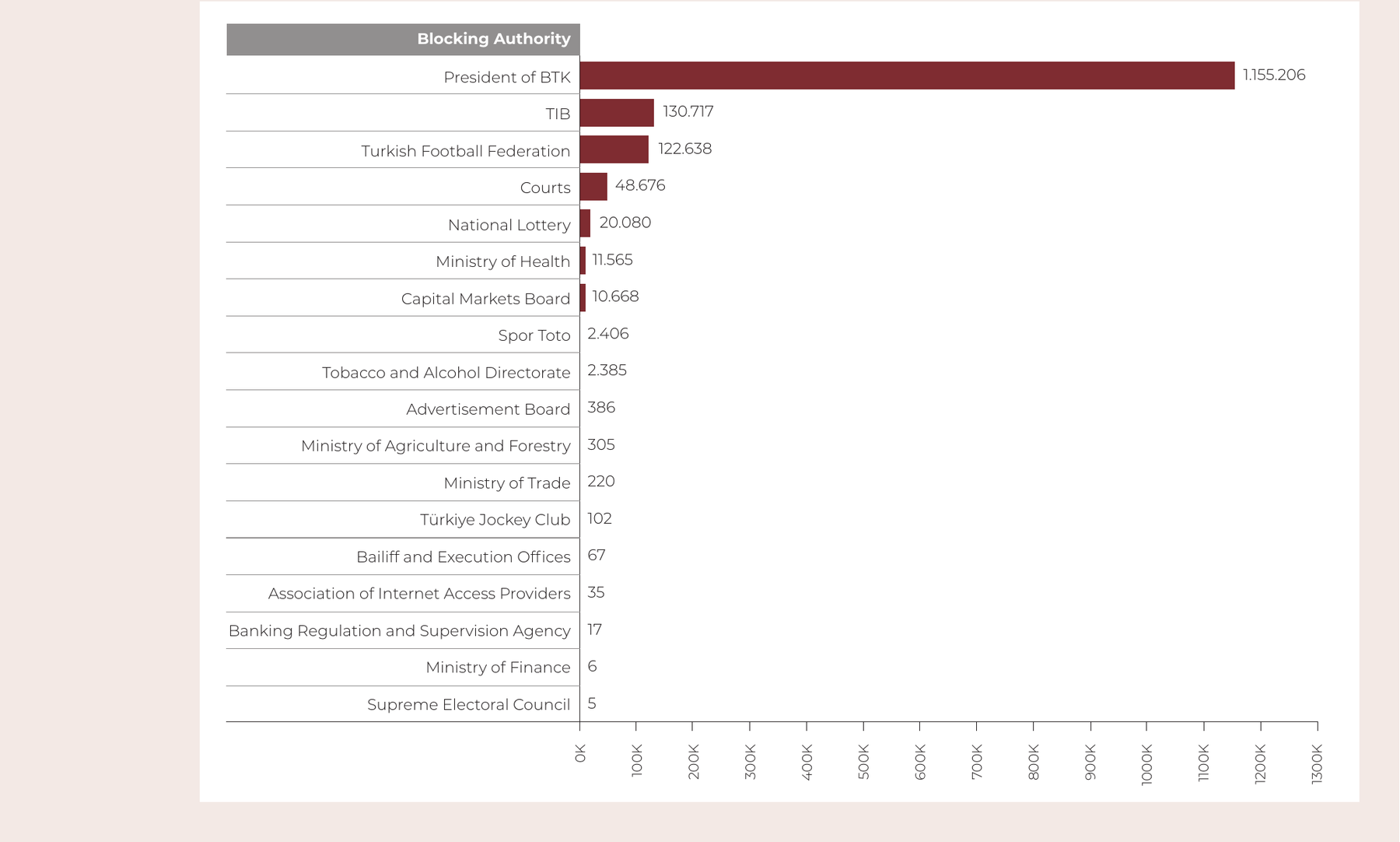
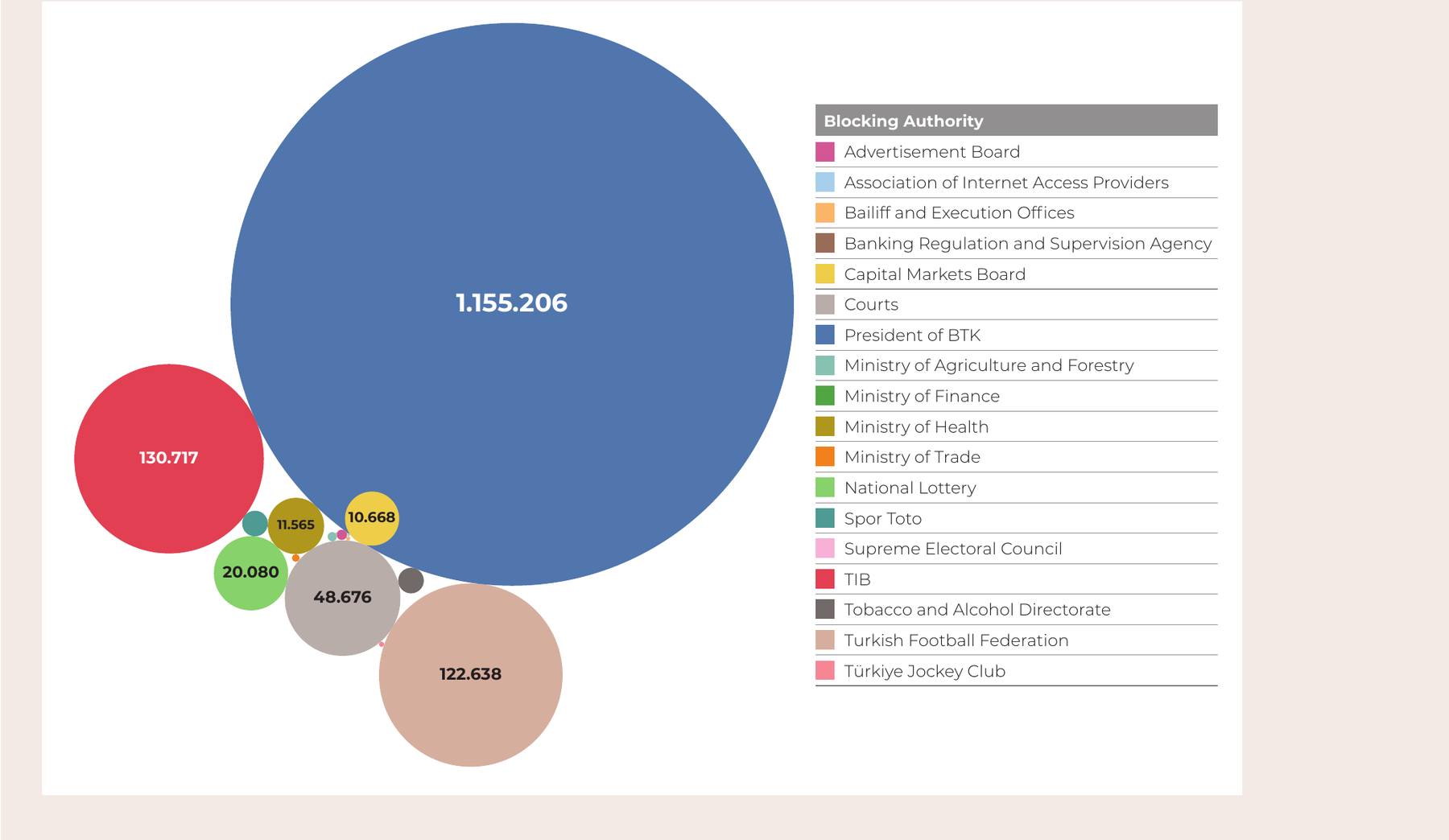
With these blockings, the total number of domain names blocked from Türkiye as of the end of 2025 reached 1.505.484. As shown in Figures 3 and 4, as of the end of 2025 a total of 1.285.923 websites blocked from Türkiye have been blocked under Article 8 of Law No. 5651 by administrative measure decisions — 130.717 of these by TİB before its abolition, and 1.155.206 by the President of BTK after the abolition of TİB. In addition, 122.638 domain names have been blocked by the Turkish Football Federation. Cumulatively, 48.676 domain names and websites have been blocked by the judiciary (criminal judgeships of peace, public prosecutors' offices and courts), 20.080 by the National Lottery Administration, 11.565 by the Ministry of Health, 10.668 by the Capital Markets Board, 2.406 by the Sports Toto Organisation Presidency, 2.385 by the Tobacco and Alcohol Department (Ministry of Agriculture and Forestry), 386 by the Advertising Board, 305 by the Ministry of Agriculture and Forestry, 220 by the Ministry of Customs and Trade, 102 by the Turkish Jockey Club, 67 by enforcement offices, 35 by the Association of Access Providers, 17 by the Banking Regulation and Supervision Agency (“BDDK”), 6 by the Ministry of Finance and 5 by the Supreme Election Council (“YSK”).
At first glance, the 2025 figures, when compared with the 2024 data, may appear to indicate a relative decline. While the number of access blockings identified in 2024 stood at 314.843, this figure fell to 232.441 in 2025. This apparent decline, however, cannot be interpreted as signalling a structural transformation in access blocking practices or a narrowing of their scope. The principal explanation for the fall must be sought not in BTK’s administrative decisions under Article 8 but in the sharp drop in Turkish Football Federation (“TFF”) blockings. The number of domain names blocked by the TFF fell from 50.120 in 2024 to 16.821 in 2025; this single category statistically accounts for the primary cause of the year-on-year decline. By contrast, although the number of domain names blocked by the President of BTK through administrative measure decisions, the true centre of gravity of access blocking practice, fell from 257.639 in 2024 to 196.570 in 2025, BTK’s proportional share of total blockings rose from 82% to 84,6% over the same period. This figure shows that access blockings are increasingly being concentrated in a single administrative authority; while institutional diversity recedes into the background, BTK’s dominance deepens. The 2025 data therefore carry the risk of producing a misleading impression of relief when read on the basis of absolute figures. Yet, when subjected to a proportional and structural analysis, they reveal that the dynamic of intensification of administrative censorship continues, and that the centralising dynamic exercised by the President of BTK under Article 8 of Law No. 5651 continues to gain strength.
At the opposite end of this picture, certain secondary institutions are seen to have markedly intensified their blocking practices as of 2025. The most striking example of this trend is the National Lottery Administration: while in 2024 a total of 2.875 domain names were blocked by 63 decisions, in 2025 the number of decisions rose to 266 and the number of blocked domain names to 15.669. The increase in the number of blocked domain names is approximately 5,5-fold, and the increase in the number of decisions approximately 4,2-fold. The fact that the number of domain names blocked per decision rose only modestly, from 46 to 59, indicates that the overall increase is driven not by more domain names being targeted in each decision, but rather by a fundamental rise in the frequency of decision-making. The monthly distribution likewise confirms this structural shift: the blocking practice, which proceeded at a relatively contained pace in the first six months of 2025, accelerated sharply from July onwards, with the number of domain names blocked monthly between July and December consistently exceeding 1.897. The fact that 5.631 domain names were reached in just the first three months of 2026 shows that this intensified pace of blocking has acquired structural continuity. The “Action Plan to Combat Illegal Betting, Games of Chance and Gambling in the Virtual Environment (2025–2026)”, brought into force by Presidential Circular in November 2025, and the announcement at the subsequent monitoring meeting that the granting of “additional powers” to the National Lottery Administration and BTK in this field is under consideration, indicate that the observed increase in blocking is not coincidental but rather the product of a coordinated administrative mobilisation.52
A similar trend of intensification is also observed in Directorate of Spor Toto Organization blockings: the blocking volume, limited to 136 domain names in 2024, rose to 424 in 2025, more than tripling in under three years. The pattern displayed by these two institutions indicates that, alongside the central pressure created by BTK’s dominance, sectoral regulatory bodies are also exercising their access blocking authority with increasing aggression. The blocking practice is therefore continuing to intensify not only at the centre but also at the periphery.
In this context, the Presidential Circular entitled “Action Plan to Combat Illegal Betting, Games of Chance and Gambling in the Virtual Environment (2025–2026)”, signed by the President and published in the Official Gazette in November 2025, constitutes the legal backdrop to the observed institutional mobilisation. The official statement shared with the public at the Action Plan Monitoring Meeting held in January 2026 disclosed that, over the 2006–2025 period, a total of 548.420 illegal betting and virtual gambling sites had been blocked, and that 84.585 Internet sites in this category had been blocked in 2025. That same statement, however, is far from reflecting the institutional architecture of blocking practices in its entirety. According to EngelliWeb data, in 2025 approximately 70% of the 196.570 domain names blocked by the President of BTK, that is, 137.600 of them are gambling and betting sites. When the 15.669 domain names blocked by the National Lottery Administration and the 424 domain names blocked by the Directorate of Spor Toto Organization are added to these figures, the blockings by these three institutions alone in the betting and gambling category exceed 153.500. Where the government’s figure of 84.585 sits within this picture remains unanswered in official communications. A further structural shift is observable when comparison is made with 2024 data. Whereas in 2024 betting and gambling sites accounted for approximately 86% of BTK’s 257.639 blockings, this share fell to 70% in 2025. In other words, BTK’s absolute blocking volume in the betting/gambling category fell from approximately 221.000 to 137.600. Over the same period, the surge in National Lottery Administration blockings from 2.875 to 15.669 indicates that the blocking burden in the betting and gambling field has shifted in part from BTK to other administrative bodies, and that the Action Plan has operationally activated sectoral regulatory bodies in this area. The failure of official communications to report this institutional distribution in an integrated manner renders the true volume and institutional reach of access blocking practices invisible. This remains a structural problem from the perspective of the principles of transparency and accountability.
The 2025 data confirm once again that access blocking practices in Türkiye continue to centralise structurally while preserving their quantitative scale. In particular, the blocking of hundreds of thousands of domain names by the President of BTK alone, through administrative decisions issued under Article 8 of Law No. 5651, demonstrates that access blockings have become a systematic and centralised censorship mechanism. At the same time, the increase in the number of institutions granted access blocking authority, and the increasingly broad exercise of these powers, transforms the access blocking practice from a tool confined to content control into a far more comprehensive instrument of control.
The arbitrary narrowing, by public institutions other than the judiciary (for example the Turkish Football Federation, the Capital Markets Board and the National Lottery Administration), through administrative decisions, of the field of expression and access to information, signals the construction of a censorship regime that escapes judicial oversight. The implementation of the great majority of access blocking decisions without any disclosed reasoning and without judicial review seriously erodes the principles of transparency, accountability and legal foreseeability.
Against this backdrop, access blockings are now being used not only within the framework of lawfulness or the protection of personality rights, but increasingly for the suppression of political, economic and social content. This reveals that, with respect to freedom of expression, freedom of the press and the right of access to information in Türkiye, the limits drawn by the case law of the ECtHR and of the Constitutional Court are being systematically exceeded. The 2025 data show clearly that, alongside their sheer volumetric scale, access blockings have acquired the character of a systematic interference with the exercise of rights and freedoms.
Domain Names Blocked from Access Under Article 8 of Law No. 5651¶
Law No. 5651 on Regulation of Publications on the Internet and Combating Crimes Committed by Means of Such Publications entered into force on 4 May 2007. By the amendment made to Article 8 of Law No. 5651 in July 2020,53 the “content removal” sanction was added to the Article in addition to the access blocking measure.
With this amendment, Article 8 now provides that “content removal and/or access blocking shall be ordered in respect of publications on the Internet where there is sufficient suspicion that the content constitutes the offences listed below”. The offences brought within the scope of this provision are: incitement to suicide,54 sexual abuse of children,55 facilitating the use of narcotic or stimulant substances,56 supply of substances dangerous to health,57 obscenity,58 prostitution,59 and providing a place and opportunity for gambling,60 all set out in the Turkish Penal Code; the offences set out in Law No. 5816 on Offences Committed Against Atatürk; and the offences set out in Law No. 7258 on the Regulation of Betting and Games of Chance in Football and Other Sports Competitions.61
By Article 32 of Law No. 7418 on Amendments to the Press Law and Certain Laws, adopted in October 2022, paragraph (ç) was added to Article 8(1) of Law No. 5651, bringing within the catalogue of offences content constituting offences against the activities62 and personnel63 of the National Intelligence Organisation.
Decision-Making Methods and Implementation Practice Under Article 8 of Law No. 5651¶
“Content removal” and/or “access blocking” decisions in respect of content falling within the scope of Article 8 of Law No. 5651 may be issued by two distinct routes. The first is by way of protective measure: such decisions may be issued by a criminal judgeship of peace at the investigation stage and by a court at the prosecution stage. The second route is by way of administrative measure. In this context, content removal and/or access blocking decisions concerning the offences listed in Article 8 may be issued ex officio by TİB and, following its abolition, by the President of BTK.64 In practice, the great majority of decisions issued under Article 8 are taken through these administrative measure decisions, with protective measure decisions issued by investigation or prosecution authorities remaining very limited in number.
Under the legislative arrangement formerly in force, the President of BTK had been expressly granted ex officio decision-making authority “where the content or hosting provider of the publication is abroad” or where, “even where the content or hosting provider is within Türkiye, the content concerns the offences of sexual abuse of children, prostitution or providing a place and opportunity for gambling”. This provision was, however, repealed by Article 32 of Law No. 7418 of 13.10.2022.
The Constitutional Court’s Annulment of the President of BTK’s Ex Officio Authority¶
Prior to the amendments that entered into force in October 2022, the President of BTK’s authority to block access to foreign sites containing obscene content was annulled by the Constitutional Court. This judgment of the Constitutional Court was published in the Official Gazette on 07.02.2018, and has been comprehensively assessed in our EngelliWeb reports for 2018 to 2024.
Upon the constitutional challenge made by way of objection by the 13th Chamber of the Council of State, the Constitutional Court, by a majority, found the ex officio access blocking authority granted to the President of BTK under Article 8/4 of Law No. 5651, in respect of “obscene” (Article 8(1) paragraph 5) sites originating from abroad, to be contrary to the Constitution and annulled it.65 As justification for the annulment, the Court found that “even where a publication whose content constitutes a crime is hosted on Internet sites providing mass communication and which do not have the purpose of committing or facilitating a crime, the administration may issue an access blocking decision ex officio without a judge’s approval”. This was held to be contrary to the rule-of-law principle and, in particular, to the principle of legal certainty. The principle of legal certainty requires that legal arrangements be clear, foreseeable, intelligible and objective in a manner leaving no room for doubt or hesitation, both for individuals and for the administration, and that they do not afford public authorities the possibility of arbitrary interference. The Constitutional Court held that the ex officio access blocking authority granted to the President of BTK was contrary to these fundamental principles.
Implementation of the Constitutional Court’s Decision on the President of BTK’s Ex Officio Authority and Subsequent Developments¶
In its judgment published in the Official Gazette on 07.02.2018, the Constitutional Court annulled the President of BTK’s ex officio access blocking authority over foreign sites containing obscene content, granted by Article 8/4 of Law No. 5651, setting the date on which the annulment was to enter into force as one year later, namely 07.02.2019. At the end of that period, and as of 07.02.2019, since no new amendment had been made to the law, the President of BTK’s authority in this respect came to an end and access blocking decisions on the ground of obscenity could be issued only by criminal judgeships of peace.
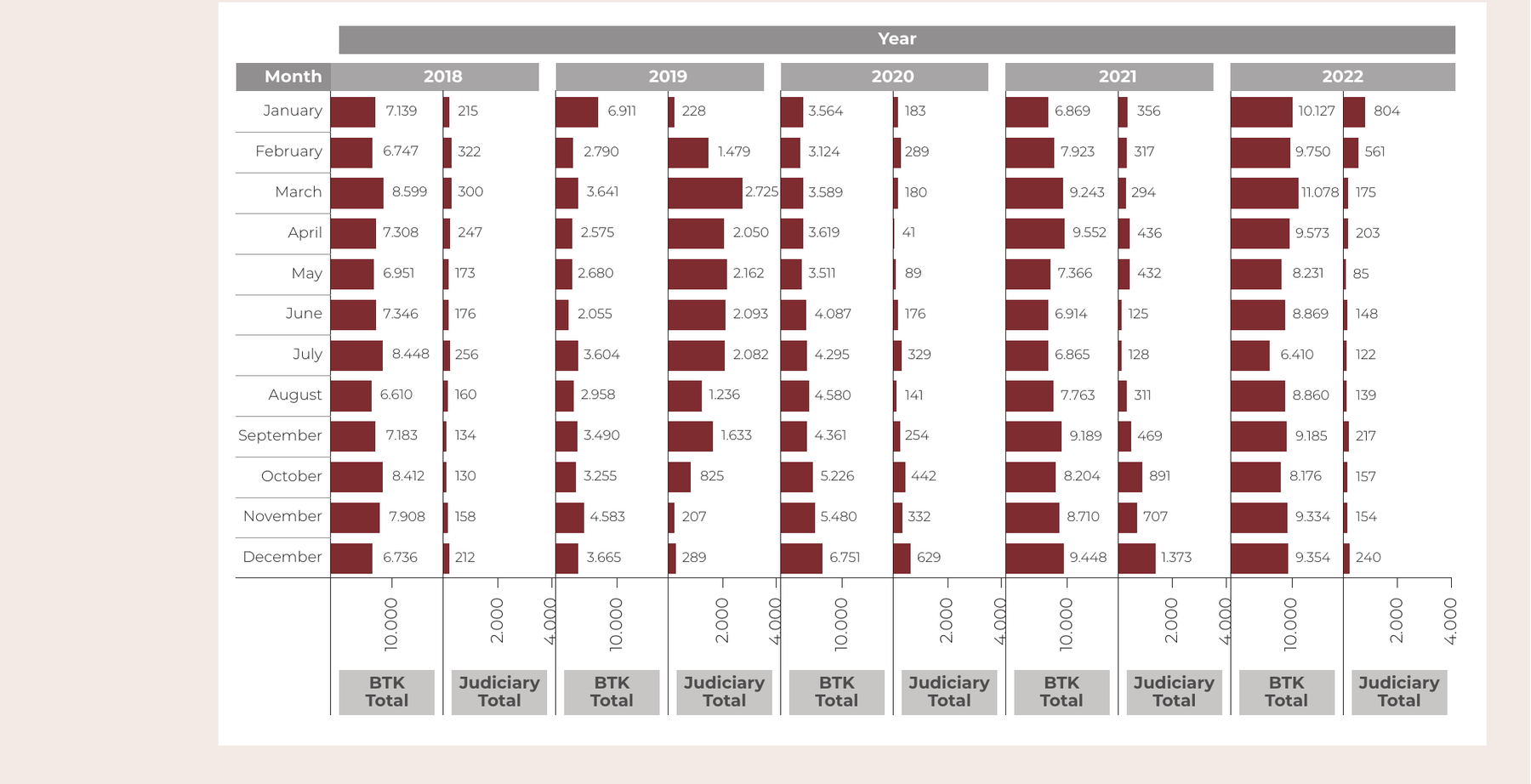
In practice, however, this limitation was not observed. As detailed in our 2019 EngelliWeb report and in subsequent annual reports, the President of BTK continued to disregard the Constitutional Court’s judgment after the date on which it took effect, issuing ex officio administrative measure decisions without a judge’s approval. As shown in Figure 5, the President of BTK for a brief period (February to October 2019) did obtain approval from criminal judgeships of peace, but this practice appears to have been abandoned as of November 2019. In 2020 and in subsequent years, the number of decisions issued ex officio by the President of BTK can be seen to have risen sharply. Over the same period, the number of decisions issued by judicial bodies underwent a marked decline.
Given that the great majority of domain names blocked by the President of BTK during this period consisted of sites with obscene content, the issuance of these decisions without a judge’s approval was manifestly unlawful. This unlawful state of affairs was “legally” resolved by the comprehensive amendment effected by Law No. 7418 on Amendments to the Press Law and Certain Laws of October 2022. By Article 32 of that Law, the “domestic/foreign” distinction in Article 8(4) of Law No. 5651 was entirely abolished, and the President of BTK’s access blocking authority was re-enacted on an expanded basis without any distinction between domestic and foreign sources. The legislative justification submitted to the TBMM with the bill described the rationale for this amendment as “resolving the difficulties encountered in determining where the content or hosting provider is located, owing to the dispersed and dynamic nature of the Internet, and the resulting dispute as to jurisdiction”.66
This arrangement broadened still further the provision that the Constitutional Court had found to be “contrary to the principle of legal certainty” and to confer on the administration “the authority to take ex officio decisions without a judge’s approval”, and a renewed and yet more unbounded discretion was vested in the President of BTK. The Constitutional Court’s annulment was thereby rendered, in effect, a dead letter. In other words, an express constitutional oversight mechanism was neutralised by way of legislation.
The Constitutional Court’s 2023 Decision on Article 8 of Law No. 5651¶
The “content removal” measure was introduced into Article 8 of Law No. 5651 by the legislative amendments of July 2020. In September 2020, the Republican People’s Party (CHP) brought an annulment action before the Constitutional Court challenging these amendments, and the Court delivered its judgment in 2023.67 Its review focused on the constitutionality of the newly introduced “content removal” measure.
In summary, the annulment application argued that the responsibility of hosting and access providers had been expanded; that, while unlawful content should be requested only of content providers, this obligation had also been imposed on hosting providers; that, although administrative decisions were implemented within a short time, the revocation of erroneous decisions took a long time; that the content removal measure directed at hosting providers located abroad was contrary to international law; and that these arrangements were contrary to Articles 2, 6, 13, 22, 26, 28, 38 and 48 of the Constitution.68
The Constitutional Court examined whether the content removal decision was inconsistent with the presumption of innocence, conducting its analysis under Article 36 of the Constitution (the right to a fair trial) and Article 38(4) (the presumption of innocence).69 In the Court’s view, the content removal decision issued under Article 8, although tied to a finding that a crime has been committed, is not of a criminal nature but is an administrative measure whose aim is the permanent removal from the Internet of content constituting a crime.70
The Constitutional Court nonetheless drew attention to the fact that the presumption of innocence applies not only in the context of criminal proceedings but also in all administrative, legal and disciplinary processes carried out in parallel to that process.71 In this respect, the Constitutional Court stated that “for a content removal measure to be applied, it shall be necessary and sufficient that the President of BTK has determined that the offences listed in paragraph (1) of Article 8 have been committed”.72 By this rule, accordingly, “it is neither required that criminal proceedings be initiated against the person making the publication, nor is it required that that person have been convicted by a criminal court”.73 In other words, the issuance of a final content removal decision based solely on a finding of alleged criminal activity made by the administrative authority, in the absence of any prosecution or conviction, leads to the person being treated as guilty without a criminal court ruling and prejudices the presumption of innocence.74
The Court also drew attention to the fact that, even where criminal proceedings conclude with a decision other than a conviction, the content removal decision continues to be enforced,75 producing a final and irreversible result. The Constitutional Court accordingly held that “final content removal decisions issued solely on the basis of an administrative authority’s finding, before the commission of a criminal offence has been established by a final court judgment, violate the presumption of innocence”. It further held that the imposition of an administrative fine for non-compliance with such a decision likewise violates that principle.76 On these grounds, the measure was annulled as contrary to Articles 36 and 38 of the Constitution. The annulment took effect only on 10.10.2024.77
Notable Access Blocking Decisions Taken by BTK and Other Institutions in 2025¶
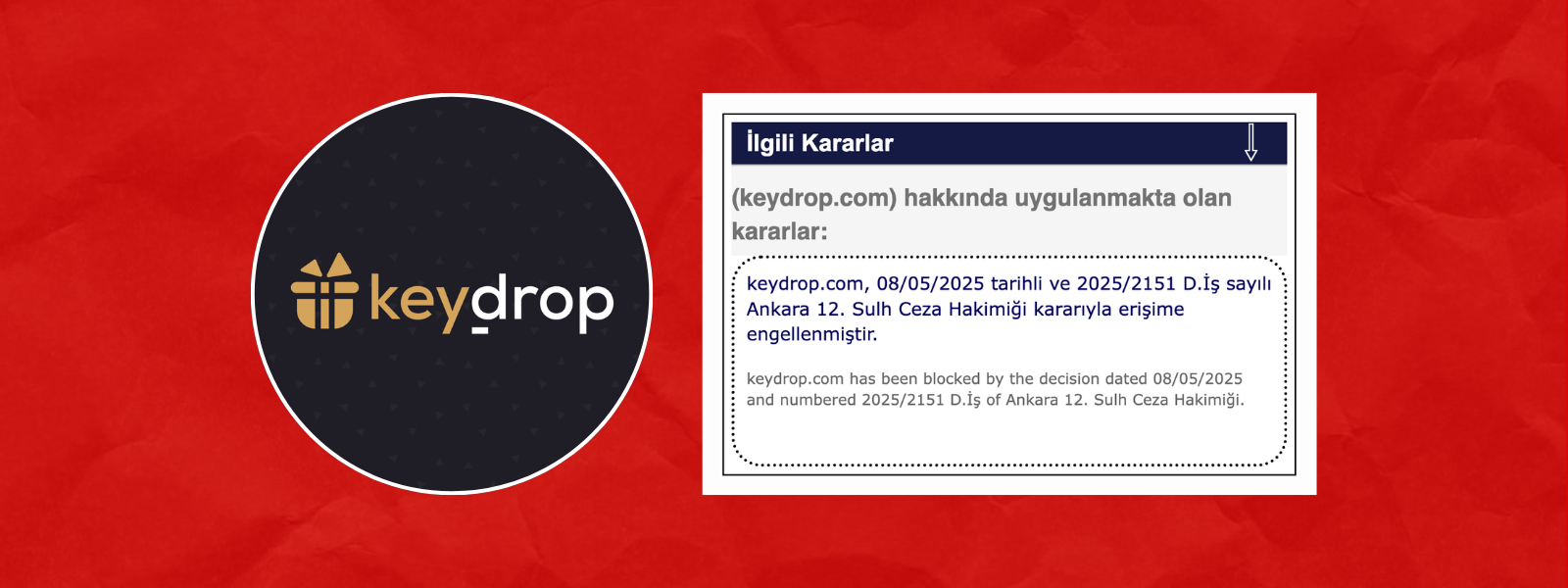
Notable access blocking decisions issued by BTK in 2025 once again laid bare the fact that the “illegal betting” ground has, in practice, been turned into a functionally meaningless content-classification criterion. Within this scope, the Key-Drop platform, on which CS:GO players open cases to win in-game cosmetic items (skins), was blocked from access on the ground of illegal betting by BTK’s decision no 490.05.01.2025.-96915 of 14.02.2025. That blocking was lifted shortly thereafter; however, the domain names keydrop.com and key-drop.com were blocked from access a second time by Ankara 12th Criminal Judgeship of Peace decision no 2025/2151 of 08.05.2025.
Similarly, the domain zyngapoker.com of Zynga Poker, a purely entertainment Texas Hold’em application that offers no real-money prizes, was blocked from access on the ground of illegal betting by BTK’s decision no 490.05.01.2025.-311990 of 22.05.2025; the blocking was subsequently lifted.

Porofessor.gg, which provides real-time match analysis and statistics for League of Legends players, was also blocked from access on the ground of illegal betting by BTK’s decision no 490.05.01.2025.-118051 of 21.02.2025. The blocking of a game statistics platform that involves no real-money betting on this ground concretely demonstrates that the de facto scope of the “illegal betting” characterisation extends well beyond its statutory definition.

In 2025, blocking decisions whose grounds were either never disclosed or appeared disproportionate to those grounds also reached striking dimensions. The domain netlify.app of Netlify, which provides deployment and hosting infrastructure for web projects, was blocked from access on the ground of illegal betting by BTK’s decision no 490.05.01.2025.-118058 of 21.02.2025. This decision provides a striking example of the instrumentalization of hosting infrastructure for content control.

The anime streaming platform AnimeciX was blocked from access without any justification disclosed by BTK’s decision no 490.05.01.2025.-117589 of 21.02.2025.

The online platform Arkadium, which offers sudoku, puzzles and word games, was also blocked from access without justification by BTK’s decision no 490.05.01.2025.-412857 of 18.07.2025.

Blockings targeting technical infrastructure services also came clearly to the fore in 2025. The domain archive.ph of the web-page archiving tool archive.today was blocked from access by BTK’s decision no 490.05.01.2025.-377819 of 02.07.2025.

The popular dynamic DNS service Duck DNS was blocked from access by BTK’s decision no 490.05.01.2025.-565284 of 19.09.2025.

The direct targeting of dynamic DNS infrastructure signals that the blocking practice has escalated from the level of individual content or platforms to the level of network infrastructure. This development demonstrates that both the technical scope and the potential side-effects of access blocking, in other words systemic over-blocking, are expanding systematically.
Finally, the platform Fansly, on which content creators offer exclusive content on a subscription basis, was, following its 2024 blocking by BTK’s decision of 10.12.2024, blocked from access a second time on 21.10.2025 by a fresh BTK decision no 490.05.01.2025.-655614, laying bare the fact that blocking has been transformed not into a means of permanent resolution but into a repetitive administrative reflex.

Taken as a whole, the access blocking decisions issued by BTK during 2025 reveal that the actual scope of the “illegal betting” ground has overflowed well beyond its statutory definition; that ground has been transformed into a functional umbrella legitimising a wide spectrum that extends from game statistics platforms to hosting infrastructure, and from puzzle sites to dynamic DNS services.
Alongside BTK’s applications under Article 8, sectoral regulatory bodies have also been concretely documented as using their access blocking authority through increasingly expansive interpretations in 2025. The most striking example of this picture is Amazon Web Services’ live streaming infrastructure service Amazon IVS: the domain live-video.net was blocked from access on the ground of illegal betting by the National Lottery Administration’s decision no 2025/134 of 16.09.2025, and this decision also effectively interrupted live streaming on platforms directly using Amazon IVS infrastructure, including Kick.com. Assessed together with the Netlify blocking, these two decisions clearly demonstrate that access blocking is evolving from individual content targeting towards the disabling of integrated infrastructure layers, and that this evolution inevitably deepens the problem of over-blocking.

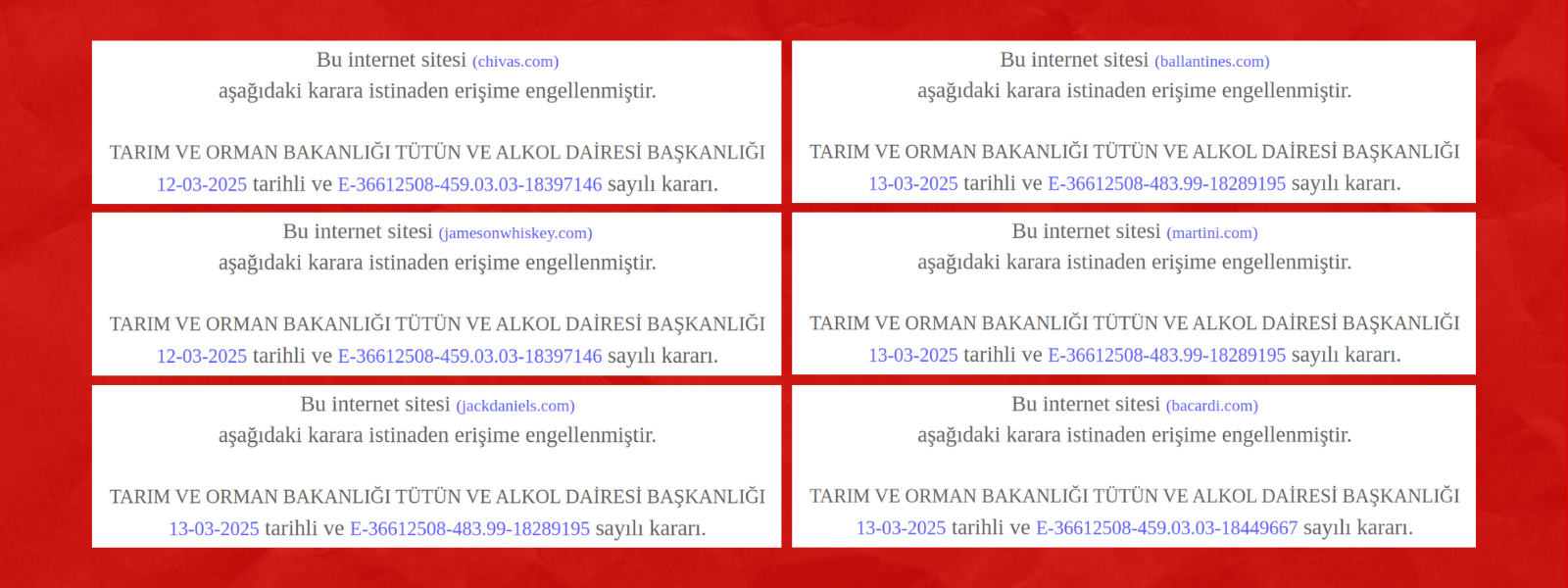
On another front, in March 2025 the Tobacco and Alcohol Department of the Ministry of Agriculture and Forestry, by three separate decisions, blocked from access the official websites of seven world-renowned alcoholic beverage brands, including chivas.com, jamesonwhiskey.com, jackdaniels.com, ballantines.com, martini.com, bacardi.com and bombaysapphire.com. Given that these sites function solely as official pages for brand promotion and corporate communication, these blocking decisions directly restrict consumers’ right of access to information and exemplify a disproportionate interference that eliminates the distinction between content and commercial activity.
The Capital Markets Board, for its part, by its decision of 30.06.2025, blocked from access the decentralised crypto exchange platform PancakeSwap. The blocking of this platform, on which users can transact directly without any intermediary institution, shows that the Capital Markets Board has begun to deploy its access blocking authority against technological infrastructures that operate outside the centralised system of financial intermediation.

Alongside these decisions of disproportionate ground, blockings carried over from 2024 and continuing throughout 2025 form an integral part of the picture. The Discord platform, with hundreds of millions of users, continued to be blocked throughout 2025; the access blocking of talkSPORT, which had been blocked on the ground of illegal betting in 2024, likewise remains in place. The blocking of Fansly for the second time in October 2025, following its 2024 blocking, constitutes one of the most striking examples documenting the evolution of these sanctions into a repetitive administrative habit. The access blocking decisions issued by BTK and other administrative bodies in 2025 reinforce this picture as a whole. They clearly demonstrate that the authority to block access has been transformed into a systematic censorship mechanism, and that the field of democratic expression and access to information is being progressively narrowed.
Access Blocking Decisions Targeting eSIM Providers and the Problem of Legal Basis¶
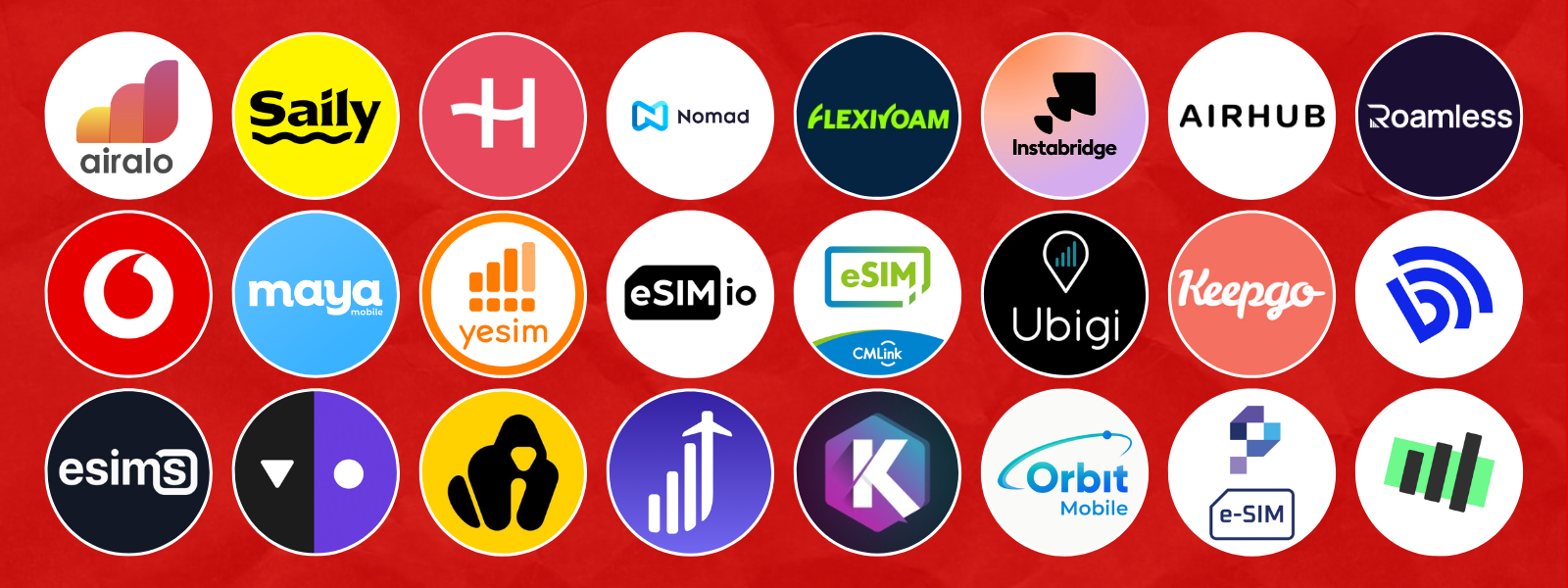
One development that drew attention in 2025 and that, by its nature, sets itself apart from other access blocking applications, is the blocking by the BTK Authorisation Department Presidency, by three separate decisions taken in July and September 2025, of the domain names of more than 52 eSIM providers. By the Authorisation Department Presidency’s decision no E-98966759-450.08-36681 of 10 July 2025, the domain names of 13 eSIM providers including Saily, Airalo, Holafly, Nomad, Instabridge, Mobimatter, Alosim, BNESIM, Holiday eSIM, FlexiRoam, Airhub, GlobaleSIM and Roamless; by decision no E-98966759-450.08-37512 of 17 July 2025, the domain names of 26 eSIM providers including Vodafone Travel, Maya, Yesim, esim.io, CMLink, Ubigi, Keepgo, BetterRoaming, USIMS, AIRSIMe, EnjoyeSIM, eSIMtr, NumeroeSIM, GoMoWorld, eTravelSIM, Eskimo, RedteaGO, SimOptions, Sim Local, GigSky, OneSimCard, Voye, DENT, Soracom Mobile, eSIM Go and UPeSIM; and by decision no E-98966759-450.08-48093 of 15 September 2025, the domain names of 16 eSIM providers including esims.io, Global YO, Gorilla eSIM, Jetpac, KnowRoaming, Orbit Mobile, Pocket eSIM, Roafly, Romio, Simfly, Surfroam, VIA eSIM, WorldSIM, YO Mobile, Telmo and Simfinity were blocked from access. Among the blocked providers, the fact that CMLink (offered through a subsidiary of the Chinese state-owned company China Mobile Communications Group) and Ubigi (a service of Transatel, in which the Japanese government has a stake through the NTT Group) feature on the list further raises the possible diplomatic dimensions of the practice.
The legal basis for these blocking decisions is not the access blocking provisions of Law No. 5651, but Article 8 of the Electronic Communications Law No. 5809. In its response of 11 August 2025 to a request for information submitted to BTK under the Right to Information Act No. 4982 concerning these blocking decisions, BTK characterised the blockings as the prevention of unauthorised electronic communications services within the framework of Article 8 of Law No. 5809, and relied on the rationale that “as the sale of physical SIM cards and/or eSIMs in our country is an activity that makes possible and complements the provision of mobile electronic communications services, that activity may be carried out only by operators authorised to provide electronic communications services”.
This rationale, however, embeds more than one fundamental legal problem. First and foremost, Article 8 of Law No. 5809 confers on BTK regulatory authority over the authorisation of electronic communications services; that Article, however, does not provide an express legal basis for the taking of access blocking measures against Internet sites. The Authorisation Department Presidency’s instrumentalization of the authorisation regime to cut off access to foreign service providers’ domain names, in the absence of the required legislative framework, and the implementation of these blockings in a manner that disables the procedural guarantees of Law No. 5651 (notice requirement, right of objection and judicial review), raises serious concerns from the perspective of the principles of foreseeability and legality. The fact that the access blocking covers a category of service that directly affects users who travel abroad or who have a need for international communications also renders the proportionality dimension of the practice separately problematic.
-
As far as we have been able to identify, in 2025 the President of BTK blocked access to 196.570 domain names and websites by 196.518 administrative measure decisions. ↩
-
See Action Plan to Combat Illegal Betting, Games of Chance and Gambling in the Virtual Environment (2025–2026), Official Gazette, 01.11.2025, no 33064. See also Anadolu Agency, “Monitoring Meeting of the Action Plan to Combat Illegal Betting, Games of Chance and Gambling in the Virtual Environment held”, 22.01.2026. ↩
-
By the amendments made by Article 4 of Law No. 7253 of 29.07.2020, the title of Article 8 was changed to “Content removal and access blocking decisions and their implementation”. ↩
-
Turkish Penal Code, Article 84. ↩
-
Turkish Penal Code, Article 103/1. ↩
-
Turkish Penal Code, Article 190. ↩
-
Turkish Penal Code, Article 194. ↩
-
Turkish Penal Code, Article 226. ↩
-
Turkish Penal Code, Article 227. ↩
-
Turkish Penal Code, Article 228. ↩
-
Offences set out in Law No. 7258 of 29.04.1959 on the Regulation of Betting and Games of Chance in Football and Other Sports Competitions were added to the scope of Law No. 5651 by Article 32 of Law No. 7226 of 25.03.2020. ↩
-
Article 27(1) of the State Intelligence Services and National Intelligence Organisation Law No. 2937: “Anyone who, without authorisation, obtains, procures, steals, falsely produces, falsifies or destroys information and documents relating to the duties and activities of the National Intelligence Organisation shall be punished by imprisonment from four to ten years”. ↩
-
Article 27(2) of the State Intelligence Services and National Intelligence Organisation Law No. 2937: “Persons who, by any means, disclose the identities, positions, duties and activities of members of MİT and their families, as well as persons who falsely produce or alter the identities of MİT members or use such forged documents, shall be punished by imprisonment from three to seven years”. ↩
-
See Law No. 5651, Article 8(4). ↩
-
Constitutional Court, E. 2015/76, K. 2017/153, 15.11.2017, Official Gazette no 30325, 07.02.2018. ↩
-
See https://www.tbmm.gov.tr/Yasama/KanunTeklifi/f72877c1-f87b-037b-e050-007f01005610 ↩
-
Annulment action E. 2020/76 brought by Members of the Grand National Assembly of Türkiye Engin Altay, Özgür Özel and Engin Özkoç together with 131 other Members of Parliament. ↩
-
Constitutional Court, E. 2020/76, K. 2023/172, 11.10.2023, Official Gazette no 32425, 10.01.2024, § 74. ↩
-
ibid § 76. The constitutional guarantee requiring that a person’s guilt be determined by an independent court is not subject to waiver. See Constitutional Court, E. 2013/133, K. 2013/169, 26.12.2013; E. 2022/72, K. 2023/3, 05.01.2023, § 27. ↩
-
ibid § 80. ↩
-
ibid § 82. ↩
-
ibid § 83. ↩
-
ibid § 83. ↩
-
ibid § 84. ↩
-
ibid § 85. ↩
-
ibid § 86. ↩
-
Yıldız Seferinoğlu, İrfan Fidan, Muhterem İnce and Engin Yıldırım did not participate in this decision. ↩