Conclusion and General Assessment¶
Within the framework of the 2025 EngelliWeb Report prepared by the Freedom of Expression Association, as of the end of 2025, a total of 1.505.484 websites and domain names have been blocked from access from Türkiye, pursuant to 1.284.464 different decisions issued by 875 different institutions and judgeships. These decisions have been taken on the basis of the statutory regulations and administrative authorisations explained in detail in the preceding parts of the report. In particular, since the entry into force of Law No. 5651, it is observed that access-blocking powers have been distributed to an ever-increasing number of institutions, that decision-making processes have diversified, and that they have moved further away from transparency. As of today, approximately 30 different public institutions and bodies have been granted, under different statutory bases, the authority to issue, or to request the issuance of, access-blocking decisions. A significant proportion of these powers is applied, without any judicial review being required, as an administrative measure directly through BTK or the Association of Access Providers (ESB). Accordingly, access-blocking measures have been transformed in Türkiye into a permanent, widespread and politically charged censorship practice. In other words, freedom of expression and the right of access to information continue to be systematically violated. In this context, more than one and a half million websites and domain names have been blocked from access from Türkiye.
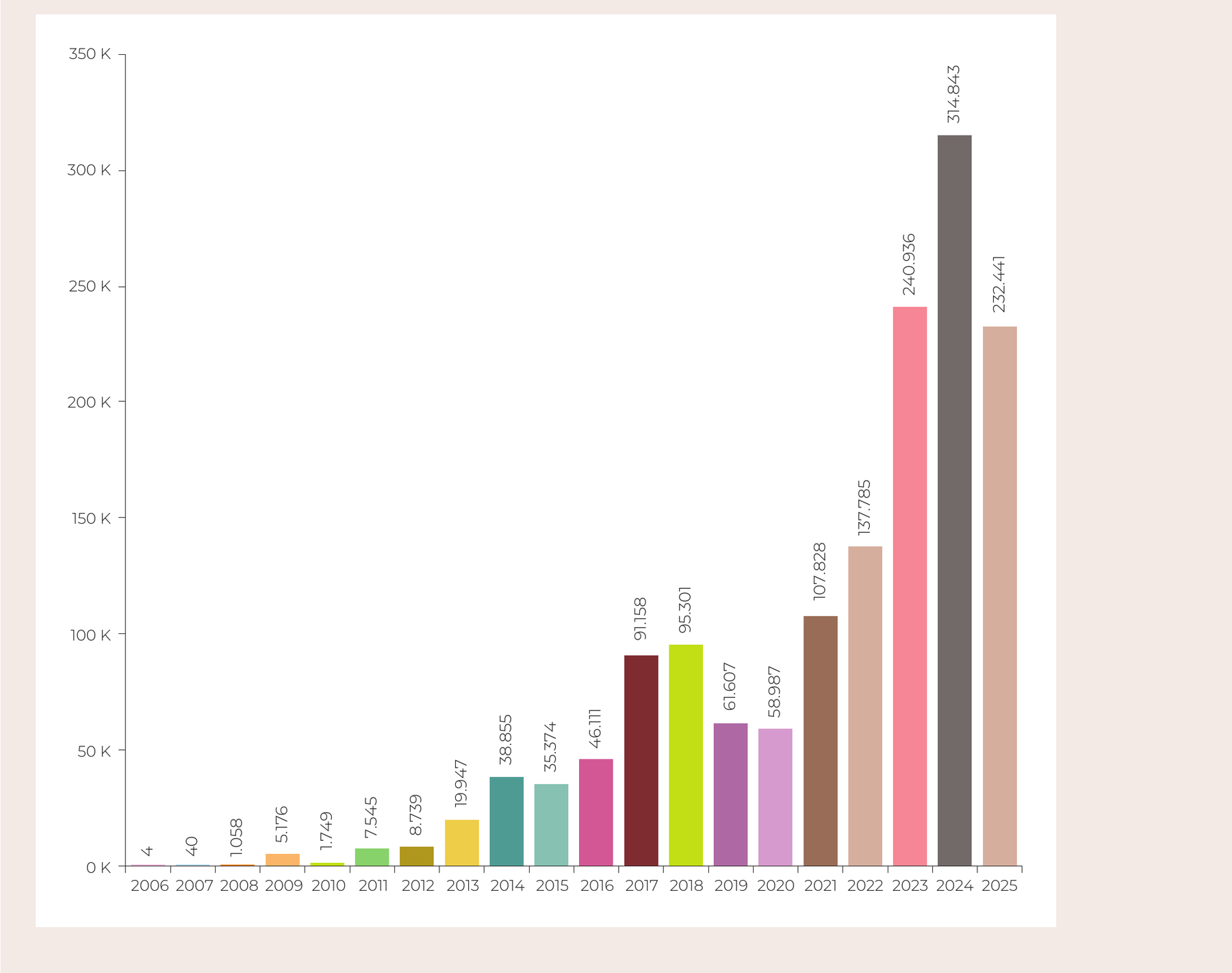
As can be seen from the table below, in the course of the EngelliWeb study, the number of websites and domain names blocked from access has shown a marked increase year on year. While only 4 domain names were blocked from access in 2006, this number rose to 40 in 2007, to 1.058 in 2008 and to 5.176 in 2009. The numbers of domain names blocked from access were 1.749 in 2010, 7.545 in 2011, 8.739 in 2012, 19.947 in 2013, 38.855 in 2014, 35.374 in 2015, 46.111 in 2016, 91.158 in 2017, 95.301 in 2018, 61.607 in 2019, 58.987 in 2020, 107.828 in 2021, 137.785 in 2022, 240.936 in 2023, 314.843 in 2024 and 232.441 in 2025. These data openly demonstrate that access-blocking measures are being used in an increasingly widespread and systematic manner in Türkiye.
Accordingly, as of the end of 2025, a total of 1.505.484 websites and domain names have been blocked from access from Türkiye. Of these websites, 130.717 were blocked, until its closure, by the Telecommunications Communication Directorate (TİB), and 1.155.206 following the closure of TİB by the President of BTK, that is to say a total of 1.285.923 domain names, through an administrative measure within the scope of Article 8 of Law No. 5651. In addition, 122.638 domain names have been blocked from access by the Turkish Football Federation; 48.676 by decisions of the criminal judgeships of peace, prosecutors’ offices and courts; 20.080 by the National Lottery Administration; 11.565 by the Ministry of Health; 10.668 by the Capital Markets Board; 2.406 by the Sports Toto Organisation Presidency; 2.385 by the Tobacco and Alcohol Department under the Ministry of Agriculture and Forestry; 386 by the Advertising Board; 305 by the Ministry of Agriculture and Forestry; 220 by the Ministry of Customs and Trade; 102 by the Jockey Club of Türkiye; 67 by enforcement offices; 35 by the Association of Access Providers (ESB); 17 by the Banking Regulation and Supervision Agency (BDDK); 6 by the Ministry of Treasury and Finance; and 5 by the Supreme Electoral Council (YSK). These data show that the authority to block access has been spread across a great many different institutions, and that it is, very often, applied while exempted from judicial review.
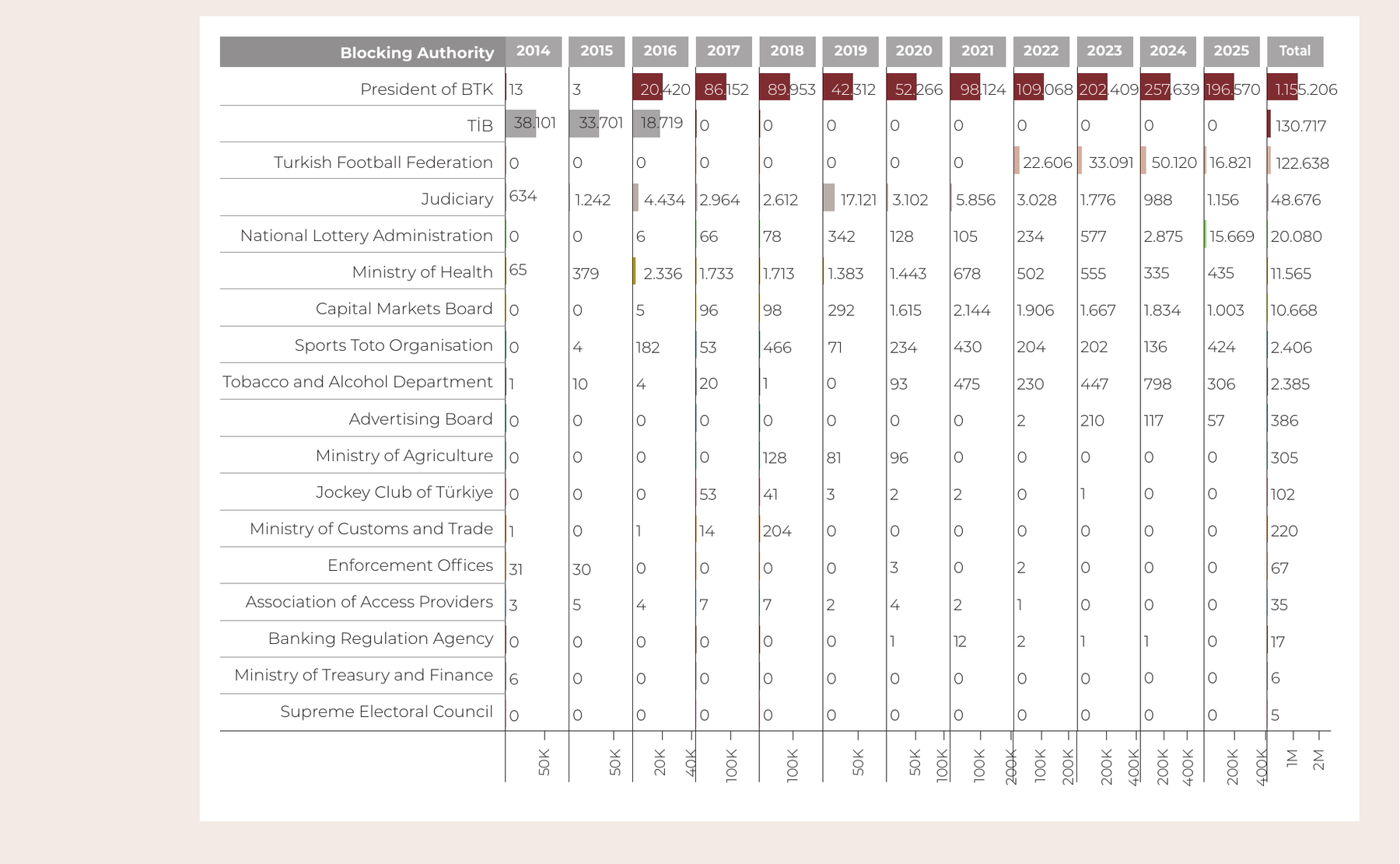
Although on a reading in absolute terms the 2025 figures may, compared with the record level of the previous year, point to a relative decline, it is not possible to interpret this apparent decrease as pointing to a structural easing or a narrowing of scope in the practice of access blocking. The primary explanation of the decline is the fall in the number of domain names blocked by the Turkish Football Federation from 50.120 in 2024 to 16.821 in 2025, and the drop in the absolute volume of blocking by BTK in the gambling-and-betting category from approximately 221.000 to 137.600. By contrast, the proportional share of the President of BTK, which constitutes the true centre of gravity of access-blocking practice, in total blockings, has risen over the same period from 82 per cent to 84,6 per cent; while absolute figures have declined, the dynamic of centralisation has continued to gain strength. The leap in the volume of blocking by the National Lottery Administration from 2.875 to 15.669 is the product of an administrative mobilisation coordinated with the “Action Plan to Combat Illegal Betting, Games of Chance and Gambling in the Virtual Environment (2025–2026)” declared by a Presidential Circular that entered into force in November 2025. Accordingly, the 2025 data, when subjected to a proportional and structural analysis, openly reveal that the tendency for administrative censorship to intensify has continued without abatement.
On a separate front, within the framework of the EngelliWeb project, throughout the roughly ten-year period (2014–2024) during which Article 9 of Law No. 5651 (containing the aim of “protection of personality rights” and annulled by the Constitutional Court) remained in application, 49.533 news items (URLs), sanctioned by 8.793 different decisions issued by 605 different criminal judgeships of peace, have been identified.314 In annual terms, 2023 ranks first with a total of 8.658 news items sanctioned, while 2022 ranks second with 6.601 news items. In 2024, with the annulment of Article 9, the Article 9 decisions came to a halt on 10.10.2024, by which date sanctions had been applied to 5.740 news items.
In the course of 2025, in which Article 9 can no longer be applied, the criminal judgeships of peace, which have become the symbol of injustice in Türkiye, disregarded freedom of expression and freedom of the press, the public’s right to receive and access information, and the Constitutional Court’s case law. In doing so, they ensured the protection of the “reputation, honour and dignity” of those holding public office within the scope of Articles 8/A (concerning “the protection of national security and public order”) and 9/A (concerning “the protection of the privacy of individuals”) of Law No. 5651. As elaborated in this 2025 report, it has been identified that, under Article 8/A alone, access has been blocked and sanctions imposed in respect of 145 news websites and domain names and 2.118 individual news items. In this context, 2025 has openly demonstrated that Article 8/A has ceased to be an exceptional measure for extraordinary situations and has been transformed into a routine administrative act. While a significant proportion of the 8/A decisions was issued in the aftermath of the 19 March 2025 process, the article was also, in the absence of Article 9, used (as in previous years) on the applications of senior public officials, certain public institutions and companies close to the government.
By these decisions, not only current and politically charged content but also archive-quality, older news items have been removed from Internet and press archives, and accordingly destroyed. The effect of this situation on social memory has been comprehensively set out in the reports previously published by the Freedom of Expression Association under the titles The Right Not to be Forgotten on the Internet315 and The Right to Remember: The Social Memory Dimension of Internet Censorship.316 As the European Court of Human Rights has emphasised, public interest is not limited to current events but may also be directed to the past, and archive content is also protected under Article 10 of the European Convention on Human Rights.317 In Türkiye, by contrast, online archives are systematically suppressed and erased. Indeed, the statistical analyses show that, as in previous years, sanctions were also applied to news archives in 2025.
The Three-Stranded Censorship Practice Emerging After the Annulment of Article 9¶
The year 2025 has demonstrated that the annulment of Article 9 did not halt censorship practices. Rather, it has shown that the practice of censorship has continued, having changed form, through three different strands. The first strand, Article 8/A, has, as detailed above, been transformed into a kind of reputation-management tool, on the ground of “national security and public order”. Politicians, senior bureaucrats and capital groups close to the government have used this avenue to have stories about bribery, corruption and nepotism allegations against them censored. The second strand, Article 9/A, has, for its part, assumed a similar function on the ground of the privacy of individuals. The third and (in 2025) emergent strand consists of the preliminary injunction applications made to the civil courts of first instance. As the rapid and effective censorship mechanism afforded by Article 9 has disappeared, the actors instrumentalising it have begun to request access-blocking and content-removal decisions, by way of preliminary injunction, from the civil courts of first instance, on the basis of Articles 389 et seq of the Code of Civil Procedure No. 6100. In 2025, by decisions of the civil courts of first instance in Manavgat, Mersin, Istanbul and Kayseri, hundreds of URLs were blocked from access on the ground of personality rights, without the right of defence being afforded, on an ex parte basis and frequently without security. Although the decisions of the 4th Civil Chambers of the Antalya and Istanbul Regional Courts of Appeals showed that appellate review can constitute an important brake on this alternative censorship channel, the appellate proceedings take weeks, even months, to conclude; throughout that time the news items remain blocked from access, and the public’s right to receive information is de facto violated. This picture, in which the principle that “justice delayed is justice denied” is given concrete form, openly demonstrates that the normative effect of the Constitutional Court’s annulment judgment is being sidestepped.
19 March 2025: The New Dimension of Digital Censorship¶
The dense picture set out in the 2018–2024 EngelliWeb reports has, in 2025, continued by assuming a different dimension. The detention on 19 March 2025 of the Mayor of the Istanbul Metropolitan Municipality, Ekrem İmamoğlu, on charges of corruption, bribery and terrorist-organisation propaganda, and his subsequent arrest, triggered mass protests across the country; this process initiated one of the historically most intense periods of the use of Law No. 5651 as a censorship tool. Immediately after the detention decisions, with effect from 07:00 on 19 March, a bandwidth throttling lasting approximately 42 hours was applied across Istanbul against the X, YouTube, Instagram, Facebook, TikTok, Twitch, Telegram, Signal and WhatsApp platforms; an attempt was made to obstruct the organisation of the public reaction and the flow of information. With the conclusion of the throttling implementation, the censorship was carried to a more targeted and lasting dimension through the decisions of the criminal judgeships of peace issued under Article 8/A. Within days, by decisions issued at jet speed by the criminal judgeships of peace in Ankara, Izmir, Mersin and Istanbul, access was blocked to 985 X accounts (formerly Twitter) addressing a total audience of approximately 25,8 million followers. These blockings were not confined to accounts directly connected with the protests; a broad swathe extending from student initiatives to women’s organisations, from independent journalists to human rights defenders and artists, was targeted. A great many of the accounts subjected to access blocking were rapidly made invisible from Türkiye by the X platform itself; the censorship decisions thereby had a direct effect, for the first time on this scale, on social media platforms.
Throughout 2025, in line with the decisions issued on the grounds of the protection of national security and public order and of the privacy of individuals, news websites have, for the most part, complied with the decisions and removed the content from publication; the trend of the rapid erasure of current news items and articles from press archives has accordingly continued. The year 2025 has, however, been one in which a great many decisions were issued with no reasoning and using boilerplate expressions; even 8/A decisions, in many cases, were not transmitted by BTK to content providers; it has been a year distant from judicial transparency.318
VPN Restrictions Continued Into 2025¶
Another critical dimension of access-blocking practice in 2025 has been the wholesale blocking of VPN services. BTK has, without any judicial decision and without sharing the grounds for its administrative action with the public, continued to block access to numerous VPN services. The action brought by the Freedom of Expression Association for the annulment of the blocking applied to the Proton VPN service was dismissed by the Ankara 17th Administrative Court; however, the 13th Administrative Chamber of the Ankara Regional Administrative Court determined that BTK’s action was in the nature of a regulatory act required to be applied country-wide, set aside the decision, and sent the file to the Council of State. As of the date of this report, the action is pending before the Council of State. VPN blockings directly extinguish citizens’ right of access to information, beyond the reach of State censorship, and constitute the structural counterpart in Türkiye of the wholesale blocking practices criticised by the ECtHR in Kharitonov v Russia and RFE/RL Inc. and Others v Azerbaijan decisions.
The Constitutional Court and the ECtHR: The Continuation of Structural Ineffectiveness¶
As the 2025 EngelliWeb report approaches its close, Law No. 5651, which has for years been transformed into a heavy censorship tool over freedom of expression and freedom of the press, continues to be effectively used through Articles 8/A and 9/A, notwithstanding the annulment of Article 9. As emphasised in our previous reports, the Constitutional Court has failed to conduct an effective review against the decisions of the criminal judgeships of peace that restrict freedom of expression, and by remaining silent for a long period has become part of this structural problem.
Indeed, the 503 violation findings rendered in the Abdullah Kaya and Others judgment have remained mere belated and bulk dispositions of years-long individual applications relating to the annulled Article 9. A large proportion of the criminal judgeship of peace decisions that were the subject of the violations did not result in retrials; in 57 per cent of the 503 applications, in approximately 290 files, no retrial was conducted by the criminal judgeships of peace. This situation points not only to the ineffectiveness of the individual application mechanism but also to a structural resistance to the judgments of constitutional review. The systematic non-implementation of the Constitutional Court’s judgments points to a process in which freedom of expression violations have been normalised at the judicial level and censorship practices have been routinised through the courts. In the course of 2025, the Constitutional Court did not decide on any individual applications relating to Law No. 5651. The access-blocking practice applied to globally and widely used platforms such as Wattpad, Roblox and Discord continued throughout 2025; the individual applications lodged with the Constitutional Court concerning these platforms in 2024 have still not been decided.
Before the ECtHR, 2025 has, in turn, been a year in which no progress has been made and therefore no application has been decided in the context of Law No. 5651. By contrast, two applications directly connected with Article 8/A, both lodged by founders of the Freedom of Expression Association, have been pending before the ECtHR for over six years.319 That these applications remain undecided after more than six years means that Article 8/A is de facto exempted from international judicial review under Article 10 of the Convention.
That said, the most important development of 2025 has been the ECtHR’s communication, on 16 October 2025, to the Government of the application in Keskin Kalem Yayıncılık ve Ticaret A.Ş. v Türkiye.320 This application carries critical importance in several respects. The applicant company is the publisher of the Diken news website and complains of access-blocking decisions issued by the criminal judgeships of peace within the scope of Article 9 of Law No. 5651, which was annulled by the Constitutional Court. At the focus of the application are 33 separate individual applications lodged on various dates between 2015 and 2022 that remained pending before the Constitutional Court at the time of the ECtHR application. All of these applications relate to interventions directed at the publication of news stories concerning President Erdoğan and his family. Accordingly, this case has the character not only of a Diken matter but of a structural case in which it will be tested before the ECtHR how Article 9 was systematically transformed into a tool of political censorship.
The questions put by the ECtHR to the Government also confirm this structural dimension. The Court did not confine itself to asking whether the access-blocking measures pursued a legitimate aim and were necessary in a democratic society within the meaning of Article 10 of the Convention; it expressly cited the Constitutional Court’s judgment of 11.10.2023 annulling Article 9, and questioned whether, in the pre-annulment period, that provision and its application satisfied the Convention’s requirements of being “prescribed by law” and of the “quality of law”. The ECtHR also questioned, with reference to Bulgakov v Russia, whether the applicant had at its disposal an effective remedy under Article 13, having particular regard to the lack of reasoning in the decisions of the criminal judgeships of peace and to the length of the waiting period of individual applications before the Constitutional Court. These questions point to the ECtHR’s tendency to treat the access-blocking regime in Türkiye not as an isolated violation but as a structural problem.
That said, considering the ECtHR’s current workload and the times taken for the resolution of applications relating to Türkiye, it does not seem possible, in the short term, for this structural problem to be resolved through international judicial review. This situation, once again, lays bare that the practice of censorship in Türkiye has reached a dimension that also tests the effectiveness of international human rights mechanisms.
From the Digital Obedience Regime to the Digital Panopticon: Social Network Providers and the New Phase of Law No. 5651¶
The period covered by this report is also directly connected with the findings of the report The Digital Obedience Regime: Social Network Providers in Türkiye and the Illusion of Transparency, published by the Freedom of Expression Association in December 2025. That report sets out how the obligations of representation, data localisation and transparency reporting, imposed on social network providers by the amendments made to Law No. 5651 in 2020 and 2022, have in practice constructed a “digital obedience regime”. According to that report, the foreign-origin social network providers that have lawful representatives in Türkiye have, in the shadow of opaque administrative sanctions and the threats of throttling, formally complied with the requirements of Law No. 5651; that compliance, however, has been transformed not into a real transparency mechanism protective of user rights, but into a mechanism of obedience submitting to the State’s censorship demands. This picture was concretely confirmed by the X platform’s rendering of hundreds of accounts unreachable from Türkiye through geographical blocking in the course of the 19 March 2025 process.
A still more worrying development was experienced in the early months of 2026. By the comprehensive amendments deliberated in the Turkish Grand National Assembly and adopted under Law No. 7578 of 22.04.2026, published in the Official Gazette no 33240 of 01.05.2026, Law No. 5651 has carried the digital oversight regime to a new phase. The amendments made to Supplemental Article 4 by Article 22 of Law No. 7578, and the new Supplemental Article 5 added by Article 23, will enter into force on 01.11.2026.
Central to these amendments is the re-drafted paragraph 7 of Supplemental Article 4: “The social network provider may not provide service to children who have not completed fifteen years of age and is obliged to take the necessary measures, including age verification, to ensure that this service is not provided.” Although the legislative text does not expressly state an obligation of “identity-based access” to social media, as the Freedom of Expression Association set out in detail in its press statement of 06.04.2026, the technical applicability of this obligation necessarily requires that every user’s Turkish Citizenship Number be matched to the user’s social media account via the e-Government Gateway. This regulation, presented to the public under the discourse of “the protection of children”, in reality transforms the e-Government infrastructure into a vast identity-account matching database, and de facto extinguishes the right of anonymity in the digital public sphere. The knowledge of every citizen who writes a political criticism, exposes corruption, or shares a call to protest, that they may be conclusively identified by the State, will produce an enormous chilling effect on society. The safeguards under Article 10 of the ECHR (freedom of expression) and Article 8 (respect for private life) make it difficult to reconcile this regulation with the principle of proportionality emphasised in the ECtHR’s case law and with the requirement of necessity in a democratic society.
The oversight architecture constructed by Law No. 7578 is, however, not confined to the age-verification mechanism. The new paragraph 22 added to Supplemental Article 4 obliges social network providers with daily access exceeding ten million to implement, within at most “one hour”, decisions issued in cases of urgency under Article 8/A. As elaborated in the preceding parts of this report, given how Article 8/A has, in 2025, been transformed into a “routine reputation-management tool”, it is clear that the one-hour period leaves no room for any legal assessment and aims to transform platforms into automatic censorship apparatuses applying every request received from the State without question. The new paragraph 23 added to the same article, for its part, requires platforms to take “all necessary measures” to prevent the republication of content that has been blocked from access or removed; this de facto mandates the establishment of automatic content-filtering systems. Breach of either of these obligations is met, under the re-drafted sanction paragraph, with a spiral of administrative fines reaching up to three per cent of the platform’s global turnover, advertising bans and throttling of up to ninety per cent. With the removal from the article of the phrase in paragraph 3 of Supplemental Article 4, “in respect of content within the scope of Articles 9 and 9/A”, this hefty sanction regime has now been linked not only to decisions issued under specific articles but to all access-blocking and content-removal decisions within the scope of Law No. 5651.
Supplemental Article 5, added by Article 23 of Law No. 7578, has, for its part, carried the censorship mechanism beyond social media to target the digital gaming ecosystem directly. Obligations have been imposed on global game distributors such as Steam and Epic Games to designate a representative in Türkiye, to grade content according to age criteria, to provide parental-control tools, and, upon BTK’s request, to disclose their institutional structures and data-processing mechanisms. In the event of non-compliance with these obligations, administrative fines reaching up to TRY 30 million and throttling of up to fifty per cent are envisaged on a graduated basis. This regulation has carried the scope of the digital oversight regime beyond social media platforms alone, extending it across the whole of the digital public sphere, including the gaming ecosystem.
This development shows that the architecture of censorship documented in the 2025 EngelliWeb report will not remain confined to its current dimensions, but is, on the contrary, evolving into an ever more comprehensive infrastructure of digital surveillance and oversight. Onto the practices of access blocking, throttling, content removal, VPN blockings and mass blocking of social media accounts have been added compulsory identity verification and automatic censorship mechanisms; these constitute the most critical infrastructural building blocks of a project of digital isolation that cuts Türkiye off from the open Internet world and confines it within itself. It has openly emerged that Law No. 5651, far beyond being an “Internet regulation law”, has been transformed into the legal backbone of the construction of a multilayered digital panopticon.
Conclusion¶
In conclusion, at the end of the approximately twenty years that have passed since the entry into force of Law No. 5651, the number of websites and domain names blocked from access has exceeded 1.5 million. Following the 2020 amendments, the censorship effect has become still more marked; in particular, rates of compliance with the decisions of the criminal judgeships of peace issued on the ground of the “violation of personality rights” have risen, and thousands of news items and items of online content have been removed from publication.
As a consequence of these developments, Internet archives have begun to be increasingly purged of news stories directly concerning the public, on matters such as corruption, harassment, sexual assault and femicide. To put it another way, as we have shown by example in our 2025 report, the practice of “reporting the truth” is being systematically obstructed by the criminal judgeships of peace, notwithstanding the violation findings and even the annulment judgments of the Constitutional Court. Moreover, by Law No. 7578, published in the Official Gazette on 1 May 2026, new obligations, to enter into force on 1 November 2026, have been added to this picture: the prohibition on providing social media services to children who have not completed 15 years of age and the identity verification that will, in practice, become mandatory for its enforcement; the imposition of a one-hour period for the implementation of decisions within the scope of Article 8/A; the obligation to establish automatic filtering mechanisms to prevent the republication of content blocked from access; and the bringing of the digital gaming ecosystem within the scope of an oversight subject to the threat of throttling. Accordingly, the picture that has emerged as of the end of 2025 demonstrates not only the weight of the existing practice of censorship, but also that this practice will deepen still further, and its scope expand, in the near future.
The bandwidth throttling implementations, VPN blockings, mass blockings of social media accounts and transformation of civil courts into censorship tools via preliminary injunctions that emerged in the 19 March 2025 process demonstrate that Law No. 5651 is no longer merely an access-blocking statute, but the backbone of a multilayered digital oversight regime. In this regime, the judiciary is positioned not as an independent review mechanism, but as an approval authority that legitimises the executive’s censorship demands. As expressly stated by the Constitutional Court in its Artı Media GmbH judgment, the finding that the violation stems directly from Article 8/A itself, and that the article must be re-drafted, stands, in the light of the 2025 data and decision texts, as a more urgent need than ever before. Before the ECtHR, as has become concrete in the Keskin Kalem Yayıncılık application, the structural problems of Law No. 5651 can be carried onto the international agenda only through years-long judicial processes. As we have set out in detail in this report, the scope, number and effect of access-blocking decisions have expanded over the years; particularly in recent years, censorship directed at Internet news and content has come directly to threaten journalism and public-interest access to information. The 2025 data show that censorship has now become not only a part of the conduct of political actors but also of the various levels of the administration and of the ordinary functioning of the judiciary.
The public’s access to current and historical information is being progressively destroyed, and digital memory on the Internet is being deliberately and systematically erased. The de facto extinguishing of the right of anonymity in the digital public sphere by the compulsory age-verification mechanism introduced by Law No. 7578 carries this process to a new phase: it is now sought to bring under the absolute knowledge and control of the State not only “what is said”, but also “who has said it”. The whole of this picture shows that the sphere of online expression in Türkiye is no longer under an exceptional, but under a systematic, permanent and ever-deepening, digital oversight regime.
These developments make it clear, for those working in the field of freedom of expression in Türkiye, not only that the conditions have grown more onerous, but also that this battle is now being waged against uncontrolled controllers. In a system in which even the Constitutional Court’s judgments are systematically ignored, the arbitrary censorship powers of the criminal judgeships of peace are subjected to no constitutional review. This situation brings an ancient question back to the agenda: Quis custodiet ipsos custodes? But who, after all, will watch the watchers? It is precisely for this reason that, the EngelliWeb project, keeping the record of censorship, archiving what is sought to be forgotten and preserving public memory has become a still more vital task. This report not only exposes which content has been blocked or who has been sought to be silenced; it is part of a battle of memory and resistance against unchecked power itself. Notwithstanding every effort at pressure and intimidation, the activities we conduct for the protection of freedom of expression will continue.
-
News stories blocked from access and/or removed, taken down from publication or deleted. ↩
-
Freedom of Expression Association, The Right NOT to be Forgotten on the Internet: Freedom of Expression Assessment of the Application of the Turkish Right to be Forgotten Measures under Law No. 5651 (May 2023) https://ifade.org.tr/reports/UnutulmamaHakki_2021_Eng.pdf ↩
-
Freedom of Expression Association, The Right to Remember: The Social Memory Dimension of Internet Censorship (June 2024) https://ifade.org.tr/reports/HatirlamaHakki_2024.pdf ↩
-
Fuchsmann v Germany App no 71233/13 (ECtHR, 19 October 2017) §§ 37-39. See also Times Newspapers Ltd v United Kingdom (Nos 1 and 2) App nos 3002/03 and 23676/03 (ECtHR, 10 March 2009) § 45. ↩
-
Sanction notifications are transmitted to news sites through BTK, but the relevant criminal-judgeship-of-peace decisions are not attached to the transmission; requesting the decisions from the judgeships delays the objection processes, while the judgeships themselves serve those decisions on the addressees with delay, or, in violation of the principle of a fair trial, do not serve them at all. ↩
-
Akdeniz and Altıparmak v Türkiye App no 5568/20, lodged 14.01.2020, communicated to the Government on 26.08.2020; Akdeniz and Altıparmak v Türkiye App no 35278/20, lodged 28.07.2020, communicated to the Government on 09.02.2021. ↩
-
Keskin Kalem Yayıncılık ve Ticaret A.Ş. v Türkiye App no 62388/22, lodged 23.12.2022, communicated to the Government on 16.10.2025. ↩