Article 9 of Law No. 5651: History, Annulment and Legacy¶
Legal Framework and Historical Development¶
Following the corruption investigations of 17–25 December 2013, Article 9 of Law No. 5651 underwent a fundamental transformation through omnibus Law No. 6518, prepared in their wake and enacted in February 2014.78 By this amendment, a new mechanism was established that allowed access to content to be blocked on the alleged ground of “violation of personality rights”, and at the same time Article 9/A was incorporated into the legislation in respect of allegations of violation of the privacy of individuals. Under Article 6/A introduced by the same Law, the Association of Access Providers (“ESB”) was established, and it was provided that access blocking decisions issued on the grounds of personality rights and the privacy of individuals would be forwarded directly to the ESB, with such notice being deemed to have been issued to access providers as well.79
By Law No. 7253, adopted in July 2020, the scope of Article 9 was further expanded; alongside the access blocking sanction, the sanctions of removal of content from publication and of non-association of the names of requesting persons with the relevant Internet addresses (“delisting”) were also added. By the amendments made by Law No. 7418 of October 2022, the ESB was empowered to serve decisions on the e-mail addresses appearing on content or hosting providers’ websites. It was also provided that, where a publication amounting to a violation of personality rights is published at other Internet addresses, the existing decision may be applied to those addresses as well.80 Assessed as a whole, these arrangements show that Article 9, over its ten-year course of application, was progressively transformed into an ever-expanding arsenal of sanctions.
Statistical Overview: A Decade’s Reckoning¶
Within the scope of the EngelliWeb project, it was established that, between 2014 and 2024, a total of 8.793 distinct decisions issued by 605 different criminal judgeships of peace had sanctioned 49.533 news addresses (URLs) on 1.149 websites under Article 9 of Law No. 5651. The annual distribution of these figures reveals the steady expansion of the mechanism: 537 news items were sanctioned in 2014, 1.303 in 2015, 2.108 in 2016, 2.600 in 2017, 5.111 in 2018, 5.760 in 2019, 5.756 in 2020, 5.449 in 2021, 6.601 in 2022 and 8.658 in 2023. Up to 10.10.2024, the date on which the annulment of Article 9 took effect, 5.740 news items were sanctioned in 2024; the highest annual figure remains that of 2023, with 8.658 sanctions.
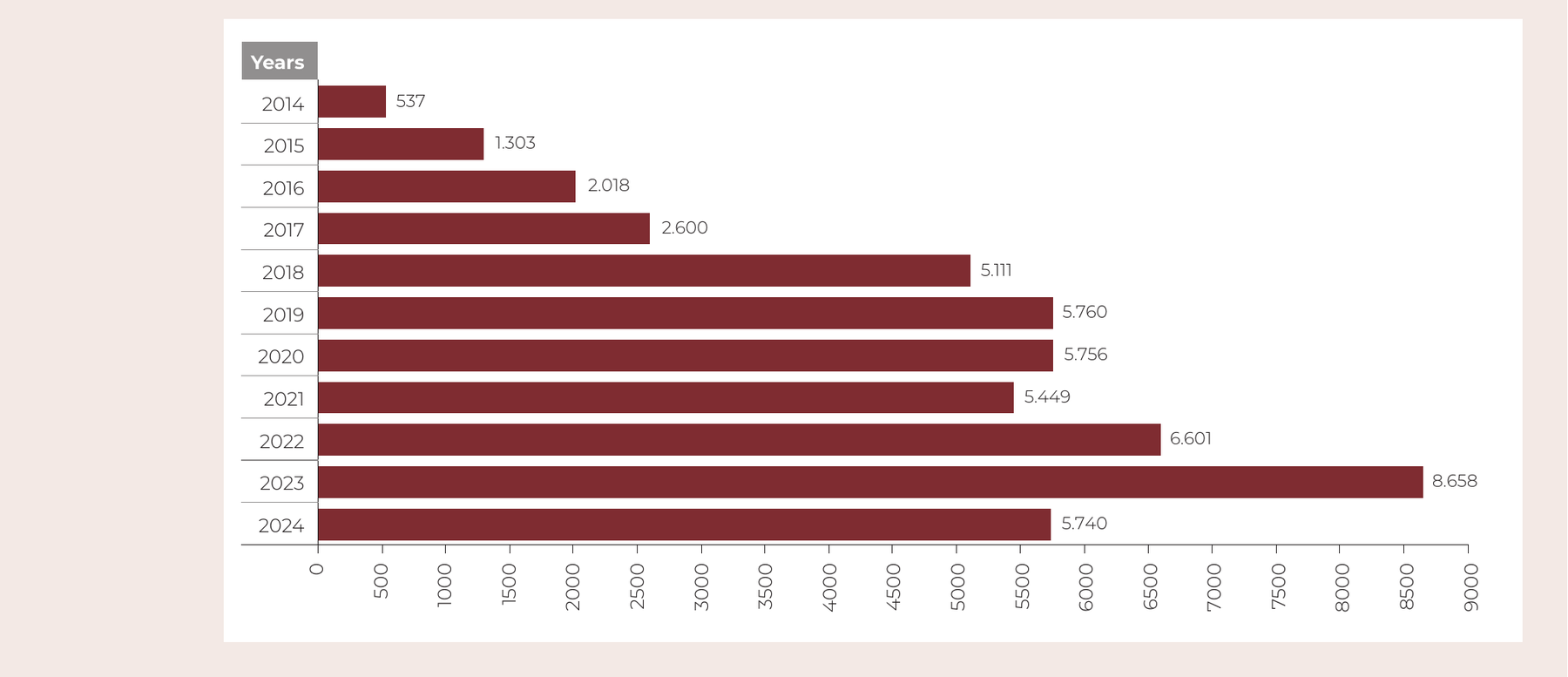
In practice, the access blocking sanction was implemented solely by Internet service providers and by the ESB; the content removal sanction by content providers; and the delisting sanction solely by search engines. The great majority of these decisions concerned news items involving serious allegations such as bribery, corruption, the improper use of public resources, appointments made without regard to merit, fraudulent academic titles, tax evasion, post-earthquake responsibilities, and links between public officials and organised crime. The bulk of the content was prohibited on generalised and abstract grounds, without specifying which expression amounted to the violation. In certain decisions, the mere fact that the content had been published in the past was held, on the ground that it had “lost its actuality”, to exempt it from a public-interest assessment.
The Constitutional Court’s Identification of the Structural Problem and Annulment Decision¶
The Constitutional Court identified the structural problems arising from the application of Article 9 at various stages. In its 2017 judgment in Ali Kıdık,81 the Court laid down the principle that access blocking decisions could not be issued without a prima facie violation assessment. That case law was, however, largely disregarded by the criminal judgeships of peace. In the face of a steadily rising volume of applications, the Court, by its judgment of 27.10.2021 in Keskin Kalem Yayıncılık ve Ticaret A.Ş. and Others,82 applied the pilot judgment procedure and called on the legislature to make the necessary legislative changes within one year. That call went unanswered, and the period given for implementation of the pilot judgment expired on 06.01.2023.
In its pilot judgment, the Constitutional Court set out in detail the structural problems carried by Article 9. The Court found that the criminal judgeships of peace issued access blocking and content removal decisions without conducting adversarial proceedings, without delay and without even providing a justification for the need to dispose of the matter swiftly; that the decisions were taken on abstract and generalised grounds independent of the concrete circumstances of the case; that the obligation to strike a fair balance between conflicting rights was not fulfilled; and that the avenues of objection had been rendered ineffective.83 The Court also drew attention to the fact that the indefinite application of the decisions issued amounted to “a serious and permanent interference” with freedom of expression and freedom of the press.84
The Constitutional Court ultimately joined the annulment action brought by the Republican People’s Party in September 2020 with the objection application made by the Tavşanlı Criminal Judgeship of Peace,85 and on 11.10.2023 annulled Article 9 of Law No. 5651 as contrary to Articles 13, 26 and 28 of the Constitution.86 The decision was published in the Official Gazette on 10.01.2024 and entered into force on 10.10.2024. The failure to provide reasons for the nine-month deferral period attached to the annulment decision constitutes a problem in its own right. The Court itself had emphasised, in its earlier individual application judgments, that the civil actions available under the Turkish Civil Code No. 4721 and the Turkish Code of Obligations No. 6098 offered alternative routes for the protection of personality rights.87 The European Court of Human Rights took the same view in Savcı Çengel v Turkey.88 In this respect, the deferral of the annulment contradicted the Constitutional Court’s own case law.
-
Law No. 6518 on Amendments to the Decree-Law on the Organisation and Duties of the Ministry of Family and Social Policies and to Certain Laws and Decree-Laws, adopted on 06.02.2014, Official Gazette no 28918, 19.02.2014. ↩
-
Law No. 5651, art 6/A(7): “Access blocking decisions are forwarded to the Association for implementation. Notice given to the Association within this scope is deemed to have been given to access providers” (Additional sentence: 13/10/2022-Law 7418, art 31). ↩
-
Law No. 5651, art 6/A(11) (Addition: 13/10/2022-Law 7418, art 31). ↩
-
Ali Kıdık, App No 2014/5552, 26.10.2017, § 62. ↩
-
Keskin Kalem Yayıncılık ve Ticaret A.Ş. and Others, App No 2018/14884, 27.10.2021, Official Gazette no 31712, 07.01.2022. ↩
-
Keskin Kalem Yayıncılık ve Ticaret A.Ş. and Others, §§ 115, 116, 126, 128–133. ↩
-
Keskin Kalem Yayıncılık ve Ticaret A.Ş. and Others, § 92. ↩
-
CHP annulment action: Constitutional Court, E. 2020/76; joined with the Tavşanlı Criminal Judgeship of Peace’s objection application. ↩
-
Constitutional Court, E. 2020/76, K. 2023/172, 11.10.2023, Official Gazette no 32425, 10.01.2024. ↩
-
See Ali Kıdık, §§ 64–67; Kemal Gözler, App No 2014/5232, 19.04.2018, § 53. See also Turkish Civil Code No. 4721, arts 24–25; Turkish Code of Obligations No. 6098, art 58. ↩
-
Songül Savcı Çengel v Turkey, App no 30697/19 (ECtHR, 10 June 2021). ↩