VPN Blockings¶
As of 2025, one of the most critical dimensions of Internet censorship in Türkiye consists of the wholesale access blockings applied by the Information and Communication Technologies Authority (“BTK”) to virtual private network (VPN) services.236 VPN (Virtual Private Network) technology, by encrypting users’ Internet traffic and routing it through a different server, serves a great many legitimate functions, including online privacy, data security, anonymity, and the bypassing of geographical restrictions. Used daily by millions of individual and corporate users worldwide, VPN services are positioned as indispensable tools for cybersecurity, data protection, the remote-work infrastructure and Internet freedom.
In the Turkish context, however, VPN services serve a further function of particular importance. According to the data of the EngelliWeb project, in an environment in which hundreds of thousands of domain names, tens of thousands of URLs and hundreds of thousands of social media contents have been blocked from access from Türkiye, VPN services have in practice become the only means by which citizens may exercise their right to receive information.
BTK’s Administrative Action Against VPN Services¶
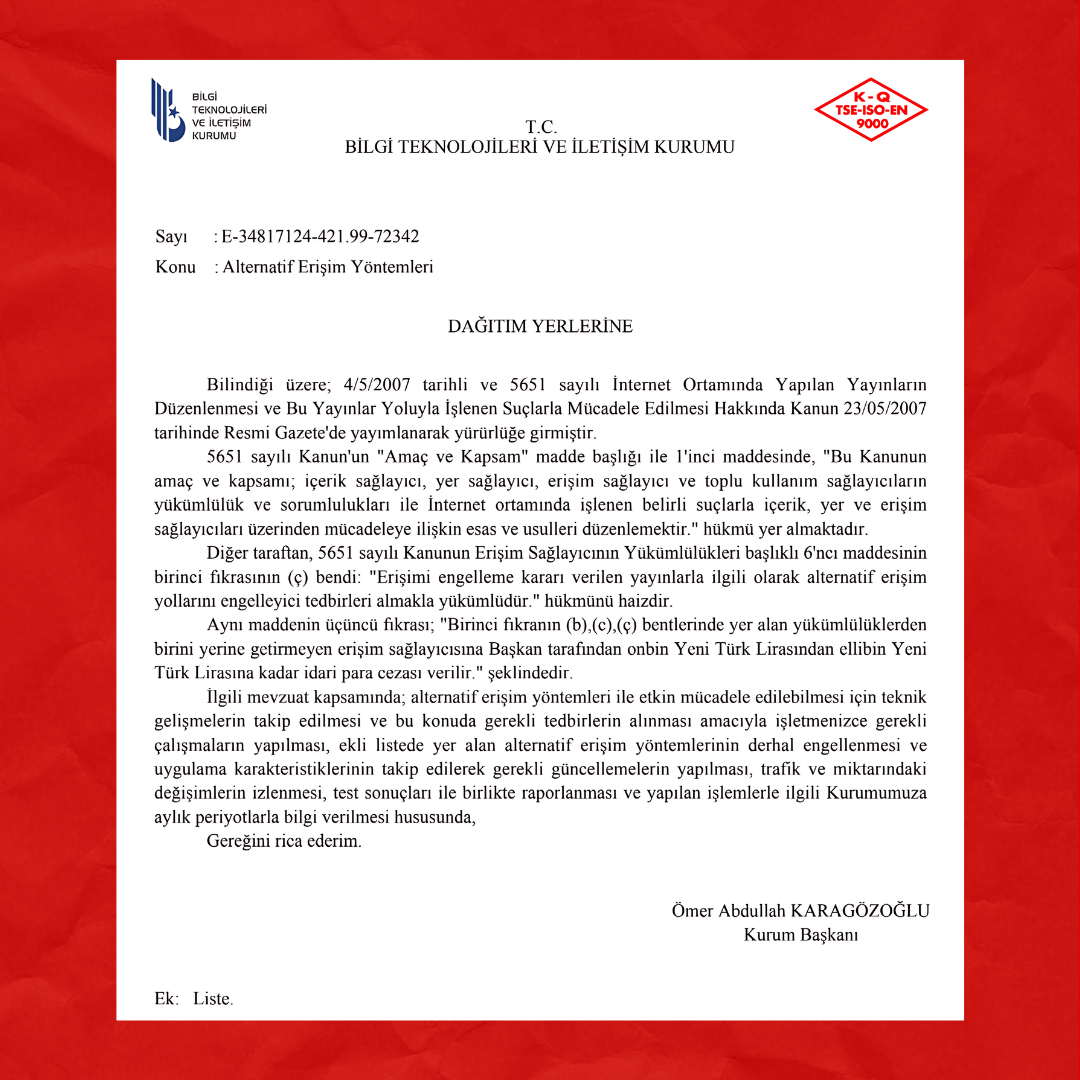
On 23.11.2023, BTK sent a circular letter to the access providers in Türkiye, relying on Article 6(1)(ç) of Law No. 5651, requesting the blocking of access to 16 different VPN services listed in its annex.237 The VPN services whose blocking was requested included globally renowned services such as Proton VPN, Surfshark, IPVanish, CyberGhost, Pure VPN, TunnelBear, Hotspot Shield, Nord VPN and Express VPN.238

In its letter, BTK requested from the access providers not only blocking but also a comprehensive monitoring and reporting activity. Within that framework, the access providers were asked to immediately block the alternative access methods set out in the annexed list, to track the application characteristics and make the necessary updates, to monitor the changes in traffic and volume, to report the test results, and to provide information to the Authority on a monthly basis on the actions taken. This request is in the nature of a distributed operation, to be applied country-wide and directed at 126 content, hosting and access provider addressees.
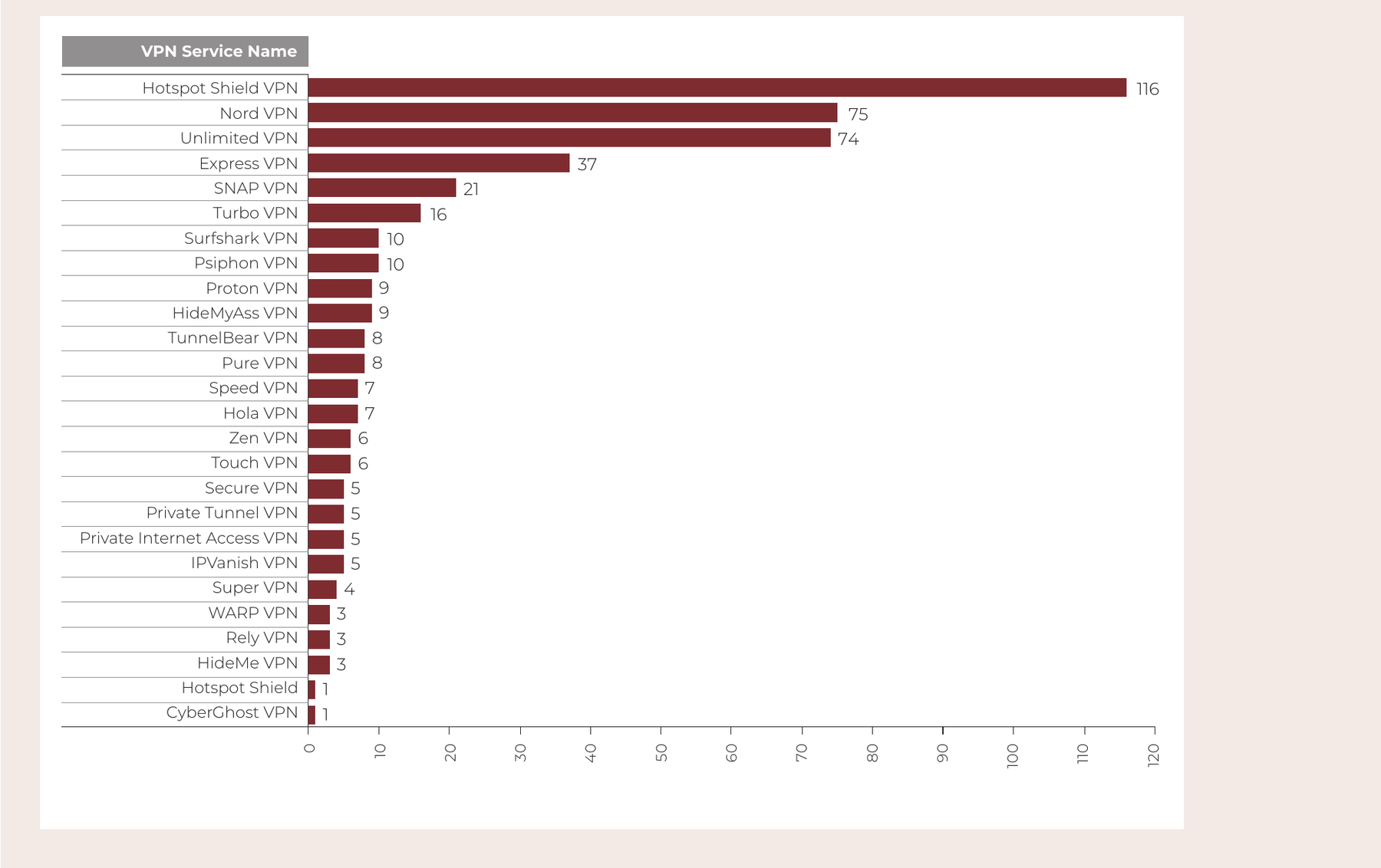
According to the data obtained within the framework of the EngelliWeb project, BTK’s blocking list has not been confined to those 16 VPN services. EngelliWeb project, as of 2023, identified 454 distinct server addresses belonging to 26 different VPN services which had been brought within the scope of monitoring and blocking.239 Identified by the number of blocked addresses, the services with the greatest number of server addresses are Hotspot Shield VPN (116 addresses), Nord VPN (75 addresses), Unlimited VPN (74 addresses) and Express VPN (37 addresses). These data demonstrate that BTK’s blocking of VPN services is far more comprehensive and systematic in character than appears at first sight.
The Legal Basis Problem: Article 6(1)(ç) of Law No. 5651¶
Article 6(1)(ç) of Law No. 5651, on which BTK relied as the legal basis for the VPN blocking, provides that access providers “shall be obliged to take alternative-access-prevention measures in respect of publications in respect of which an access-blocking decision has been issued”.240 That provision was added by Article 89 of Law No. 6518, whose preamble explained the purpose as “taking measures that render alternative access avenues more difficult, in order to render access blocking effective”.241
There is, however, neither in Law No. 5651 nor in any other law a provision that prohibits access by alternative means to websites whose access has been blocked. Likewise, there is no statutory provision prohibiting the use of VPN services from Türkiye. Article 6(1)(ç) of Law No. 5651 grants neither to BTK nor to its president any power to identify VPN services and to request their blocking.
The Constitutional Court confirms this assessment. According to the Constitutional Court, which did not uphold the request for the annulment of the rule by way of a reasoned-rejection method, the provision “imposes on the access provider the obligation to take alternative-access-prevention measures to prevent access being made to publications in respect of which an access-blocking decision has been issued”.242 In addition, according to the Constitutional Court, “the access providers will apply the said alternative measures in respect of publications in respect of which an access-blocking decision has been issued. The rule whose annulment was sought does not directly confer on the access providers the power to block access. The duty imposed on the access providers consists solely of the effective implementation of an access-blocking decision previously issued”.243
In the light of these findings, it is clearly seen that the provision of Article 6(1)(ç) of the Law cannot be applied in two respects. First, no blocking may be carried out on the basis of that provision in respect of content or an address not previously the subject of an access-blocking judicial decision. Secondly, the measure to be taken cannot produce consequences exceeding the scope of an access-blocking decision previously issued. By contrast, BTK’s action of 23.11.2023 has both blocked VPN services not previously the subject of any judicial decision, and affected access not only to sites already subject to an access-blocking decision but to the whole of the Internet.
Indeed, in RFE/RL Inc. and Others v Azerbaijan, the ECtHR emphasised that the discretionary power conferred on the administration in domestic law must be surrounded by sufficient safeguards against arbitrariness, and that legal discretion conferred on the executive in matters affecting fundamental rights cannot be expressed as “unfettered power”.244 The Court concluded that the power of the Azerbaijani telecommunications authority to determine independently which content was unlawful, and on that basis to request wholesale blocking, was an “unfettered power not surrounded by sufficient safeguards against arbitrariness”, and accordingly did not satisfy the “quality of law” standard required by the Convention.245 BTK’s unilateral determination, on the basis of Article 6(1)(ç) of Law No. 5651, of which VPN services are to be blocked, without any judicial review, and the implementation of that determination country-wide, constitutes a precise mirror image of the structural problem condemned by the ECtHR in that judgment.
| Türk Telekom | Vodafone | Türksat Kablonet | Turkcell Superonline | |
|---|---|---|---|---|
| NordVPN | Blocked | Blocked | Blocked | Blocked |
| TurboVPN | Blocked | Blocked | Blocked | Blocked |
| Proton VPN | Blocked | Blocked | Blocked | |
| IPVanish | Blocked | Blocked | Blocked | Blocked |
| TunnelBear | Blocked | Blocked | Blocked | Blocked |
| CyberGhost | Blocked | Blocked | Blocked | Blocked |
| ExpressVPN | Blocked | Blocked | Blocked | Blocked |
| Private Internet Access | Blocked | Blocked | Blocked | Blocked |
| PureVPN | Blocked | Blocked | Blocked | Blocked |
| Hola VPN | Blocked | Blocked | Blocked | Blocked |
| Surfshark | Blocked | Blocked | Blocked | |
| Private Tunnel | Blocked | Blocked | Blocked | |
| ZenVPN | Blocked | Blocked | Blocked | |
| Hotspot Shield | Blocked | Blocked | ||
| Psiphon | Blocked | Blocked | ||
| Touch VPN | Blocked | |||
| HideMyAss | Blocked | |||
| SurfEasy | Blocked | Blocked | ||
| hide.me | Blocked | Blocked | ||
| Mullvad | Blocked | |||
| VyprVPN | Blocked | |||
| IVPN | Blocked | |||
| VPN Unlimited | Blocked |
Deep Packet Inspection (DPI) and Surveillance Concerns¶
That BTK has not confined itself to requesting blocking but has also demanded the monitoring, testing and monthly periodic reporting of VPN traffic brings with it serious surveillance concerns. It was previously assessed that such an in-depth monitoring, reporting and analysis could only be carried out by means of Deep Packet Inspection (DPI). As of 2026, independent technical findings have confirmed that assessment, and have shown that the use of DPI has ceased to be a theoretical possibility and has been transformed into a documentable reality.
The TLS (Transport Layer Security) protocol used in HTTPS connections encrypts the web traffic between the client and the server. For that reason, access providers cannot, under normal conditions, read the content of the page, the full URL path, form data, or session information. For DPI systems to be able to classify particular connections, however, content reading is not always necessary. In the handshake phase, which takes place before the TLS connection is established, certain metadata such as the destination IP address, port, Server Name Indication (SNI) information, and the supported TLS versions can be observed. Accordingly, although the use of HTTPS protects the content of the communication, certain signals as to the service or domain with which a connection is associated may, in classical TLS configurations, be used by DPI systems.
Independent forensic tests carried out over the infrastructures of the Internet Service Providers in Türkiye technically demonstrate that certain providers are using selective intervention methods against VPN traffic. In tests conducted in the course of preparing this report, on connections to the Proton VPN servers, rather than a DNS- or pure-IP-based blocking, a selective slowing and connection-instability mechanism triggered through TLS SNI/Host information was detected.247
The technical anatomy of the blocking is also noteworthy. Connections are silently routed to a blackhole (silent blackholing), without an RST (reset) packet being sent. This is a low-visibility censorship technique designed to ensure that the connection failure experienced by the user is perceived not as a censorship intervention but as a technical malfunction or a server-side issue. Indeed, the access providers themselves, in response to such complaints, have given standard answers such as “technical malfunction” or “infrastructure works”, taking the path of cloaking the administration’s unlawful intervention with a commercial pretext.
Another critical finding is the selective structure of the blocking. While non-Proton HTTPS targets on the same line function in the ordinary way, on certain Proton domains TLS delays, SSL timeouts and data-transmission timeouts have been observed. That the behaviour of the connection changes meaningfully where only the SNI/Host information sent is altered on connections to the same Proton IP address shows that the intervention cannot be explained by the general quality of the network or by an ordinary line problem. This selective structure shows that, beyond BTK’s request to the access providers to block “alternative access methods”, a deliberate and targeted traffic manipulation is being carried out that singles out particular VPN providers and the targets belonging to them. Such an intervention shows that not only particular VPN protocols but also the TLS connection attributes of particular VPN providers can be targeted, and lays bare the level of sophistication reached by the DPI infrastructure.
There is no legal basis for the use of DPI on Internet traffic in a manner that endangers the protection of personal data and violates the principles of network neutrality, in order to detect the use of particular VPN services. The use of this method, therefore, constitutes a violation of Articles 13 and 20 of the Constitution.248 Moreover, DPI, by its very nature, transforms not only the targeted VPN traffic but the entire network traffic of the access provider into an object of analysis. For traffic classification to be performed on the basis of TLS SNI/Host information, fingerprint, or connection behaviour, the handshake phase of connections must be systematically examined. This means that the online communications of all Internet users, whether or not VPN users, are transformed into a potential object of surveillance. The use of the DPI infrastructure in this way openly fails to satisfy the standard of “a specific and foreseeable regulation that does not permit arbitrariness”, emphasised in the Constitutional Court’s settled case law on the protection of personal data.
İFÖD’s Legal Battle on VPN Usage¶
The Litigation Process and the First-Instance Decision¶
The first legal initiative against BTK’s VPN blocking action was launched by the Freedom of Expression Association (İFÖD). İFÖD, as a civil society organisation that had been a paying subscriber to the Proton VPN Plus service since 03.08.2022, identified on 02.12.2023 that access to the Proton VPN service had been blocked.249 The Association transmitted to BTK, pursuant to Article 11 of the Administrative Procedure Code, a request for the withdrawal of the action. BTK, however, left this application unanswered and impliedly rejected it. Upon this, İFÖD brought an action on 28.02.2024 before the Ankara 17th Administrative Court.250
İFÖD’s statement of claim set out comprehensively the unlawfulness of the action in respect of its elements of competence, form and subject-matter. It emphasised in particular that a civil society organisation serving as a public watchdog needed the VPN service, and that with the blocking of that service the freedom to seek a legal remedy was also de facto extinguished.251
The Ankara 17th Administrative Court, by its decision of 24.10.2024, dismissed the action.252 Although the Court characterised the contested action as essentially “an action in the nature of a reminder to the access providers of their statutory obligations”, it nevertheless examined and dismissed the action on the merits.253 One of the most striking aspects of the Court’s decision is its reference to Article 9 of Law No. 5651, which had been annulled in its entirety by the Constitutional Court on 11.10.2023. The Court included in its decision a statutory provision that had been repealed. Moreover, it referred not to the final form of that article but to its earlier form before the amendment effected by Law No. 7253. Furthermore, the Court did not assess any of İFÖD’s detailed objections of unlawfulness in respect of the elements of competence, form and subject-matter, and none of the standards counted by the ECtHR in Pişkin v Turkey among the requirements of effective judicial review was met.254
The principles set out by the ECtHR in RFE/RL Inc. and Others v Azerbaijan make the problematic character of the Ankara 17th Administrative Court’s approach all the more apparent. In that judgment, the ECtHR criticised the Azerbaijani courts for, in issuing their blocking decisions, not genuinely examining the applicants’ arguments, accepting the administration’s assertions without question, and not affording the applicants the opportunity to call witnesses or to obtain independent expert opinions.255 The Ankara 17th Administrative Court’s dismissal of İFÖD’s detailed objections concerning the elements of competence, form and subject-matter, without responding with any ground at all, is the reflection in Türkiye of the deficiency in judicial review identified by the ECtHR in the Azerbaijani context.
The Appeal Decision: Setting Aside on Jurisdictional Grounds and Referral to the Council of State¶
Upon İFÖD’s appeal, the Ankara Regional Administrative Court, 13th Administrative Chamber, by its decision of 30.12.2025, set aside the first-instance court’s decision.256 The Regional Administrative Court determined that BTK’s contested action was in the nature of a regulatory act required to be applied country-wide.
Under Article 24(1)(c) of Council of State Law No. 2575, actions for the annulment of regulatory acts of this nature fall within the jurisdiction of the Council of State sitting as the court of first instance.257 In making this determination, the Regional Administrative Court also referred to decisions to the same effect rendered by the 13th and the 10th Chambers of the Council of State.258
Following the Regional Administrative Court’s decision, the case file was returned to the first-instance court for transmission to the Council of State as the court with jurisdiction. As of the date of this report, the file is pending before the Council of State.
The International Human Rights Law Dimension of the VPN Blockings¶
The wholesale blocking of VPN services carries, within the framework of the ECtHR’s case law, the potential of violating several categories of right. In a number of judgments, the ECtHR has concluded that measures which go beyond the blocking of access to criminal content and which extend to the blocking of access to entire websites have no statutory basis, permit arbitrariness, and do not contain sufficient safeguards against abuse, and accordingly that Article 10 of the Convention has been violated.259
In its 2024 judgment in RFE/RL Inc. and Others v Azerbaijan, the ECtHR further developed this case law, concluding that wholesale website blockings do not satisfy the “prescribed by law” condition. The Court characterised the wholesale blocking of access to the website of a media organisation, on the ground of allegedly unlawful content said to be contained in several articles, as a disproportionate measure that “rendered inaccessible a large quantity of content which had not been determined to be unlawful”.260 The Court further found that a legal framework in which the administration could, without prior recourse to any judicial decision, determine unilaterally which content was to be considered unlawful, and in which that determination gave rise to an unsupervised arbitrariness, did not bear the quality of law required by the Convention. The VPN blockings in Türkiye structurally constitute a more severe interference than the situation addressed in that judgment. While in Azerbaijan the wholesale blocking of individual websites violated Article 10 of the Convention, in Türkiye, in an environment in which already hundreds of thousands of websites, tens of thousands of URLs and hundreds of thousands of social media contents have been blocked from access, the blocking also of the VPN services that are the sole means of circumventing those barriers extinguishes users’ right of access to information through a twofold censorship mechanism. In other words, whereas the ECtHR’s case law counts even the blocking of a single website as a violation of the Convention, Türkiye both blocks the content and destroys the capacity to circumvent the block.
The ECtHR has stated that the barriers created with a view to preventing access to information may cause those working in the media or in related fields no longer to be able effectively to assume their “watchdog” roles, and may adversely affect their capacity to provide accurate and reliable information.261
The judgment in RFE/RL Inc. and Others v Azerbaijan sheds light on a further point in this context. The Azerbaijani Government had argued that the blocked sites could still be accessed by VPN services or alternative browsers, and that the blocking measures accordingly did not constitute a serious disadvantage. The ECtHR firmly rejected that argument, observing that an average Internet user, on encountering a website to which access is unavailable, cannot be expected to research and use tools such as VPNs, and that the user may not even be able to discern whether the site is inaccessible by reason of censorship or of a technical malfunction. The Court emphasised that even users who are aware may avoid such tools by reason of privacy concerns, cost, and performance issues.262 This finding contains a striking irony in the Turkish context. VPN access, which the ECtHR considered “insufficient even as a compensating mechanism for blocking” in Azerbaijan, has, in Türkiye, itself been made the subject of blocking, and even this possibility has been denied to users. To put it another way, the very avenue that the ECtHR did not consider sufficient even as a limited compensating mechanism is, in Türkiye, being wholly extinguished.
The Arbitrary Character of the VPN Blockings¶
Another important point laying bare the arbitrary character of BTK’s VPN blocking action is the indeterminacy of the criteria by which the VPN services to be blocked are selected. Although hundreds of VPN services exist worldwide and millions of people benefit from them, the blocking by BTK of only certain services and the non-blocking of the use of others cannot be justified by any reasonable explanation. By the same token, although Article 6(1)(ç) of Law No. 5651 has been in force since February 2014, why a measure was applied to VPN services almost ten years later, citing that provision as a ground, is likewise incomprehensible.
In addition, that BTK’s VPN blocking action was not served on the affected users and not announced to the public also constitutes a distinct dimension of unlawfulness. Article 40(2) of the Constitution mandatorily provides that the State, in its actions, must indicate which legal avenues and authorities the persons concerned are to apply to and the time limits applicable. VPN users, on experiencing access problems, have been compelled to research the reason for the situation through their own efforts; only, as in the example of İFÖD, following an enquiry to the Internet service provider, has the existence of the blocking come to light.
In RFE/RL Inc. and Others v Azerbaijan, the ECtHR examined a similar failure of notification in detail. The Court assessed the failure of the Azerbaijani telecommunications authority to send the applicants the prior warning required by law, or its transmission of the warning only to an e-mail address that had not been used for years, as a procedural deficiency that de facto prevented the applicants from exercising their rights of objection.263 In the VPN blockings in Türkiye, the situation is more serious still. BTK neither served the blocking action directly on the VPN users or the VPN providers, nor shared the existence of the blocking with the public, nor gave any prior warning to the VPN providers before the blocking. It is clear that the procedural safeguards which the ECtHR considered insufficient in Azerbaijan are absent in Türkiye.
The VPN Regulation on the Legislative Agenda¶
Although no enacted regulation existed during the reporting period, the topic of VPN was also brought onto the legislative agenda in 2026. A draft text contemplating amendments to the Electronic Communications Law No. 5809 aims, for the first time, to give VPN services a statutory definition and to broaden BTK’s powers in that field.264
A draft amendment that emerged in April 2026 envisages adding to Article 3 of Law No. 5809 the definitions of “virtual network service” and “virtual network service provider”. According to the draft, a virtual network service is defined as “network services that, in part or in whole for purposes of privacy or security, encrypt and transmit the Internet traffic provided by the operator”.
The most critical provisions of the draft are situated on the sanction and authorisation axis. The new paragraph 14, proposed to be added to Article 9 of the Law, would grant BTK the power to issue regulations relating to the provision of over-the-top services and virtual network services, and to take all manner of measures against operators that fail to meet the obligations set out in those regulations. The new paragraph 17, proposed to be added to Article 60 of the Law, would provide that the Authority may decide on the throttling of up to ninety-five per cent of the Internet traffic of, or the blocking of access to the relevant application or website of, any virtual network service provider that fails to pay an administrative fine on time.265
This draft is to be assessed as an attempt to place on a statutory footing the VPN blockings already in practice being carried out. The compatibility of such a regulation with Articles 13 and 26 of the Constitution, with Article 10 of the ECHR, and with the ECtHR case law referred to above gives rise to serious problems. Considering that the use of VPN is an indispensable element of individual privacy, data security and the right to receive information, whether a regulation directly targeting that technology can be reconciled with the principle of proportionality will be a significant subject of debate.
Assessment¶
The wholesale blocking of VPN services constitutes one of the most radical tools in Türkiye’s digital censorship architecture. This practice de facto extinguishes not only access to sites blocked from access, but secure and anonymous access to the whole of the Internet. BTK’s effecting of this blocking through an administrative action devoid of legal basis directly violates the Constitutional Court’s interpretation of Article 6(1)(ç) of Law No. 5651, and stands in open contradiction with the ECtHR’s settled case law on wholesale access blocking decisions.
The course of the action brought by İFÖD lays bare just how arduous a process the judicial review of this blocking is. The careless and unreasoned dismissal by the first-instance court was, on appeal, set aside on jurisdictional grounds, and it was determined that the blocking action, being in the nature of a regulatory act, was required to be heard by the Council of State sitting as the court of first instance. That the action is pending before the Council of State shows that the legal fate of the VPN blockings has not yet been determined. The very fact, however, that, more than two years after the blocking decision, an examination on the merits has still not been able to be conducted openly demonstrates the absence of an effective mechanism of judicial review.
That the topic of VPN has been brought onto the legislative agenda is a further source of concern. The attempt to bring the currently lawful-basis-lacking VPN blockings within a statutory framework amounts to the ex post facto legitimation of an existing unlawful practice. The ECtHR’s 2024 judgment in RFE/RL Inc. and Others v Azerbaijan has substantially clarified the reference framework of this debate. In that judgment, the Court determined that even wholesale website blockings, justified by reference to content in specific articles, did not satisfy the “prescribed by law” condition; the Government’s own argument presenting VPN access as a compensating mechanism was rejected by the Court. Türkiye’s VPN blockings contain, in a graver form, each element of violation addressed in that judgment: the target of the blocking is not individual websites but the whole of a technology providing secure access to the Internet; no warning or notification was made prior to the blocking; and the blocking decision is a purely administrative act, rather than a judicial one.
It must not, however, be forgotten that the enactment of a practice into law does not automatically render it compatible with the Constitution and the ECHR. Whether a regulation directly targeting VPN technology can be reconciled with the Constitutional Court’s and the ECtHR’s settled case law on freedom of expression, respect for private life, and the protection of personal data will be one of the critical legal debates of the period to come.
-
EngelliWeb, “Türkiye’den Erişime Engelli VPN Servisleri”, 04.08.2024 https://ifade.org.tr/engelliweb/turkiyeden-erisime-engelli-vpn-servisleri/; Freedom House, Freedom on the Net 2024: Turkey (2024). ↩
-
BTK, circular letter no E-34817124-421.99-72342, 23.11.2023. ↩
-
The VPN services whose blocking was requested in the letter sent by BTK to the access providers were: Proton VPN, Surfshark, IPVanish, CyberGhost, Pure VPN, TunnelBear, Hotspot Shield, Nord VPN, Express VPN, Psiphon, Hola VPN, Turbo VPN, HideMyAss VPN, Touch VPN, Private Internet Access VPN and Secure VPN. ↩
-
The research data gathered by the EngelliWeb project was limited to 2023. ↩
-
Law No. 5651, art 6/1(ç). ↩
-
Law No. 6518, art 89 (preamble). ↩
-
Constitutional Court, E. 2014/87, K. 2015/112, 08.12.2015, § 205. ↩
-
Constitutional Court, E. 2014/87, K. 2015/112, 08.12.2015, § 206. ↩
-
RFE/RL Inc. and Others v Azerbaijan App nos 56138/18 and 3 other applications (ECtHR, 13 June 2024) § 89. ↩
-
Ibid, § 106. ↩
-
Prepared on the basis of a comparison of access tests carried out, from the lines of different ISPs, to VPN services against an uncensored reference line. On VPN targets that functioned without problems on the reference line, where issues such as DNS resolution errors, dropped connections, failure to establish a TLS connection, or unusual latency were observed on the lines of ISPs in Türkiye, this was assessed as an indicator of interference. ISP cells on which such interference indicators were detected on most of the tested targets belonging to a given VPN service are marked “BLOCKED” in the table. ↩
-
In tests performed with DNS bypassed, connections established with the Proton SNI/Host information completed markedly more slowly, whereas connections to the same IP address made with non-Proton or different SNI information completed quickly. The packet records likewise show that, on connections using the Proton SNI, the transition from ClientHello to ServerHello was markedly extended, while on connections using a non-Proton SNI this period remained at a normal level. This comparison supports the conclusion that the interference is associated with SNI/Host information rather than being DNS- or pure-IP-based. The fact that connections to the same Proton IP address with the same Proton SNI/Host information complete quickly over an uncensored line, but are markedly slow on the ISP lines tested in Türkiye, reinforces the assessment that the issue is associated not with the ordinary behaviour of the Proton server but with a selective intervention on the network path sensitive to the SNI. ↩
-
İFÖD Proton Case, Statement of Appeal, pp 8-10; Statement of Claim, pp 7-9. ↩
-
Proton VPN, “Proton VPN is being blocked in Turkey” (02.12.2023) https://status.proton.me/incidents/dzl872r2tn5m ↩
-
İFÖD, BTK VPN Statement of Claim (28.02.2024), pp 3-4. ↩
-
İFÖD, Statement of Claim, pp 5-9; Statement of Appeal, pp 6-10. ↩
-
Ankara 17th Administrative Court, E. 2024/368, K. 2024/1575, 24.10.2024. ↩
-
İFÖD, Statement of Appeal, pp 4-6. ↩
-
Pişkin v Turkey App no 33399/18 (ECtHR, 15 December 2020) §§ 128-134. ↩
-
RFE/RL Inc. and Others v Azerbaijan, §§ 82 and 104-106. ↩
-
Ankara Regional Administrative Court, 13th Administrative Chamber, E. 2025/3748, K. 2025/5119, 30.12.2025. ↩
-
Council of State Law No. 2575, art 24/1(c). ↩
-
Decision of the 13th Chamber of the Council of State, E. 2025/368, 04.11.2025, and decision of the 10th Chamber of the Council of State, E. 2024/165, 17.09.2024, referenced in the decision of the Ankara Regional Administrative Court, 13th Administrative Chamber. ↩
-
Ahmet Yıldırım v Turkey App no 3111/10 (ECtHR, 18 December 2012); Vladimir Kharitonov v Russia App no 10795/14 (ECtHR, 23 June 2020); OOO Flavus and Others v Russia App nos 12468/15, 23489/15 and 19074/16 (ECtHR, 23 June 2020); Engels v Russia App no 61919/16 (ECtHR, 23 June 2020); Bulgakov v Russia App no 20159/15 (ECtHR, 23 June 2020); RFE/RL Inc. and Others v Azerbaijan (n 9). ↩
-
RFE/RL Inc. and Others v Azerbaijan (n 9) §§ 81, 96 and 108. ↩
-
Magyar Helsinki Bizottság v Hungary [GC] App no 18030/11 (ECtHR, 8 November 2016) § 167. ↩
-
RFE/RL Inc. and Others v Azerbaijan (n 9) §§ 73-74. ↩
-
RFE/RL Inc. and Others v Azerbaijan (n 9) §§ 98 and 102. ↩
-
Draft Amendment to the Electronic Communications Law No. 5809, art 3/1(eee) and (fff). ↩
-
Draft Amendment to Law No. 5809, art 9/14 and art 60/17. ↩